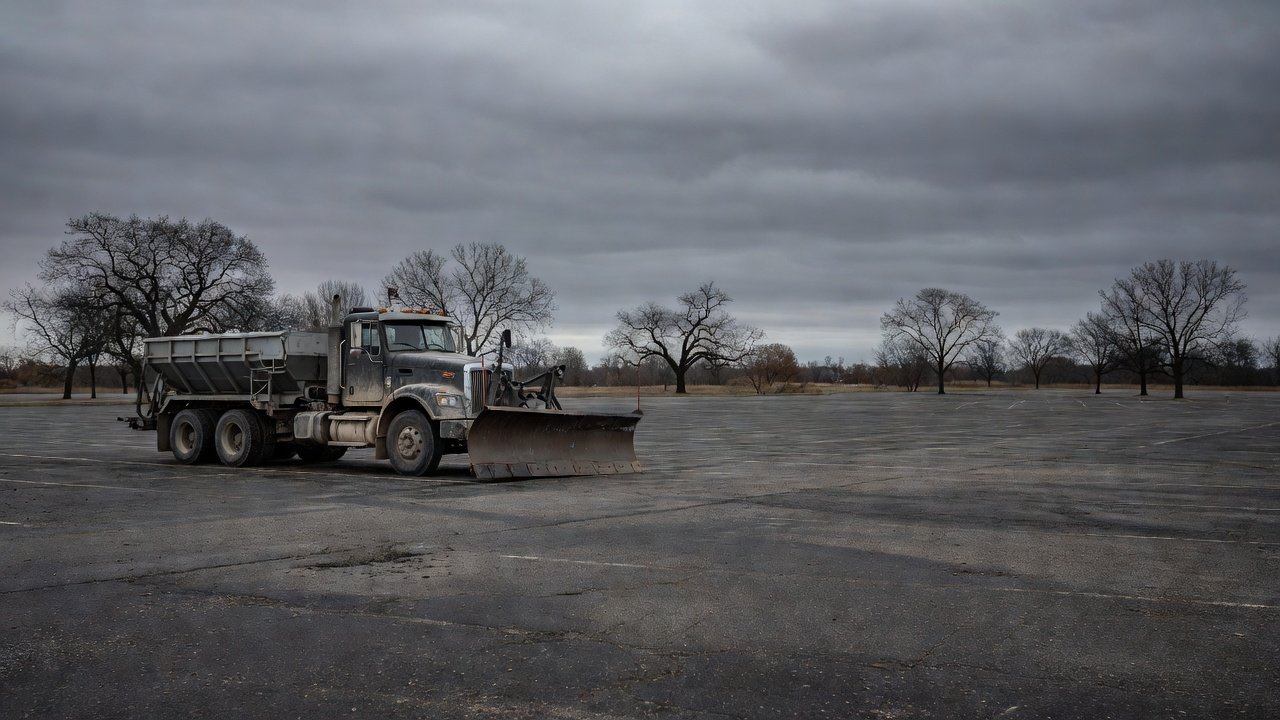
Snow contracting runs on a capacity calendar, not a weather calendar. Contractors size their fleets, hire seasonal drivers, and commit route order in late summer and early fall. A facility manager who starts shopping in November is buying from whatever capacity is left, at whatever price scarcity supports, and accepting a route position behind every client who signed in September.
This year there is an additional reason to have the conversation early, and it is not the one most northern facilities expect.
The forecast changes the risk map, not just its size
NOAA’s Climate Prediction Center has an El Niño Advisory in effect and, in its August 13, 2026 diagnostic discussion, states that “El Niño is strengthening, with a greater than 90% chance of a very strong event during the Northern Hemisphere fall and winter 2026-27,” with a 69% probability of a historic event during October–December. The Center’s seasonal outlook leans toward below-normal precipitation across the Northwest and north-central states, and above-normal precipitation across the southern tier.
Two implications for contracting:
Northern facilities may see fewer, larger events. That sounds easier and contracts poorly. Per-push pricing rewards frequency; a season of a few large storms with long tails of drifting and refreeze can cost more under per-event billing than a seasonal fixed fee, or less, depending on how the contract defines an “event.” This is the year to read that definition closely.
Southern-tier facilities are the ones exposed to the unfamiliar risk. A property in Dallas, Atlanta, or Nashville with no snow contract, no salt on hand, and no written ice protocol is one freezing-rain event away from an unmanaged liability. If your portfolio spans regions, the properties that need a contract this year may not be the ones that have always had one.
The forecast is a probability statement, not a schedule. The point is that both fewer-event and unfamiliar-region scenarios argue for the contract being settled in September rather than improvised in January.
The eight terms that decide whether the contract works
Price is the term facility managers negotiate hardest and the one that matters least when a storm goes badly. These are the terms that determine what actually happens at 4 a.m.
1. Trigger depth and the definition of an event. At what accumulation does the contractor deploy without being called? Two inches is common and often too high for a facility with early shift changes. Define whether a continuous 18-hour snowfall is one event or three, because that single sentence can double a per-push invoice.
2. Response time, measured from what. “Within four hours” from storm start and from storm end are entirely different commitments. Specify the clock, and specify the condition you require at a stated time — for example, drive aisles and accessible routes clear by 6:00 a.m.
3. Route order in writing. Ask where you sit in the sequence and get it in the agreement. Every client believes they are first. Only one is, and the contractor knows which.
4. Scope by surface, with a site map attached. Drive aisles, stalls, accessible spaces and access aisles, sidewalks, stairs, ramps, EV charging stalls, loading docks, entry aprons. Anything not on the map is not in the scope. Name the priority order explicitly — accessible parking and its routes to the entrance are cleared first, not last.
5. Ice management as a separate obligation. Plowing and deicing are different services with different triggers. Specify the product, the application standard, and — critically — that chloride deicers are not to be used on concrete less than a year old. Mark those areas on the map.
6. Snow stacking locations, on the map. Where snow goes determines what melts across a pedestrian route and refreezes overnight, and how many stalls you lose for weeks. Stacking zones belong downhill of walkways and clear of accessible stalls, EV equipment, hydrants, and sight lines at exits.
7. Documentation and reporting. Require a service log after every event: date, time in and out, surfaces treated, product and quantity, temperatures, and timestamped photographs. This is the deliverable that defends a slip-and-fall claim months later. A contractor who cannot produce it is transferring risk back to you.
8. Insurance, indemnity, and damage. Certificates of insurance naming you as additional insured, adequate limits for a snow-and-ice operation, and a stated process for plow damage to curbs, striping, gates, bollards, and sprinkler-line clearances. Pre-season photographs of the whole site are what make a damage claim collectible.
Pricing structures and what each one hides
- Per push / per event — lowest cost in a light winter, unbounded in a heavy one, and hostage to the event definition.
- Seasonal fixed fee — budget certainty, and the contractor’s incentive is to do the minimum that satisfies the trigger language. Only works when the performance standards in items 1–5 are specific.
- Time and materials — transparent and unpredictable; requires the documentation in item 7 to be verifiable.
- Hybrid with a cap or a collar — a fixed base with per-event charges above a defined threshold. Usually the most defensible in a budget review, and the structure worth asking for in a season with an unusual forecast.
Whatever the structure, get salt and deicer pricing addressed directly. Bulk rock salt generally runs in the $30–$80 per ton range, but the 2025–26 season showed how fast that moves: repeated small events drained stockpiles and spot prices in some markets doubled or tripled for buyers without a contract. Ask whether material is included, indexed, or passed through at cost plus, and whether the contractor holds pre-season inventory or buys per event.
Before you sign, and before the first storm
- Confirm subcontracting: who actually shows up, and are they insured under the same terms?
- Confirm the contractor’s own capacity math — how many sites, how many trucks, how many drivers hired.
- Walk the site together and photograph it, with the map in hand.
- Agree on the communication path for a re-treat request, and confirm any of your staff can trigger one without waiting for a manager.
- Settle who owns each sidewalk, crosswalk, and stair, including anything shared with a tenant or the municipality. Split responsibility is where the untreated surface hides.
Our winter parking lot maintenance guide covers the facility-side preparation that has to happen alongside the contract — drainage, plow stakes, equipment, and surface protection.
The contract you sign in September is a performance specification you can hold someone to. The one you sign in December is whatever the last contractor with a free truck was willing to offer. In a season the Climate Prediction Center is describing in superlatives, that difference is worth the two weeks it takes to negotiate properly.