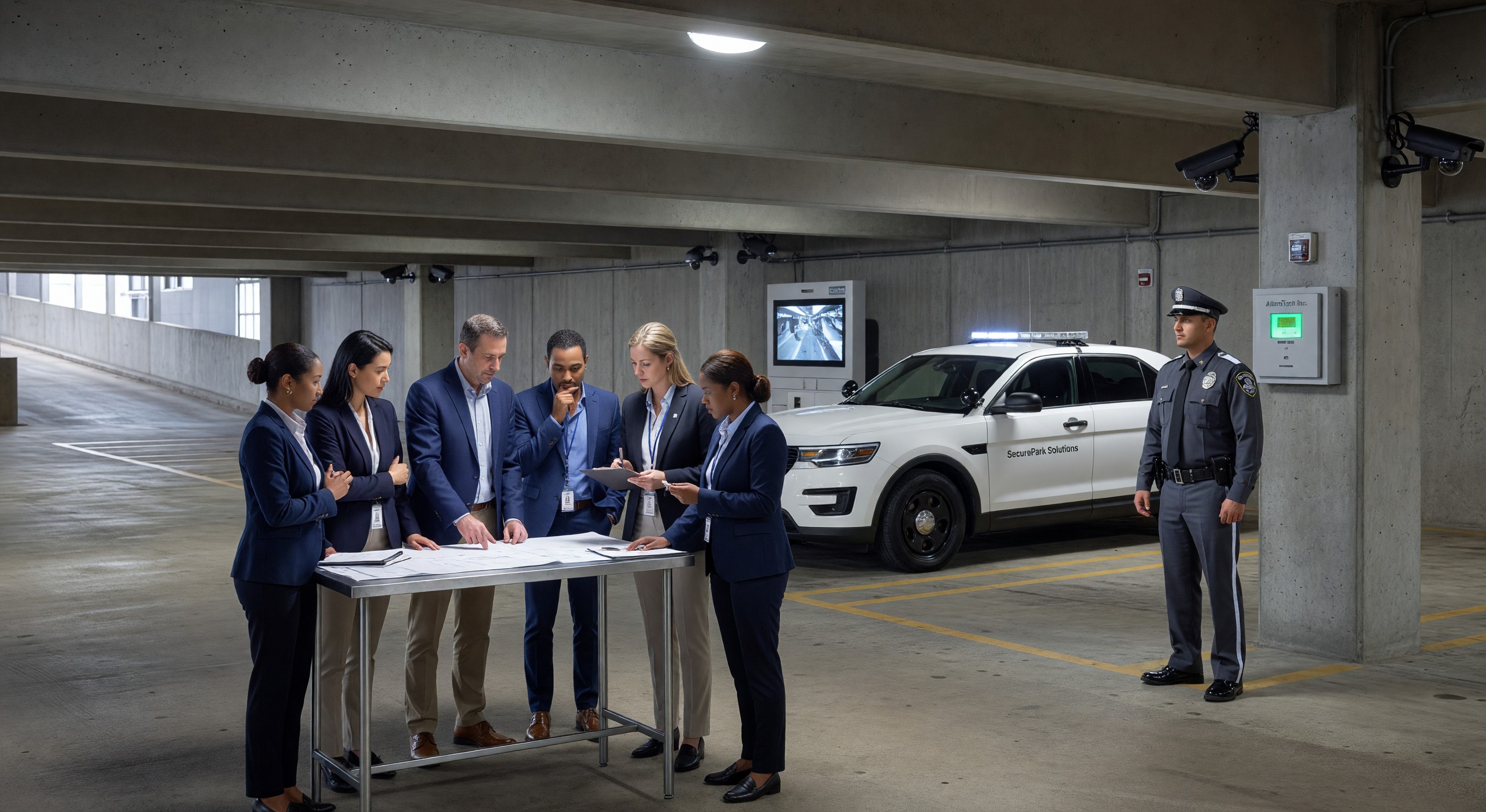
Security in parking facilities is delivered through a combination of physical security personnel, electronic systems, and deterrence measures. Facility managers typically work with multiple security vendors — a uniformed security company for physical presence, an alarm and CCTV monitoring service for electronic oversight, and potentially specialized vendors for access control and emergency systems.
Selecting and coordinating these vendors effectively is essential to a coherent, cost-effective security program.
The Security Vendor Landscape for Parking
Uniformed security guard services provide a physical human presence in parking facilities. Guard services range from unarmed security officers (the most common for parking applications) to armed officers (appropriate for high-value or high-risk environments). Guard companies contract for patrol services, fixed post coverage, or on-call response.
Remote monitoring services use CCTV systems to monitor parking facilities from a central operations center, typically staffed 24/7. When suspicious activity is detected, monitoring staff can communicate via intercom, dispatch a guard response, or notify law enforcement. Remote monitoring is increasingly replacing fixed guard posts for many parking facilities, with significant cost savings.
Alarm monitoring services monitor intrusion, fire, and equipment alarms from a central station and dispatch appropriate response. Most parking facilities use alarm monitoring for their revenue control equipment enclosures, utility rooms, and any enclosed spaces within the facility.
Access control system vendors (covered separately under technology vendors) provide the hardware and software that restricts physical access to controlled areas within the facility.
Uniformed Guard Service Evaluation
For facilities that use uniformed security, vendor quality varies enormously.
Licensing: Security companies and individual officers must be licensed under state security regulations. Verify company license and ask for officer license compliance documentation for individuals assigned to your facility.
Training standards: What training do officers receive before assignment? Minimum training standards vary by state; better companies exceed the minimums. Training should cover: parking-specific security scenarios, emergency response procedures, customer interaction and de-escalation, report writing, and facility-specific hazards.
Supervision: How are officers supervised? Random supervisory checks, GPS tracking of officer patrols, and regular supervisory visits are indicators of active management. Companies that assign officers to posts and leave them unsupervised deliver lower quality.
Turnover rates: High officer turnover (over 50 percent annually is common in the guard industry) creates quality problems — poorly trained new officers, lack of facility familiarity, and scheduling gaps. Ask potential vendors for their annual turnover rate.
Insurance and workers’ compensation: Guard companies carry workers’ compensation for their officers. Verify compliance. Workers’ compensation fraud and non-payment is a problem in the guard industry; companies without current workers’ compensation create liability for the facility when officers are injured on-site.
Remote Video Monitoring Services
Remote monitoring has become a highly effective security strategy for parking facilities. A central station staffed by trained operators who monitor live feeds can:
- Observe and document suspicious activity in real time
- Issue audio warnings via CCTV speakers to deter crime
- Dispatch guard or law enforcement response to confirmed incidents
- Provide live guidance to first responders
Evaluating monitoring services:
Operator-to-camera ratio: How many cameras does each operator monitor simultaneously? Effective remote monitoring requires operators to give adequate attention to each camera. Ratios above 30 to 50 cameras per operator during active monitoring shifts produce degraded awareness.
Response protocols: What does the monitoring service do when suspicious activity is detected? Well-defined escalation protocols (verbal warning, guard dispatch, law enforcement notification) with documented decision criteria ensure consistent responses.
Integration with your CCTV system: Remote monitoring services must be able to receive and view your camera feeds. Verify compatibility with your camera system and VMS platform.
24/7 staffing: Confirm that central station staffing is maintained 24/7, including weekends and holidays. Some services reduce staffing during low-demand periods.
Alarm Monitoring Companies
Central station alarm monitoring is a commodity service with well-established quality standards. Key evaluation factors:
UL Listing: Underwriters Laboratories certifies alarm monitoring central stations that meet their security and operational standards. A UL-listed central station provides a baseline quality assurance.
Redundancy: How many central station locations does the company operate? Single-location central stations are vulnerable to regional disasters. Multi-location redundancy ensures monitoring continuity during local emergencies.
Response time: What is the average time from alarm receipt to dispatch or resolution? For security alarms in parking facilities, response times of under 60 seconds are standard.
Integration with your systems: Confirm that the monitoring service can integrate with your specific alarm and access control systems.
Coordinating Multiple Security Vendors
When multiple security vendors are involved (guard service, remote monitoring, alarm monitoring), coordination is essential to prevent gaps and conflicts.
Define roles clearly: Document which vendor is responsible for which functions. Who responds to a personal emergency at the facility? Who monitors CCTV during off-hours? Who handles after-hours access requests from authorized personnel? Gaps in role definition appear as problems during incidents.
Establish communication protocols: How do security vendors communicate with each other and with facility management? Who is the 24/7 contact for each vendor? What escalation path is used when an incident exceeds one vendor’s response capability?
Unified incident reporting: Require all security vendors to use a consistent incident reporting format so that incident data can be aggregated for trend analysis. Incidents reported in incompatible formats cannot be effectively analyzed across vendors.
Security Program Review
Security needs change as facilities change. Annual review of the security program — including all vendor relationships — ensures the program remains aligned with current risks and facility operations.
Annual review should assess:
- Incident frequency and type (are incidents increasing, decreasing, changing in character?)
- Response time performance for each vendor
- Customer complaints related to security
- Changes in facility operations, hours, or use that affect security needs
- Technology changes (new cameras, access control updates) that affect vendor capabilities
FAQ
What is a reasonable cost for security guard services in a parking facility? Guard service billing rates vary significantly by market, officer classification (unarmed versus armed), and coverage model. Unarmed security officers in most U.S. markets bill between $18 and $35 per hour. Armed officers command higher rates. Remote monitoring services are typically lower cost than equivalent fixed-post guard coverage for the same hours.
Can I manage security with cameras and remote monitoring alone, without any physical guard presence? For many parking facilities, yes. Remote monitoring with audio deterrence capability (the ability to speak to subjects through camera-mounted speakers) can address many security situations that previously required a guard response. Physical guard presence adds value for high-risk environments, facilities with frequent incidents, or when visible deterrence is particularly important.
How do I manage security company employee changes at my facility? Require advance notice of officer changes for assigned posts. Implement a site-specific training requirement for new officers before they work independently. Maintain a banned officer list for anyone removed from your property for cause.
What documentation should security vendors provide? At minimum: incident reports for all events above a defined threshold (you define what requires a report), patrol activity logs, visitor logs (for fixed posts), and monthly summary reports. Review these documents regularly to maintain visibility into security operations.
Further Reading from Authoritative Sources
- International Parking and Mobility Institute security vendor management resources — parking-mobility.org (IPMI) is on the whitelist as the primary parking industry authority with directly relevant security vendor management content for parking facility managers.
- OSHA workplace violence prevention and security guidelines — osha.gov is on the whitelist as the federal workplace safety authority whose security and violence prevention guidance provides regulatory context for security vendor program requirements in this article.