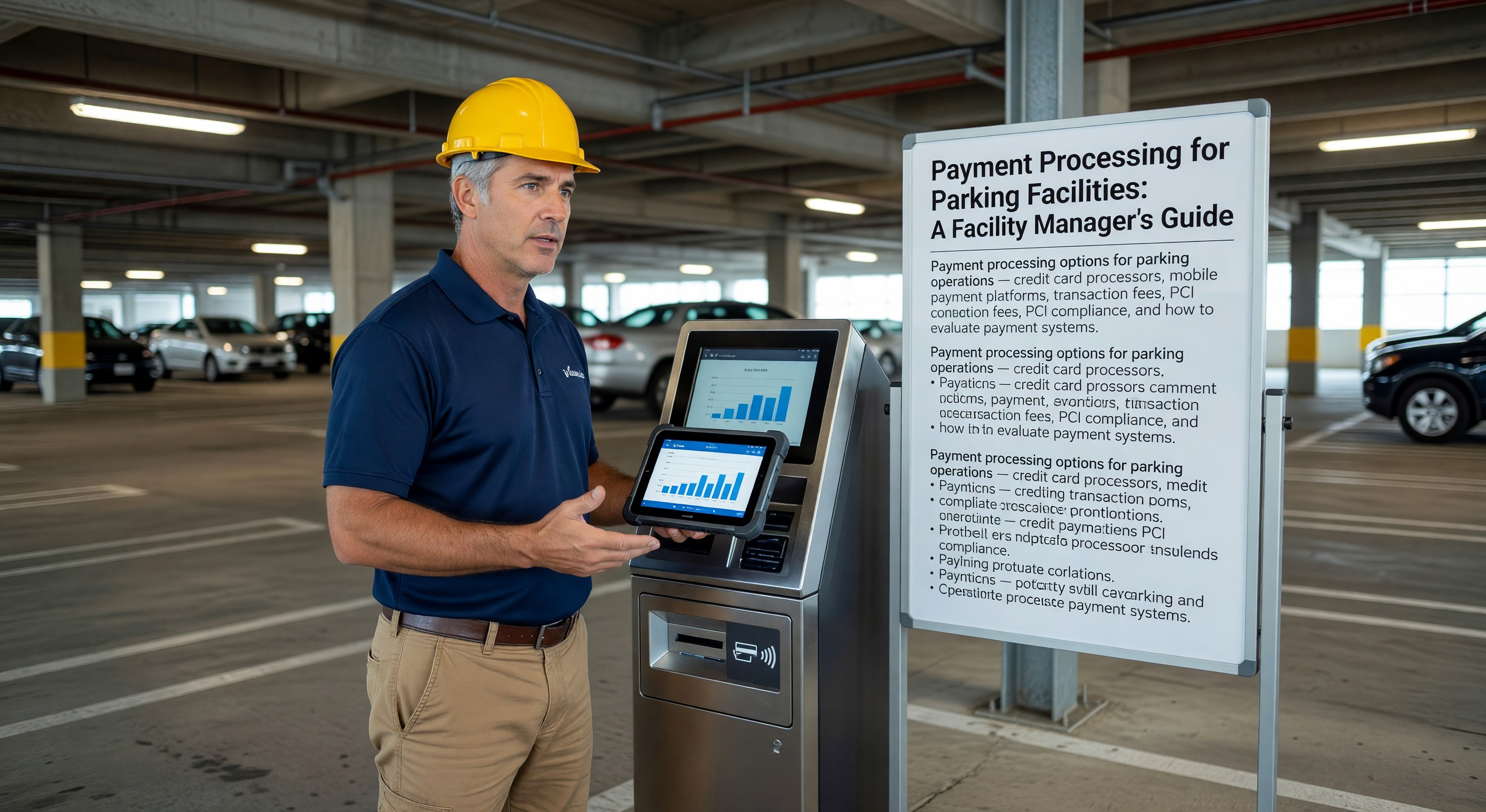
Payment processing is the revenue engine of parking operations. Customers who cannot pay conveniently — because your system does not accept their preferred payment method, because processing is slow, or because the equipment is unreliable — leave without paying or leave frustrated. And behind every payment transaction is a technology infrastructure with fees, compliance obligations, and vendor relationships that significantly affect your net revenue.
This guide covers the payment processing landscape for parking facilities, how to evaluate payment options, and the operational and compliance requirements that facility managers must manage.
The Parking Payment Landscape
Parking payment has transformed over the past decade. Cash-dominant operations have given way to multi-modal payment environments where credit/debit cards, mobile wallets, QR codes, and license-plate-linked payment accounts coexist.
Cash: Still in use at many facilities, though rapidly declining as a percentage of transactions. Cash handling has high operational cost (labor for cashiers, cash counting and reconciliation, armored car service, theft risk) that many facilities are actively working to eliminate. If you accept cash, ensure robust cash handling procedures and reconciliation processes.
Credit and debit cards (EMV chip and contactless): The dominant payment method at most commercial parking facilities. EMV chip transactions are more secure than magnetic stripe but slightly slower (1 to 3 seconds for chip processing). Contactless payments (tap-to-pay with card or phone) are the fastest card payment method and increasingly expected by customers.
Mobile payment apps: Customers pay for parking through their phone, either through a facility-specific app or a network app (ParkMobile, PayByPhone, SpotHero). Mobile payment allows frictionless payment without interacting with pay station hardware. Transaction fees vary by platform; network apps typically charge 2 to 10 percent.
QR code payment: Pay stations display a QR code that customers scan with their phone to initiate payment through a mobile browser or app. QR codes reduce hardware dependency and are increasingly used at pay-on-foot stations.
License plate-linked accounts: Customers register their license plate with a payment account. LPR cameras at entry and exit identify the plate, and payment is automatically charged to the account on file. This “frictionless” model maximizes speed and convenience.
Card Processing Fees and Rate Structures
Understanding card processing fees is essential for accurate revenue projections and cost management.
Interchange fees: Set by card networks (Visa, Mastercard, American Express, Discover). These are the largest component of processing costs — typically 1.5 to 3.0 percent of the transaction amount for consumer cards. Interchange varies by card type (rewards cards cost more than basic debit cards), transaction type (card-present is lower than card-not-present), and transaction amount.
Processor margins: Your payment processor adds a margin above interchange. This margin can be structured as:
- Interchange-plus pricing: You pay interchange plus a fixed basis points markup (e.g., interchange + 20 basis points + $0.10 per transaction). Most transparent and often most economical for merchants.
- Flat rate pricing: A fixed percentage per transaction regardless of card type (e.g., 2.6 percent + $0.10). Simple but potentially more expensive for low-interchange transactions.
- Tiered pricing: Transactions are categorized into tiers (qualified, mid-qualified, non-qualified) with different rates. Opaque and often unfavorable — avoid.
Network fees: Card networks charge assessment fees (approximately 0.13 to 0.14 percent of volume) that are typically passed through by processors.
Total effective rate: For a commercial parking operation, a total effective card processing rate of 1.8 to 2.8 percent is typical. Rates above 3 percent indicate opportunity for renegotiation.
PCI DSS Compliance for Parking Operations
Any parking facility that accepts credit or debit card payments is subject to Payment Card Industry Data Security Standard (PCI DSS). Non-compliance can result in fines from card networks ($5,000 to $100,000 per month) and loss of card processing privileges.
Compliance scope depends on your system architecture. Facilities that use point-to-point encryption (P2PE) certified equipment and do not store, process, or transmit card data in their own systems have the smallest compliance scope. Facilities with legacy systems that store card numbers or process unencrypted card data have the most complex compliance obligations.
PCI compliance for parking operators typically involves:
- Completing an annual Self-Assessment Questionnaire (SAQ) or undergoing a third-party Qualified Security Assessment (QSA) evaluation, depending on transaction volume
- Quarterly network vulnerability scans from an Approved Scanning Vendor (ASV)
- Secure configuration of all systems that touch card data
- Employee training on payment security procedures
- Incident response procedures for card data breaches
Practical step: verify your PARCS is using P2PE. P2PE-certified equipment encrypts card data at the point of swipe and never exposes unencrypted card numbers to the PARCS software or network. This significantly reduces PCI scope and compliance complexity. If your current PARCS does not use P2PE, this is a priority upgrade consideration.
Mobile Payment Platform Evaluation
For facilities considering mobile payment integration, evaluate platforms on:
Transaction fees: What percentage or flat fee is charged per transaction? For network platforms (where the app operates across many parking locations), transaction fees are typically 2 to 10 percent. Higher fees require higher transient rates to maintain equivalent net revenue.
Customer adoption. How many active users does the platform have in your market? A platform with a large, active user base delivers more incremental customers than one requiring customers to download a new app for your facility alone.
Integration with your PARCS. Does the mobile payment platform integrate with your PARCS to enable automated gate release upon payment? Integration reduces hardware dependency; non-integrated solutions require customers to retain a payment confirmation to present at exit.
Reporting and reconciliation. Does the platform provide reporting that integrates with your financial reporting? Reconciling mobile transactions against gate counts should be straightforward, not a manual exercise.
Evaluating Payment System Vendors
When evaluating payment processing vendors or PARCS platforms with integrated payment:
Contractual terms: How long is the processing agreement? What are the termination fees? What happens to processing rates if you terminate early or if the vendor changes rates mid-contract?
Chargeback handling: How does the processor handle customer disputes (chargebacks)? Parking operations face chargebacks from customers who dispute charges they do not recognize. Clear chargeback procedures and responsive dispute resolution reduce the time you spend managing chargebacks.
Settlement timing: When are card proceeds deposited to your account? Next-day settlement is standard; some processors take 2 to 3 business days. Cash flow implications are real for facilities with large transaction volumes.
FAQ
How do I reduce my card processing fees? First, audit your current effective rate. Divide total processing fees by total card volume to calculate effective rate. If above 2.5 percent, negotiate with your current processor or solicit competing bids. Interchange-plus pricing, P2PE-certified equipment (reduces compliance burden), and volume commitments can improve rates.
Should I implement surcharging for credit card payments? Card surcharging (charging customers an additional fee for using credit cards) is permitted by card network rules in most states and can offset processing costs. However, surcharging in customer-facing contexts creates friction and can suppress card payment adoption. In parking, where card acceptance is a customer expectation, surcharging is generally inadvisable — the customer experience cost exceeds the cost savings.
What do I do if I suspect fraudulent card transactions at my parking facility? Report suspected fraud to your payment processor immediately. Preserve evidence (transaction records, any available camera footage). Your processor will guide you through the fraud reporting process. Fraudulent card-present transactions typically shift liability to the card issuer rather than the merchant if EMV chip readers were used; processors can clarify the liability shift rules that apply to your specific transactions.
How long should I retain payment card transaction records? PCI DSS requires retention of transaction logs for at least one year (with three months available for immediate access). Business needs and potential dispute resolution may argue for longer retention. Transaction data should be stored securely, with access limited to authorized personnel, for the duration of retention.
Further Reading from Authoritative Sources
- NIST payment security and PCI DSS implementation resources — nist.gov is on the whitelist and NIST’s security standards provide the technical foundation for the PCI DSS and payment security compliance requirements discussed in this article.
- International Parking and Mobility Institute payment technology resources — parking-mobility.org (IPMI) is on the whitelist as the primary parking industry authority with directly relevant payment processing content for parking facility financial managers.