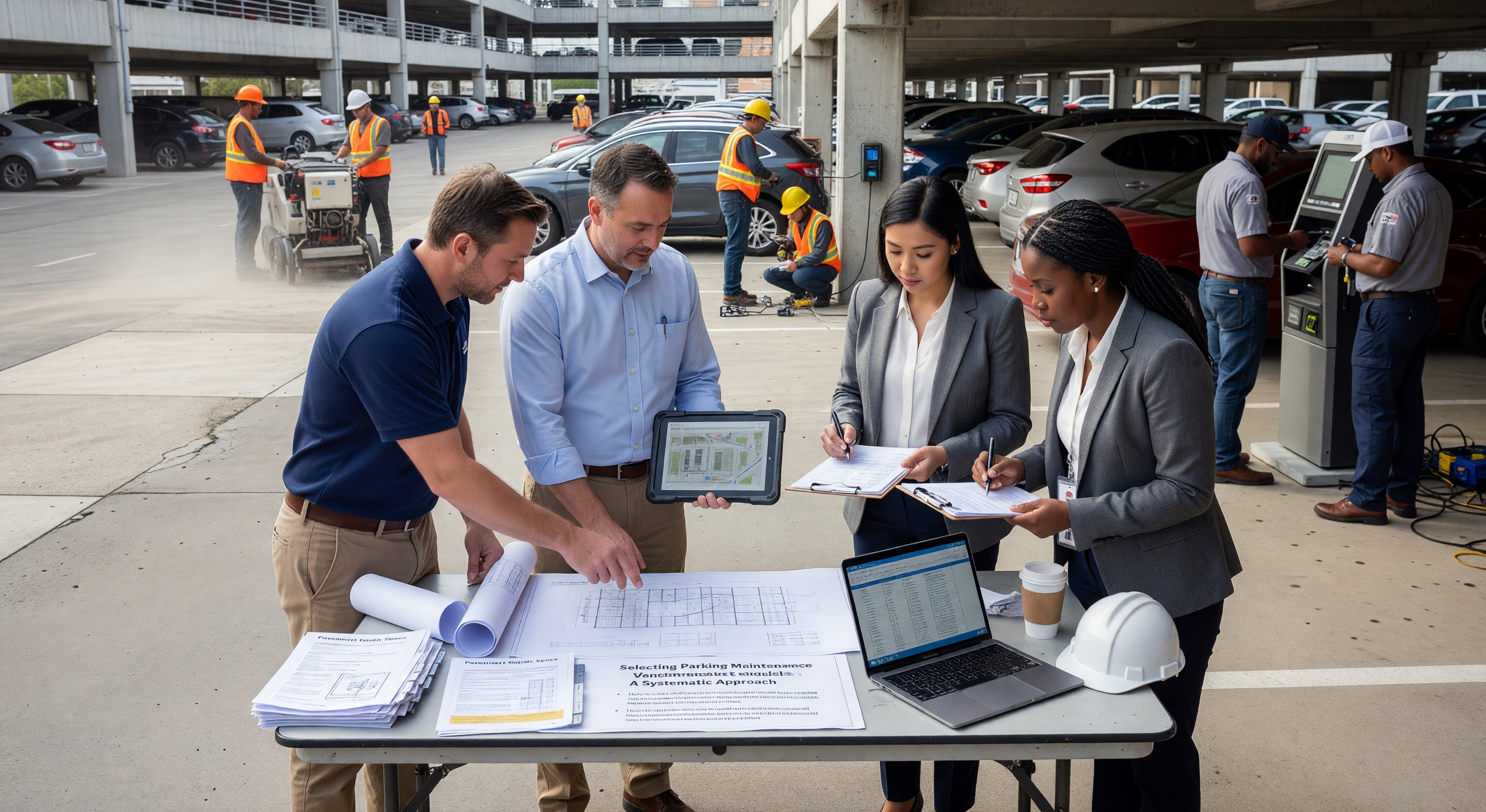
A parking facility’s operational quality depends significantly on the quality of the vendors who maintain it. A PARCS service provider who responds slowly to equipment failures costs revenue. A pavement contractor who applies substandard materials creates warranty calls that take months to resolve. A structural engineering firm that produces reports without clear action guidance leaves facility managers unable to plan capital work effectively.
Building a reliable vendor ecosystem for parking facility maintenance requires systematic vendor selection, clear performance expectations, and ongoing relationship management. This guide provides the framework.
Defining Your Vendor Ecosystem
Parking facilities need vendors in several specialized categories:
PARCS service and maintenance: Technicians who maintain, repair, and service revenue control equipment. May be the equipment manufacturer’s service organization or an authorized independent service provider.
Pavement and civil contractors: Firms that perform seal coating, crack sealing, overlay, and reconstruction of parking surfaces.
Structural and parking garage engineers: Licensed structural engineers with parking structure experience for condition assessments, repair specifications, and structural investigations.
Concrete repair contractors: Specialty contractors who perform partial-depth and full-depth concrete repairs in parking structures.
Waterproofing and coatings contractors: Specialty contractors who apply and repair traffic deck coatings and other parking structure waterproofing systems.
Electrical contractors: Licensed electricians who maintain lighting systems, install EV charging, and service electrical infrastructure.
Snow removal contractors: Firms that provide snow plowing, ice control, and winter maintenance.
Towing companies: Licensed towing operators authorized to tow unauthorized vehicles from the facility.
For each category, you should have at least one reliable primary vendor and ideally a backup. Single-vendor dependency creates operational risk when your primary vendor is unavailable.
Vendor Qualification Criteria
Not all vendors in a category are equally qualified. Develop minimum qualification criteria for each vendor category before soliciting bids.
License and certification: Verify that vendors hold the applicable licenses and certifications. Electrical contractors must be licensed. Structural engineers must be licensed and carry professional liability insurance. Concrete repair contractors who apply specialty products should have manufacturer-issued applicator certifications.
Insurance coverage: At minimum, require commercial general liability ($1 million/$2 million is standard for most trades), workers’ compensation at statutory limits, and auto liability for vendors who operate vehicles on your premises. For contractors who perform work on operating parking structures, umbrella coverage of $2 million or more is appropriate.
Experience and references: Require that vendors provide references from projects similar to yours in type and scale. A pavement contractor who primarily does residential driveways is not qualified for a 500-space commercial parking lot. A PARCS technician who services only one brand of equipment may not be the right fit for your multi-brand system.
Financial stability: For large, long-term maintenance contracts, assess the contractor’s financial stability. A concrete repair contractor who is financially overextended may not be able to stand behind a warranty or complete a large project without interruption.
Procurement Process by Contract Value
Not every vendor engagement warrants the same procurement process. Scale your process to the contract value and term.
Spot work (under $5,000): Informal solicitation — call or email two to three vendors, describe the scope, compare prices and availability. Retain documentation of who was solicited and the prices quoted.
Routine maintenance contracts ($5,000 to $50,000 annually): Written scope of work, solicited from at least three qualified vendors, with written proposals. Evaluate on price, qualifications, and references. Document the selection decision.
Major maintenance projects ($50,000 and above): Formal written specification, competitive bidding from a pre-qualified list, structured evaluation with scoring criteria, and reference checks before award. Legal review of contract terms for significant long-term commitments.
Public entities: Government facilities must follow their applicable procurement regulations, which typically require formal solicitation processes for any contract above a much lower threshold.
Writing Effective Scope of Work Documents
The quality of your vendor relationships depends significantly on the clarity of your scope of work documents. Ambiguous scopes lead to change orders, disputes, and work that does not meet your expectations.
An effective scope of work specifies:
What is included and what is excluded. Explicitly state what the vendor is responsible for. If there is any possibility of ambiguity, address it.
Quality standards. For pavement work: specific product specifications, application thicknesses, and performance standards. For PARCS maintenance: required PM tasks, response time commitments, and documentation requirements. For concrete repair: preparation standards (ICRI surface profile requirements), material specifications, and quality control testing requirements.
Scheduling and operational constraints. When can work be performed? Are there areas or times that must remain operational? What advance notice is required for work that disrupts operations?
Documentation requirements. What records must the vendor provide? Inspection reports, material documentation (data sheets, batch records), photographs, test results.
Payment terms and milestones. For larger projects, milestone-based payment tied to verified completion reduces risk.
Performance Monitoring and Vendor Evaluation
Vendor performance should be tracked systematically, not just assessed informally at contract renewal.
Post-service quality checks: For pavement and concrete work, inspect the completed work before releasing final payment. Compare to specifications. Document deficiencies in writing and provide reasonable cure opportunity.
Response time tracking: For PARCS service and other on-call maintenance, track response times against contract commitments. Consistent failures to meet response time SLAs are a documented basis for contract remediation.
Annual vendor review: At least annually, conduct a formal review of each major maintenance vendor. Rate their performance against the criteria that matter most: technical quality, reliability, communication, and responsiveness to issues. Use this review to inform contract renewal decisions.
Relationship investment: The best vendor relationships involve investment in relationship quality, not just transaction management. Understanding your vendor’s business pressures, communicating your upcoming needs in advance, and paying invoices promptly builds the kind of relationship that produces responsive service when you most need it.
FAQ
Is it worth paying more for a manufacturer-authorized PARCS service provider versus an independent? Manufacturer-authorized service organizations have the deepest knowledge of their specific equipment, direct access to parts, and often first access to software updates and technical bulletins. For complex systems or systems still under warranty, manufacturer service is generally preferable. For systems where independent technicians have demonstrated equivalent competence and offer better pricing or response time, independence can be appropriate.
Should I have annual maintenance contracts or use vendors on an as-needed basis? Annual maintenance contracts are preferable for service categories where you need predictable availability, consistent service, and relationship continuity. PARCS service, pavement maintenance, snow removal, and similar ongoing needs benefit from annual contracts. Occasional services (major concrete repair, one-time pavement reconstruction) may be appropriate for project-by-project solicitation.
How do I handle a vendor dispute about work quality? Document the deficiency with photographs and specific references to the scope of work. Communicate the deficiency in writing with a request for response within a defined timeframe. Provide a reasonable opportunity to cure. If the vendor disputes the deficiency, escalate to their management. If resolution is not achieved, consult legal counsel about your options under the contract.
Can I use the same vendor for both PARCS equipment and maintenance services? Many PARCS vendors bundle equipment sales with service contracts. This can be convenient but creates dependency. When evaluating combined equipment-plus-service offers, ensure you understand the service pricing terms and whether the service agreement survives a vendor acquisition or business change. Some facilities prefer to negotiate equipment and service separately to maintain more flexibility.
Further Reading from Authoritative Sources
- International Parking and Mobility Institute maintenance vendor resources — parking-mobility.org (IPMI) is on the whitelist as the primary parking industry authority with directly relevant maintenance vendor selection content for facility managers.
- IFMA facility maintenance vendor selection and contract management resources — ifma.org is on the whitelist as a facility management authority whose vendor selection and contract management frameworks apply directly to parking maintenance vendor evaluation.