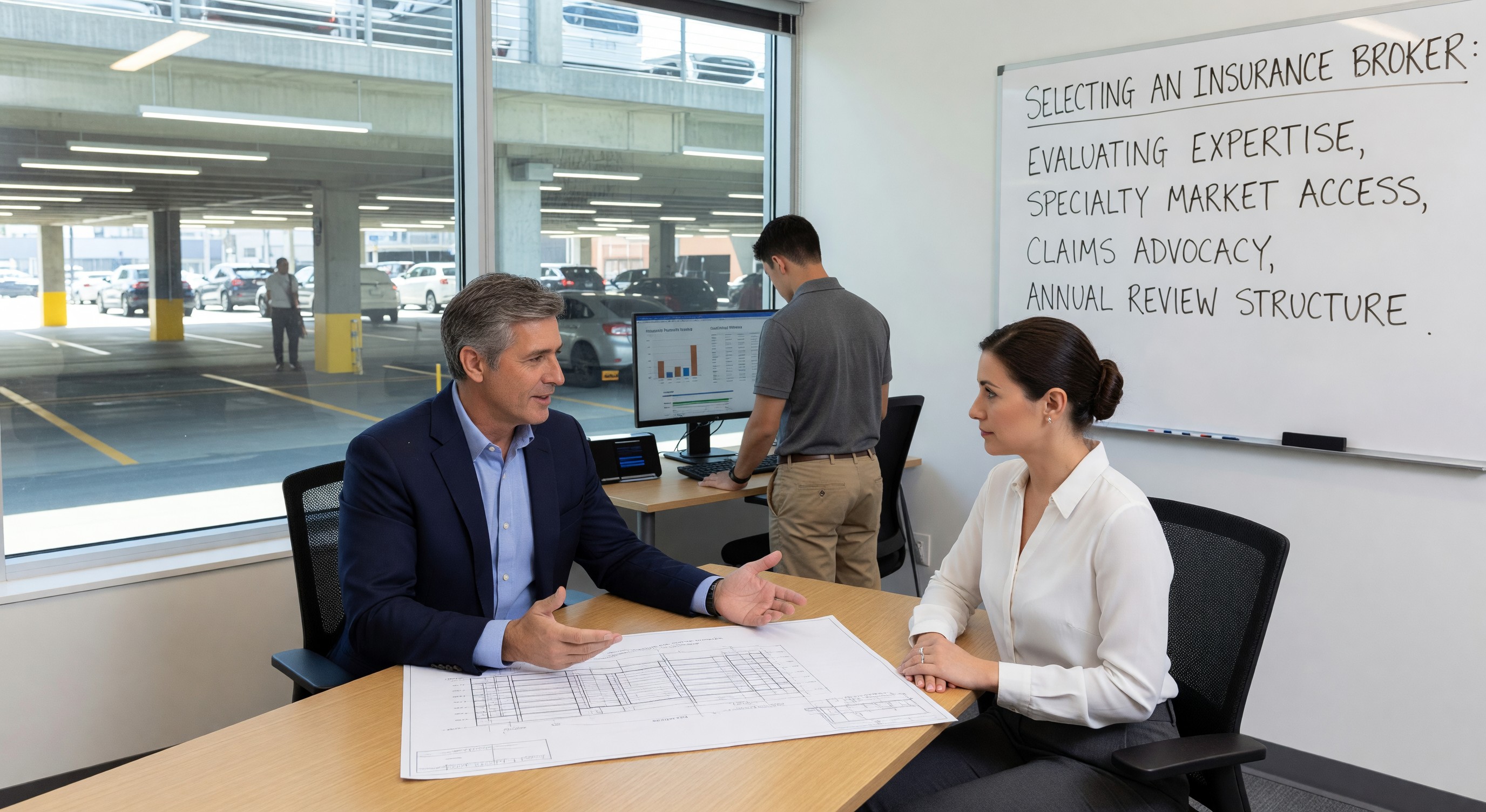
Insurance for parking facilities is a specialty area of commercial insurance that most generalist brokers are not well-equipped to handle. The specific coverages required — garage keeper’s legal liability, valet operations coverage, equipment breakdown, and the precise liability structure for multi-party parking management arrangements — require a broker with parking facility experience and access to the specialty insurance markets that write these risks.
This guide covers how to evaluate and select an insurance broker for parking facility operations, what to expect from a quality broker relationship, and how to structure your annual insurance review.
Why Generalist Brokers Fall Short for Parking
A commercial real estate or facilities-focused generalist broker may manage the property insurance and general liability for a facility adequately. But parking-specific insurance needs often fall outside their expertise.
Garage keeper’s legal liability (GKLL): Not all commercial property brokers understand that standard CGL policies explicitly exclude GKLL, or know the specific markets that write it for parking operations at competitive rates.
Valet-specific coverage: Valet operations have additional exposures (employees driving customers’ vehicles on public roads, vehicle damage during staging and retrieval) that require specific coverage not available on standard commercial auto policies.
Multi-party management arrangements: When parking is managed by a third-party operator under a management agreement, the coverage responsibilities of the property and the operator must be clearly coordinated. A broker who does not understand management agreement structures will leave gaps at the boundary between coverages.
Claims experience: Insurance markets for parking are specialized. A broker who has not placed parking risks before does not know which carriers have experience paying parking claims fairly versus those who are difficult on claims.
Evaluating Broker Candidates
Parking-specific experience: Ask directly how many parking facility clients the broker serves and what types of parking operations they represent (surface lots, garages, valet, parking management companies). A broker with 30 parking operator clients has very different expertise than one who has one parking facility among 500 commercial accounts.
Carrier relationships: Which carriers does the broker place parking business with? Specialty programs for parking operations (some offered through Lloyd’s of London, others through domestic specialty carriers) provide coverage terms that standard commercial lines cannot match. A broker with access to these programs can potentially deliver better coverage at competitive premiums.
Claims advocacy experience: A broker’s value is tested most when claims occur. Ask candidates how many parking-related claims they have supported in the past three years and what their role was in the claims process. References who can speak to claims experience are more valuable than references for policy placement alone.
Risk management services: Many quality brokers provide risk management services beyond policy placement — loss control site visits, contract review, OSHA compliance guidance. For parking operations, loss control visits that evaluate slip-and-fall risk, garage keeper procedures, and security practices add real value.
The Annual Insurance Review Process
An annual insurance review with your broker should be a structured process, not a rubber stamp of prior-year coverage.
Coverage adequacy review: Compare current policy limits to your facility’s replacement cost, revenue exposure, and liability risk profile. Has anything changed that affects coverage adequacy? New EV charging infrastructure? New valet operations? Changes in management structure?
Claims history review: Review claims from the prior year and the trailing five years. What types of claims are most frequent? What is the severity trend? Loss control investments that reduce the types of claims you are experiencing the most will have the largest impact on future premiums.
Market check: Your broker should periodically market your insurance program to competing carriers. Annual premium increases without a market check allow your rates to drift above market. Request that your broker market the program every two to three years at minimum.
Policy review: Review the actual policy language for key coverage areas, not just the declarations page. Coverage gaps are in the policy conditions, exclusions, and endorsements — not in the summary.
Emerging risk assessment: Are there new risks affecting your operation that existing coverage does not address? Cyber liability for PARCS systems that collect payment card and license plate data. Employment practices liability for parking operations staff. Technology errors and omissions coverage for software-driven operations.
Structuring the Broker Relationship
Broker compensation transparency: Insurance brokers are typically compensated through commissions paid by carriers (a percentage of the premium). This structure creates a potential conflict of interest — a broker who recommends higher-premium coverage earns more. Some facilities use fee-only brokers who charge a flat fee regardless of premium to eliminate this conflict.
Access to decision-makers: In a large broker’s commercial lines department, your parking facility account may be handled by a junior producer who lacks the experience to navigate specialty coverage questions. Ensure you know who is actually managing your account and what their experience is.
Response time expectations: Set expectations for broker responsiveness. Certificate requests should be handled within 24 hours. Coverage questions should receive substantive responses within 48 hours.
Midterm coverage changes: When operations change — new management contract, construction project, change in occupancy — notify your broker immediately. Midterm changes may require endorsements or coverage adjustments that your broker can arrange, but only if they know the change occurred.
FAQ
How do I compare broker proposals if they place coverage with different carriers? Compare total premiums for equivalent coverage terms (same limits, same deductibles, same coverage structure). Ask your broker to provide a coverage comparison table that shows where proposed coverages differ from each other. Price is a legitimate comparison factor, but only for genuinely equivalent coverage.
Should I use the same broker for parking insurance and other commercial insurance? You can, but evaluate the broker’s parking expertise separately from their general commercial lines expertise. A broker who is excellent at placing your property and casualty insurance but lacks parking specialty expertise is not the right choice for parking-specific coverages. Consider using a specialty parking broker for GKLL and valet coverages even if a different broker handles your general property.
What claims information should I retain for insurance purposes? Retain incident reports, photographs, witness statements, correspondence, and all documentation related to each claim for at least five years (longer in states with extended statutes of limitations for liability claims). Do not dispose of claim files even after the claim is resolved — reopening or related claims can occur years after initial resolution.
How do I know if my current broker is providing good service? Benchmark against what good service looks like: prompt responses, proactive coverage recommendations, annual review meetings, market checks every two to three years, and responsive claims support. If your broker is reactive (you have to ask for everything), is not familiar with parking-specific needs, or has not arranged a market check in five or more years, it may be time to evaluate alternatives.
Further Reading from Authoritative Sources
- International Parking and Mobility Institute risk management and insurance resources — parking-mobility.org (IPMI) is on the whitelist as the primary parking industry authority with directly relevant insurance broker selection and risk management content.
- BOMI International facility insurance and risk management education — bomi.org is on the whitelist as a facility management authority whose insurance and risk management curriculum directly applies to the parking facility insurance broker selection framework in this article.