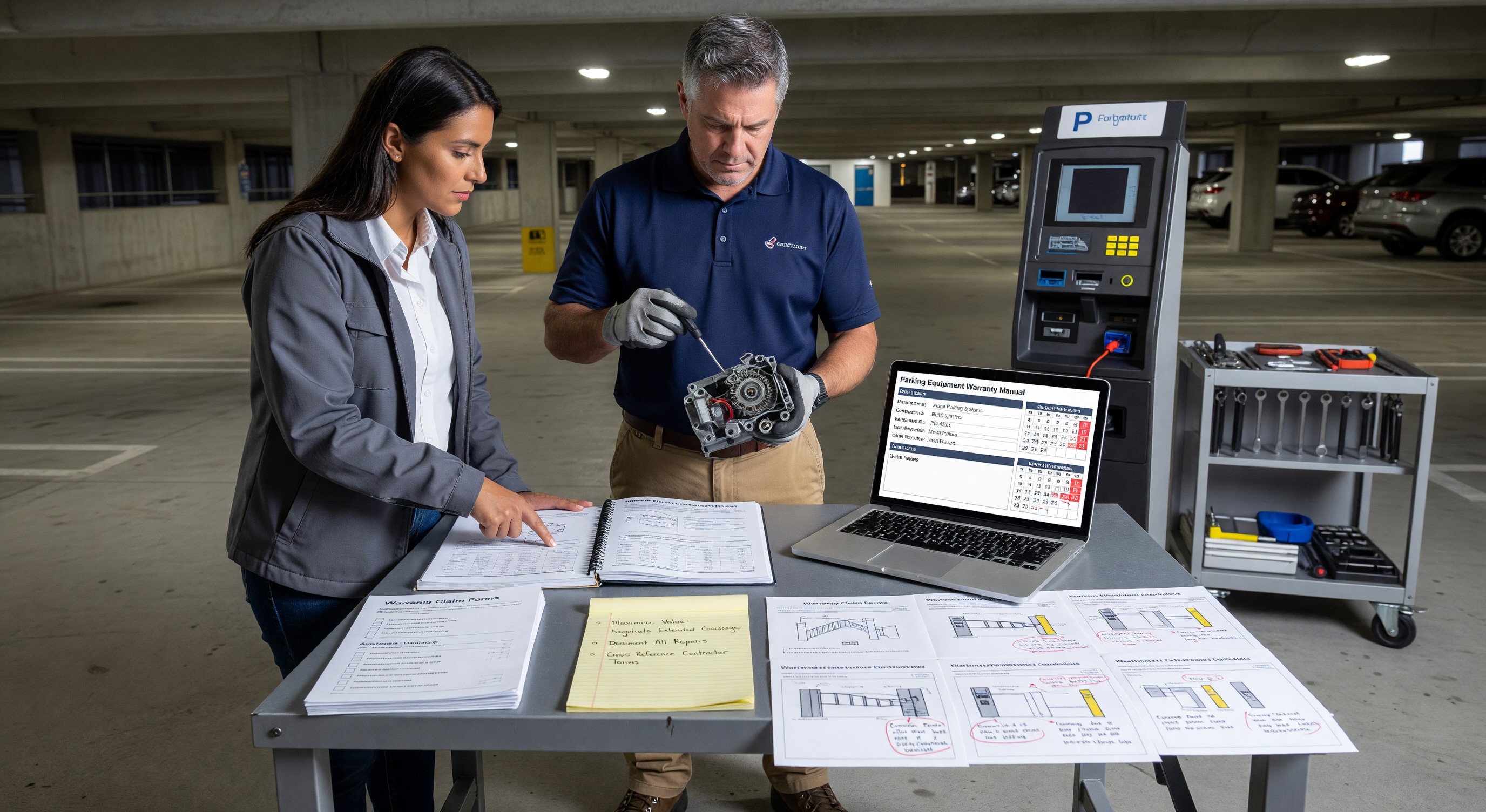
Equipment warranties in parking facilities represent substantial financial value — the right to have failures repaired or replaced at no cost within the warranty period. But parking facility managers often fail to capture this value because they do not understand what their warranties cover, do not document the conditions that support claims, or inadvertently void warranty coverage through improper maintenance practices.
This guide covers the practical aspects of warranty management for parking facility equipment and construction work.
Types of Warranties in Parking Facilities
Parking facilities involve multiple warranty types with different coverage terms, claim processes, and exclusions.
Equipment manufacturer warranties cover defects in materials and workmanship in PARCS components, lighting fixtures, EV chargers, and other equipment. Duration ranges from 1 year (standard for most hardware) to 5 or 10 years for LED fixtures and some EV charging equipment. Manufacturer warranties typically cover parts but may or may not cover labor for repairs.
Installation contractor warranties cover the quality of installation work. A gate arm installation with incorrect wiring that causes premature component failure should be covered under the installation contractor’s warranty, not the equipment manufacturer’s. Contractor warranties are typically 1 year.
Software and firmware warranties may be embedded in equipment warranties or addressed separately in software license agreements. Modern PARCS platforms include software support as a subscription; warranty for software defects is typically covered within the support term.
Construction warranties cover work on parking structures and lots. Standard construction warranties are 1 year for general construction; specialty systems (waterproofing, coatings) typically carry 5 to 10 year manufacturer warranties with separate contractor application warranties.
Extended warranties are available for purchase on many products. They extend coverage beyond the standard warranty period, often with different terms (the product may be repaired or replaced at the manufacturer’s discretion, for example, rather than repaired in the field).
Building a Warranty Register
The most common reason facility managers lose warranty claims is that they cannot locate the warranty documentation when a claim is needed. A warranty register prevents this.
For each piece of equipment or construction work covered by a warranty, maintain a record including:
- Equipment description, model, and serial number (or project description for construction)
- Vendor or manufacturer name and contact information
- Date of purchase or installation completion (the warranty start date)
- Warranty term in years
- Warranty expiration date
- Copy of the warranty documentation
- Notes on any conditions or requirements for warranty coverage (required PM, authorized service providers, registration requirements)
Maintain this register in a central location accessible to all facility management staff, not just the individual who managed the original purchase.
Warranty registration: Many manufacturers require product registration to activate warranty coverage. Check each equipment warranty for registration requirements and complete registration within the required timeframe after installation.
Conditions That Void Warranty Coverage
Warranty voidance is a significant risk for facility managers who are not familiar with warranty terms. Common voidance conditions:
Use of non-authorized service providers: Some equipment warranties specify that warranty service must be performed by the manufacturer’s authorized service organization. Using an unauthorized technician — even for routine preventive maintenance — can void coverage for failures that occur afterward.
Failure to perform required maintenance: Manufacturer warranties often require that preventive maintenance be performed according to the specified schedule. A gate arm failure that occurs after PM has been deferred may be denied if the manufacturer can show that required lubrication or adjustment was not performed.
Unauthorized modifications: Installing non-OEM components, modifying equipment wiring, or altering equipment operation in ways not authorized by the manufacturer can void warranty coverage for affected components.
Environmental conditions: Some warranties specify acceptable operating environments. Equipment installed in conditions outside the specified temperature range, humidity range, or exposure class may not be covered for failures attributable to the environmental conditions.
Damage by third parties: Warranties do not cover damage caused by accidents (vehicle strikes on gate arms), vandalism, or misuse. Distinguish between warranty claims and insurance claims for damage from external causes.
Making Warranty Claims Effectively
When warranty claims are denied or disputed, the outcome often depends on how well the claim was documented.
Document the failure promptly: When equipment fails, record the date and time, the failure symptoms (what the equipment did or did not do), any error codes displayed by the system, and the conditions at the time of failure (weather, temperature, recent maintenance).
Do not replace the failed component before investigation: If you replace a component and return the original to the manufacturer for warranty evaluation, ensure the original component is preserved in the condition it was in at failure. Some claims are denied because the failed component was damaged during removal or cleaning before the manufacturer’s inspection.
Preserve maintenance records: If a vendor disputes a warranty claim based on alleged failure to maintain, your maintenance records are the evidence that PM was performed as required. Without records, the vendor’s position may prevail by default.
Escalate denied claims systematically: When a claim is denied, request a written explanation of the denial rationale. If you believe the denial is incorrect, escalate to the manufacturer’s warranty manager or legal department. Many denied claims are approved upon escalation when the facility manager provides thorough documentation.
Managing Warranty Work During Operations
Warranty repairs in an operating parking facility require coordination that reduces disruption while preserving warranty rights.
Authorized technician scheduling: If warranty service must be performed by the manufacturer’s authorized technician, arrange access promptly. Delays in requesting warranty service for active failures may give the manufacturer grounds to claim the failure worsened due to delayed reporting.
Temporary workarounds: In many cases, equipment failures that are pending warranty service can be managed through temporary workarounds (manual gate operation, alternative payment methods) that maintain revenue while the permanent repair is arranged. Document that temporary workarounds are in use and communicate to customers.
Return-to-base versus on-site repair: Some warranties require failed components to be returned to the manufacturer for evaluation and repair. Others provide on-site service. Understand which model applies to your equipment to set appropriate expectations for repair timelines.
FAQ
My PARCS system was installed three years ago and the gate motors are failing regularly. The equipment is still under the 5-year warranty, but the manufacturer is claiming the failures are due to inadequate maintenance. What can I do? Pull your PM records and confirm that you have documentation of maintenance performed according to the manufacturer’s PM schedule. Compare your maintenance records to the manufacturer’s required schedule. If your records support that PM was performed as required, provide this documentation with a formal warranty claim letter. If PM was not consistently performed, the manufacturer may have grounds to deny the claim.
The contractor who installed my PARCS equipment went out of business. Does this affect my equipment warranty? Equipment manufacturer warranties survive the failure of the installation contractor. Contact the equipment manufacturer directly for warranty service. The contractor’s installation warranty may be unenforceable if the contractor is out of business; pursue manufacturer warranty coverage for equipment defects.
Is it worth purchasing extended warranties on parking equipment? Evaluate based on failure probability and repair cost. For high-cycle components (gate arms, pay station bill validators, card readers) that have predictable wear and high repair costs, extended warranties may have positive expected value. For low-failure-rate components like LED fixtures, extended warranties rarely pay out. Calculate the expected cost of repair versus the extended warranty premium for each equipment type.
What should I do if a manufacturer refuses to honor a warranty claim I believe is valid? Document your claim and the manufacturer’s denial thoroughly. Escalate to the manufacturer’s warranty manager. If escalation fails, consult legal counsel about whether the denial constitutes a breach of contract. For higher-value claims, attorney involvement often produces claim resolution without litigation.
Further Reading from Authoritative Sources
- International Parking and Mobility Institute equipment procurement and warranty resources — parking-mobility.org (IPMI) is on the whitelist as the primary parking industry authority with relevant equipment procurement and warranty management content for facility managers.
- IFMA equipment warranty and vendor management resources — ifma.org is on the whitelist as a facility management authority whose equipment management and vendor relations content applies to the parking equipment warranty management framework in this article.