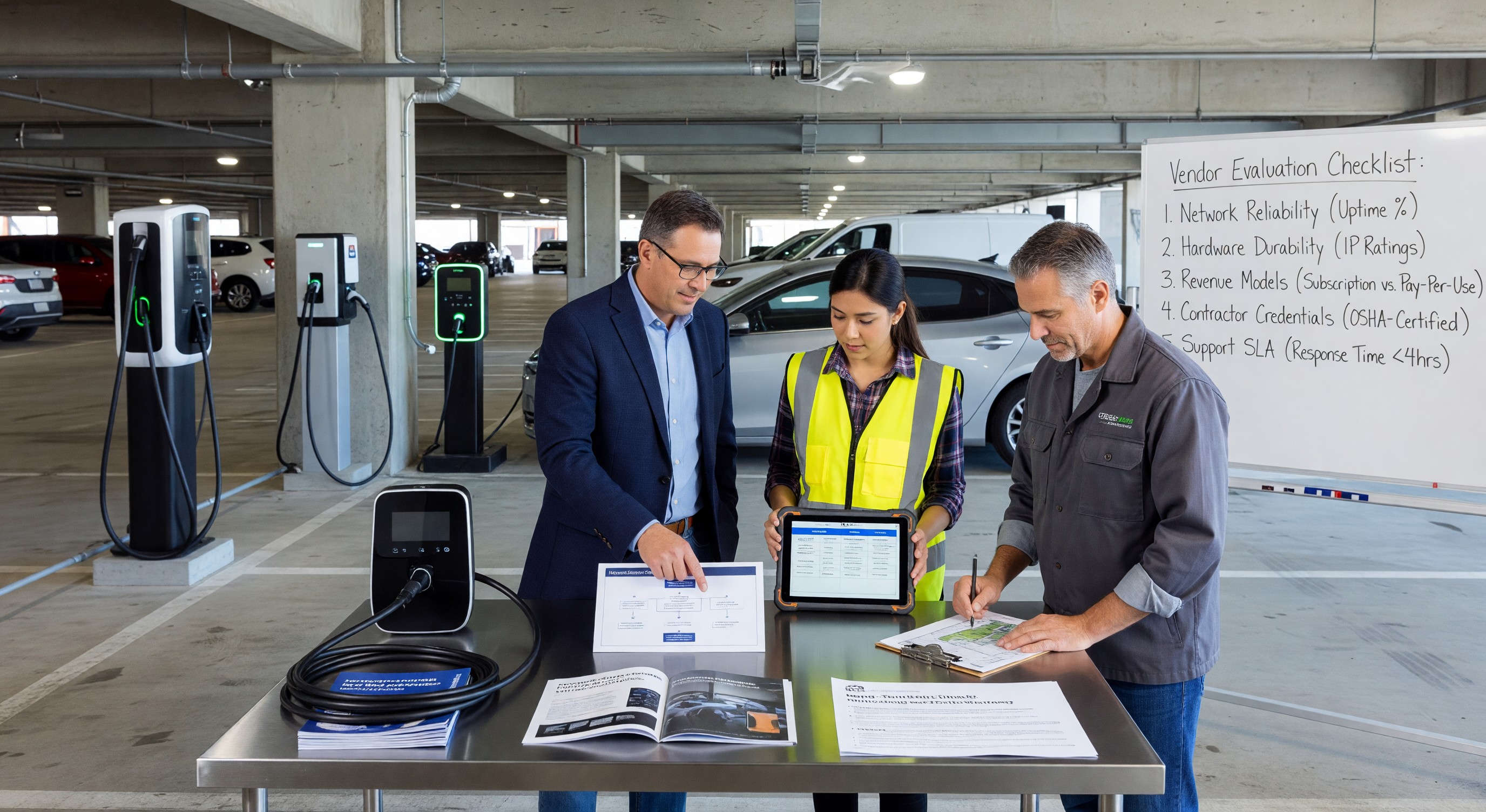
EV charging deployment requires decisions about hardware, network connectivity, installation contractors, and ongoing management that are more complex than most parking equipment purchases. Unlike a gate arm or a pay station where there is one primary vendor relationship, EV charging involves at minimum an equipment manufacturer, a network operator, an installation contractor, and often a utility program administrator — all of whom must work together for the system to function.
This guide provides a framework for evaluating and selecting the vendors in each category.
The EV Charging Vendor Ecosystem
Charging equipment manufacturers produce the physical charging units (EVSE — Electric Vehicle Supply Equipment). Major networked Level 2 manufacturers serving commercial parking include ChargePoint, Blink, Enel X (JuiceBox), and others. DC fast charging (DCFC) manufacturers include ChargePoint, ABB, EVgo, and BTC Power.
Charging networks provide the cloud-based software that manages sessions, handles billing, and provides the consumer app interface. Some networks (ChargePoint, for example) both manufacture equipment and operate the network. Others are equipment-agnostic networks (such as Greenlots/Shell Recharge) that support equipment from multiple manufacturers.
Installation electrical contractors perform the site electrical work — running conduit, installing panels or subpanels, installing charging units, and connecting to the utility service. This is licensed electrical contractor work, separate from the equipment vendor relationship.
Utility programs provide incentives (rebates, technical assistance, time-of-use rates) for EV charging installation. Your utility company is a key stakeholder in the EV charging decision, not just a service provider.
Hardware Evaluation Criteria
Connector types and compatibility: Level 2 EVSE typically offers J1772 connectors, which are universal for non-Tesla vehicles. Some newer units include NACS (Tesla) connectors as well. DCFC stations require SAE CCS and/or CHAdeMO connectors; NACS is an emerging standard. Verify that equipment supports the connector types your users will need.
Power output: Level 2 EVSE ranges from 7.2 kW to 19.2 kW per port. Higher output charges vehicles faster. 7.2 kW (32A at 240V) is adequate for 4 to 6 hour parking stays; 11.5 kW (48A) is better for 2 to 4 hour sessions. DCFC stations typically output 50 kW to 150 kW or more.
Networked versus non-networked: Non-networked chargers are less expensive but provide no usage tracking, remote management, or fee collection capability. For commercial parking facilities, networked equipment is essential.
Physical durability: Parking environment charging stations are exposed to vehicle proximity, weather, and vandalism. Look for units with robust physical housings, impact ratings, and weatherproofing (IP55 or better for outdoor installations).
Warranty: Equipment warranties for commercial Level 2 EVSE should be at minimum 3 years on parts and labor; 5-year warranties are better. DCFC stations are higher-cost equipment and warrant 3 to 5 year comprehensive warranties.
Network Selection
The charging network determines the customer experience, billing infrastructure, and your management visibility.
Consumer network size: A network with more users means more customers already equipped with the app or RFID card to use your charging station without friction. ChargePoint has the largest North American network by user count; this is a meaningful consideration if consumer convenience is a priority.
Session management capabilities: What can you control and see from the management portal? Session authorization, pricing control, real-time occupancy, historical usage reports, and load management settings are the capabilities that matter for facility management.
Pricing flexibility: Can you set your own charging rates? Some network agreements restrict pricing flexibility, particularly in revenue-sharing arrangements. Ensure you can price charging at market rates appropriate for your facility.
Payment options: Can users pay by credit card without a network membership? Tap-to-charge payment without a network membership reduces friction for first-time users.
Open standards: Some networks use proprietary protocols that lock equipment to the network. Networks that support OCPP (Open Charge Point Protocol) standards allow equipment to be migrated to a different network in the future, reducing vendor lock-in.
Revenue Models
EV charging revenue arrangements between the facility and the network operator take several forms:
Facility-owned, facility-priced: You purchase the equipment, connect it to a network, and set charging rates. Revenue (minus network transaction fees) goes to you. Maximum control and long-term revenue potential; requires capital investment.
Network-owned equipment with revenue sharing: The network installs and owns equipment on your property in exchange for a share of charging revenue (or free charging to users). Lower upfront cost; long-term revenue sharing reduces your share.
Free charging as an amenity: Equipment is installed and operated at facility expense; charging is provided free to users as an amenity. Revenue model is driven by the indirect benefits (tenant satisfaction, lease differentiator) rather than direct charging revenue.
For most commercial parking facilities, facility-owned equipment with network connectivity and facility-controlled pricing provides the best long-term financial outcome, particularly as EV charging demand grows.
Installation Contractor Selection
EV charging installation is electrical contractor work. Key qualification criteria:
Licensed electrical contractor: Must hold the appropriate state electrical contractor license for the work scope.
EV charging experience: Charging station installation has nuances (GFCI requirements, load calculation for utility service, conduit routing for weathertight outdoor installations) that require specific experience.
Utility rebate program experience: Contractors who have completed projects under your utility’s rebate program understand the documentation requirements that qualify installations for rebates.
Coordination capability: EV charging projects often require coordination between the electrical contractor, the equipment vendor, the utility company, and the building permit authority. A contractor who has navigated these coordination requirements before moves faster than one learning the process on your project.
FAQ
How do I choose between OCPP-compliant and proprietary network equipment? OCPP compliance gives you the flexibility to change networks in the future without replacing hardware. Proprietary systems may offer tighter integration with the network’s features in the short term but create dependency. For most commercial facilities deploying Level 2 equipment at moderate scale, OCPP compliance is worth prioritizing for future flexibility.
Can I participate in a utility demand response program with my EV charging stations? Yes, with appropriately configured equipment and network management. Many utilities offer demand response programs that pay commercial customers to reduce or defer load during peak grid periods. EV charging is well-suited for demand response because charging schedules are flexible. Confirm demand response compatibility with your network before deployment.
What is the typical lead time for EV charging installation from vendor selection to operational? For straightforward Level 2 installations without utility service upgrades, allow 60 to 90 days from vendor selection to operation. Utility service upgrades extend timelines significantly — 6 to 12 months is common for projects requiring transformer upgrades or service entrance modifications.
How should I allocate responsibility between the equipment vendor and installation contractor for post-installation issues? Clearly define the boundary in both contracts: the equipment vendor is responsible for equipment defects; the installation contractor is responsible for installation workmanship. Document the system’s operating condition at commissioning (photographs, measured outputs, initial diagnostics) to establish a baseline that supports warranty claims for both parties.
Further Reading from Authoritative Sources
- U.S. Department of Energy EV charging infrastructure guidance and standards — energy.gov is on the whitelist and is the primary federal authority on EV charging standards and incentive programs directly referenced in this vendor selection article.
- International Parking and Mobility Institute EV charging deployment resources — parking-mobility.org (IPMI) is on the whitelist and provides parking industry application of EV charging vendor selection that complements the DOE’s technical guidance.