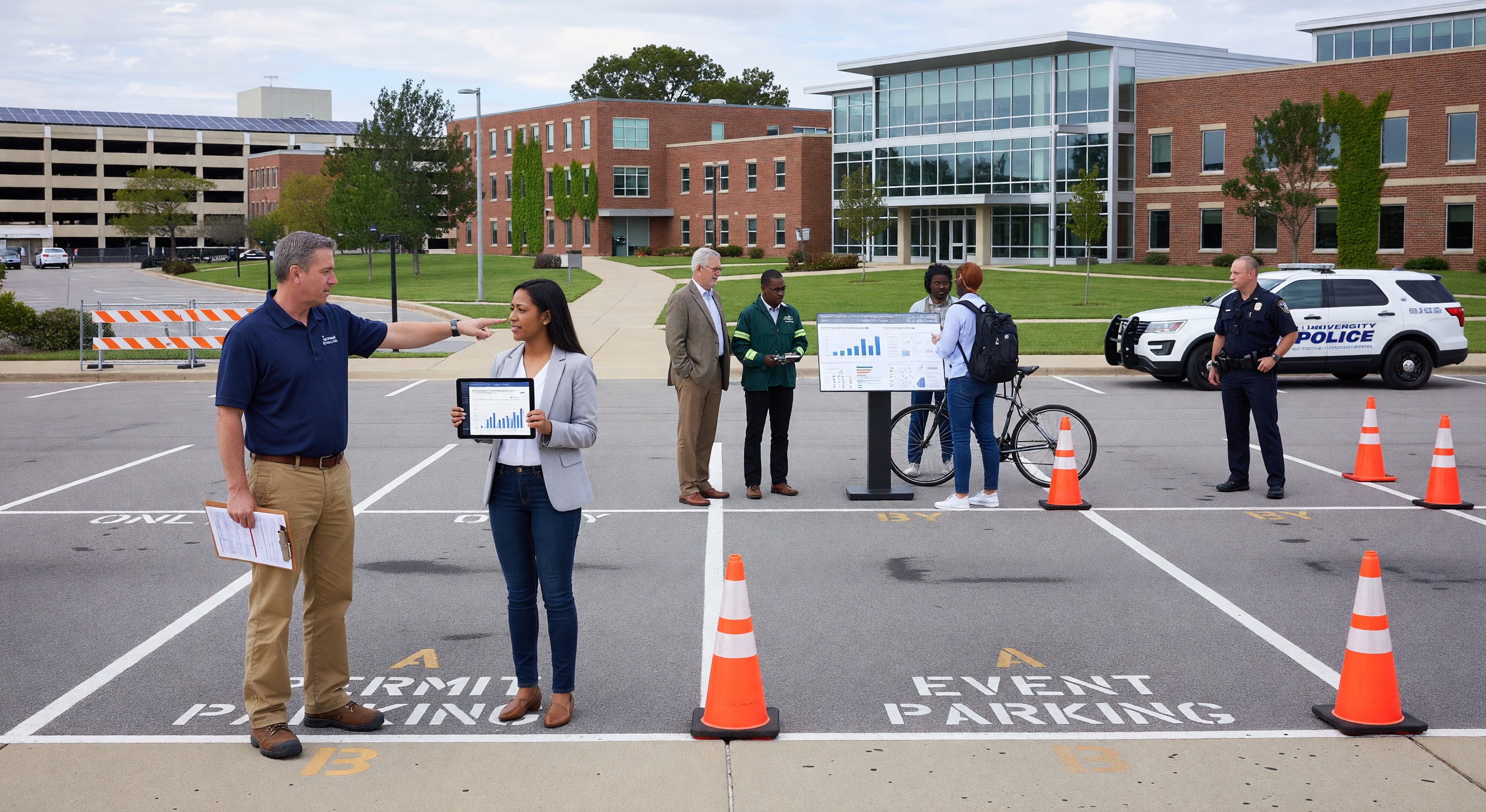
University parking management presents challenges found nowhere else in the facility management world. A university parking program manages not just vehicles, but the intersecting transportation needs of a small city — commuting students, faculty and staff on varying schedules, event attendees, service contractors, athletic program participants, and visiting lecturers — on a fixed-size campus where transportation competes for land with academic and research uses.
The tension between parking supply and campus development goals is perennial in higher education. Every parking space added is land that could host a classroom, research lab, or residence hall. Every parking space removed creates pressure to reduce permit sales or increase shuttle service. Managing this tension productively requires both operational excellence and strategic vision.
Understanding Campus Parking Demand
Campus parking demand has unique structural characteristics that make traditional parking management approaches inadequate.
Semester and academic calendar variation. Parking demand during finals week is dramatically different from demand in January term. Event demand on home football Saturdays bears no relationship to normal weekday demand. The permit program that is in equilibrium during normal class days must accommodate these extremes.
Faculty and staff versus student demand patterns. Faculty with morning classes arrive early and may be on campus all day. Graduate students may be on campus 10 to 12 hours. Undergraduate students move between classes across campus throughout the day. These different patterns create very different parking needs from the same physical space.
Transit and active transportation alternatives. Many universities are served by public transit, bicycle networks, and campus shuttles. The availability and quality of these alternatives significantly affects parking demand. A university well-served by transit can support a smaller parking supply and higher permit prices without reducing access.
Permit Zone Systems
Most large university campuses use zone-based parking permit systems that match permit holders to specific lots or zones based on their status, building affiliation, or declared need.
Zone design principles:
Faculty and senior staff zones are typically closest to academic buildings. The premium for proximity is recognized through higher permit pricing, which is appropriate given the academic time value of faculty who do not need to allow 20 minutes for a 10-minute walk.
Remote lots with shuttle service can accommodate high-volume student demand at lower cost. Students with price-sensitive parking decisions are more likely to accept remote parking when shuttle service is frequent and reliable.
ADA-accessible spaces should be distributed across zones to serve users of all status categories. Concentrating accessible spaces in a single zone near administration does not serve a mobility-impaired student in a campus-edge classroom building.
Zone allocation by building. Matching permit holders to the zone nearest their primary building reduces cross-campus driving that adds to traffic and wastes commute time. Allows the parking program to serve a space-allocation function alongside its revenue function.
Transportation Demand Management
TDM programs reduce parking demand by making alternatives more attractive. Universities are among the best-positioned institutions to implement effective TDM because they have the organizational structure, captive population, and motivation to change transportation behavior.
Transit passes. Institutional transit pass programs (often called “U-Pass” programs) negotiate bulk transit access for the campus community at rates far below individual fare costs. When all students and employees have transit access included in their fees, parking demand shifts measurably to transit.
Bicycle infrastructure investment. Secure bike parking, shower facilities for cyclists, and bicycle repair stations reduce the friction of cycling as a commute mode. For campuses with high cycling potential (flat terrain, moderate climate, dense campus geography), bicycle infrastructure investment often delivers better demand reduction per dollar than parking construction.
Parking cash-out. Programs that allow employees who commute without driving to “cash out” their parking benefit create a financial incentive to switch commute modes. For campuses where parking is provided as an employee benefit, cash-out programs have demonstrated 10 to 20 percent demand reduction.
Event Parking Management
Athletic events, concerts, commencement, and large academic events create parking demand spikes that would be impossible to accommodate if they required dedicated permanent capacity. The standard solution is temporary lot activation and temporary permit rules that allow normally restricted lots to serve event users.
Event parking planning: Develop a master event parking plan that defines lot designations, pricing, and circulation for each major event type. Rather than re-planning every event, adapt the master plan to each event’s specific configuration. This reduces the operational overhead of event planning and creates consistency for repeat attendees.
Shuttle programs for major events: Large events that exceed on-campus parking capacity benefit from remote lot shuttle programs. Athletic event shuttle programs from campus-edge lots or off-campus facilities reduce traffic congestion and can be net revenue-positive when the shuttle program fee is incorporated into event parking pricing.
Coordination with municipal traffic management: For very large events, coordinate with local police and transportation authorities. Campus parking management does not end at the campus boundary — traffic backups on adjacent streets affect campus parking operations.
Enforcement on Campus
Parking enforcement on university campuses is politically sensitive. Students, faculty, and staff all have points of view about enforcement, and the parking program’s relationship with the campus community depends in part on whether enforcement is perceived as fair and reasonable.
Consistent enforcement builds legitimacy. Selective enforcement — ticketing students but not faculty, or ticketing in some lots but not others — destroys it. Establish enforcement protocols that apply consistently across all user populations.
Appeals process. A fair, accessible appeals process for parking citations reduces the perception of arbitrary enforcement. Document the appeals criteria and make them publicly available. Overturn citations when the criteria support it; deny when they do not. Consistency matters more than any individual outcome.
Permit occupancy monitoring. Use LPR or periodic lot counts to verify that permit sales are not exceeding capacity. Overselling permits relative to physical capacity creates overcrowding that undermines the value proposition of the permit and generates complaints.
FAQ
How should faculty and student permit prices be set relative to each other? Faculty and professional staff permit prices should reflect the higher value of proximity and the higher ability to pay of that population. Student permit prices should be set with price sensitivity in mind — students on tight budgets who face high parking prices may park off-campus on residential streets, which creates community relations problems. Many universities set student permit prices at roughly 50 to 70 percent of comparable faculty permit prices.
How do I handle parking demand from construction that takes lots offline? Develop a communication-first response. Notify affected permit holders of the change well in advance, describe temporary alternatives, and consider offering prorated refunds for significant permit area closures. Add temporary shuttle service if the loss of supply is substantial. The worst outcome is a permit holder who discovers the change on arrival with no advance notice.
Should the parking program report to transportation services, facilities, or the business office? Organizational placement varies widely across institutions. From a functional standpoint, parking benefits from close coordination with transportation alternatives (TDM, transit, shuttle) and facilities (infrastructure maintenance). Programs that report to transportation services often have stronger TDM integration; programs that report to finance have stronger revenue management discipline.
What data should a university parking program track? At minimum: permit sales by zone and type, daily utilization by lot, violation counts and appeal outcomes, revenue by stream, maintenance expenditures, and shuttle ridership. Long-term trend data on permit demand relative to supply is particularly valuable for capacity planning and rate-setting decisions.
Further Reading from Authoritative Sources
- International Parking and Mobility Institute campus parking management resources — parking-mobility.org (IPMI) is on the whitelist as the primary parking industry authority with directly relevant campus parking management content for university parking administrators.
- Transportation Research Board campus transportation demand management research — trb.org is on the whitelist and TRB’s TDM research provides empirical support for the demand reduction claims and parking pricing strategy guidance in this article.