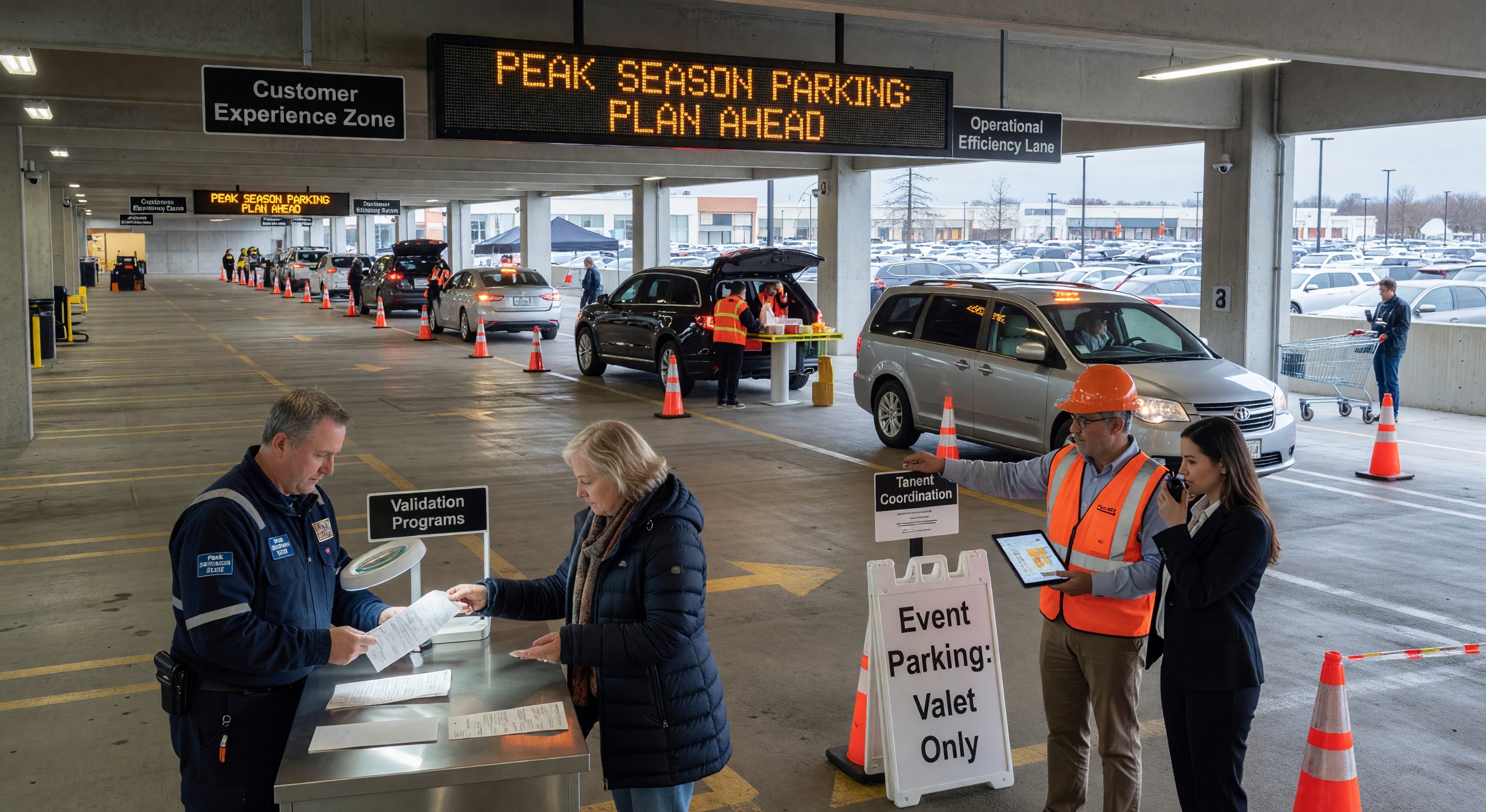
Retail parking management differs fundamentally from other commercial facility types because the parking lot is not just an operational necessity — it is a direct component of the customer experience that drives sales. Research consistently finds that parking availability and ease are among the top factors customers cite in choosing where to shop. A retailer with a frustrated parking experience loses customers to competitors, regardless of product selection or price.
At the same time, retail parking operations must balance the free-to-users expectation of most retail parking markets, the operational costs of managing a large facility, and the competing needs of dozens of tenants with different peak periods and customer profiles.
Retail Parking Demand Characteristics
Retail parking demand is highly variable and predictable in its variability. This predictability enables planning; the challenge is deploying that planning effectively.
Seasonal peaks: Retail parking demand in the United States has two dominant peak periods. The holiday season (Thanksgiving through New Year’s) drives the highest sustained demand of the year. Back-to-school season (late July through early September) creates a secondary peak at many retail formats. Understanding your specific property’s seasonal profile — which weeks hit which percentages of peak demand — is essential for staffing, overflow planning, and vendor coordination.
Day-of-week and time-of-day patterns: Most retail properties see weekend peaks, with Saturday being highest at most properties. Time-of-day patterns typically show a morning arrival build, mid-afternoon peak, and post-peak decline. Food-anchored properties see different patterns: they peak strongly at lunch and dinner for restaurant tenants regardless of day of week.
Tenant anchors drive variation: A department store anchor drives different parking demand patterns than a grocery anchor, a movie theater, or a fitness center. Mixed-anchor properties often have more complex demand profiles with multiple daily peaks.
Customer Experience: The Parking-Sales Connection
The connection between parking experience and retail sales is well-documented. ICSC (International Council of Shopping Centers) and BOMA research consistently find that:
- Parking availability ranks among the top three factors customers cite in shopping center selection
- Parking search time above 5 minutes measurably increases shopping trip abandonment
- Poor parking experiences are shared in online reviews at disproportionately high rates
These findings justify investing in parking experience improvements as retail support, not just operational efficiency.
Parking availability guidance: Real-time availability indicators at the parking lot entrance that show available spaces by zone reduce anxiety and search time. Even simple LED signage (Full / Available) at lot sections is more effective than nothing.
Wayfinding within the lot: Large parking lots benefit from aisle and section identification (letters, colors, numbers) so customers can return to their vehicle. Row markers visible from vehicle height help customers navigate.
Pedestrian crossing safety: Retail parking lots often have multiple drive aisles that customers cross on foot. Marked pedestrian crossings with signage improve safety and customer confidence.
Free vs. Paid Parking: The Retail Context
The dominant model in U.S. retail parking is free customer parking. Charging for parking at a typical shopping center would require a dramatic renegotiation of the customer value proposition in most markets. Customers shop at a competitor where parking is free.
Exceptions exist in dense urban markets where land costs justify validated parking models. Urban retail centers in San Francisco, New York, Chicago, and similar markets successfully charge for parking with validation programs that tie parking fees to purchase amounts.
For most suburban retail properties, the relevant question is not whether to charge for parking, but how to:
- Prevent long-term parking abuse (employees or commuters who use retail lots for all-day parking)
- Address situations where parking is genuinely constrained
- Generate revenue from specialty parking (premium spaces, event parking, EV charging)
Validation Programs and Tenant Coordination
Validation programs in retail contexts typically give tenants the ability to offer parking benefits to customers. A restaurant might offer two hours free with any purchase; a movie theater offers free parking with ticket purchase.
Managing validation programs across multiple tenants requires clear policies:
Validation cost allocation: Who pays for validated parking — the property, the tenant, or a hybrid? Most retail validation programs charge back the cost to the tenant who provides the validation, creating accountability for usage.
Validation controls: Electronic validation systems that require a purchase transaction or ticket scan prevent misuse. Paper validation stamp systems are more prone to abuse.
Cap management: Set monthly or daily caps on validation use by tenant. Notify tenants when caps are approached. For tenants whose legitimate business drives high validation volume, renegotiate the validation program terms rather than absorbing unlimited costs.
Abusive Parking Prevention
Long-term parking abuse — employees, commuters, or others who use retail lots for all-day parking — is a persistent problem for large retail centers. It consumes spaces intended for customers and creates management challenges.
Time limit enforcement: Posted time limits with periodic enforcement through parking patrol or LPR-based monitoring effectively deter long-term abuse. Enforcement actions (citations, towing after warning) must be consistent to maintain deterrence.
Employee parking allocation: Coordinate with tenants to direct employee parking away from customer spaces. Designate specific areas (typically the least convenient spaces) for employee parking and require tenants to enforce compliance. Include employee parking expectations in tenant lease agreements.
Peak Season Operations
Holiday and peak season operations require advance planning, additional resources, and proactive communication.
Staffing: Augment parking monitoring and customer assistance staffing during peak periods. Visible staff presence in the parking lot during holiday weekends improves safety and customer confidence.
Traffic flow optimization: Review traffic flow patterns before peak season. Are there directional issues that create congestion at critical decision points? Temporary signage or cones can address congestion points that are manageable in normal conditions but fail during peak demand.
Overflow planning: Identify overflow parking for days when primary lots fill. Negotiate temporary use of adjacent properties, notify anchor tenants in advance, and plan directional signage to overflow areas.
FAQ
How do I measure the impact of parking improvements on retail performance? The cleanest measurement approach is comparing before and after traffic counts (vehicle entries/exits) and, if available, sales data from the period. Customer satisfaction surveys with questions specifically about parking experience provide directional data. For major improvements, A/B testing (implementing changes in one section of a large lot first) can help isolate the parking effect from other variables.
Should retail parking lots be patrolled by security, parking staff, or automated systems? In most retail contexts, automated enforcement (LPR-based time limit monitoring with license plate-based citation issuance) is more cost-effective than staffed patrol for time-limit enforcement. Security patrol addresses safety and incident management. Parking staff (customer assistance, traffic direction during peak periods) serve a customer service function. The optimal mix depends on facility size and incident frequency.
How do I handle the conflict between anchor tenants who want maximum parking availability and other tenants who want reserved customer parking? Anchor tenants typically have significant influence over parking management through their lease agreements, which often include parking provisions. Smaller tenants may have legitimate concerns about proximity, particularly during peak periods. A reserved customer loading zone or short-term parking area near smaller tenants, clearly enforced, addresses the concern without conflicting with anchor tenant rights.
What is the right response when parking is chronically full during peak periods? First, verify that the problem is real parking capacity (lot is physically full) rather than perceived unavailability (customers perceive the lot as full when spaces exist). Occupancy counting and guidance technology helps with this distinction. For genuine capacity constraints, the options are expanding supply (costly), managing demand (TDM, staggered shopping incentives), or accepting that peak periods exceed capacity — which many successful retailers accept as a sign of a strong draw.
Further Reading from Authoritative Sources
- International Parking and Mobility Institute retail parking management resources — parking-mobility.org (IPMI) is on the whitelist as the primary parking industry authority with directly relevant retail parking management content for the shopping center audience.
- Institute of Transportation Engineers retail parking demand research — ite.org is on the whitelist and ITE’s retail parking demand data provides the empirical foundation for the demand characterization and seasonal peak analysis in this article.