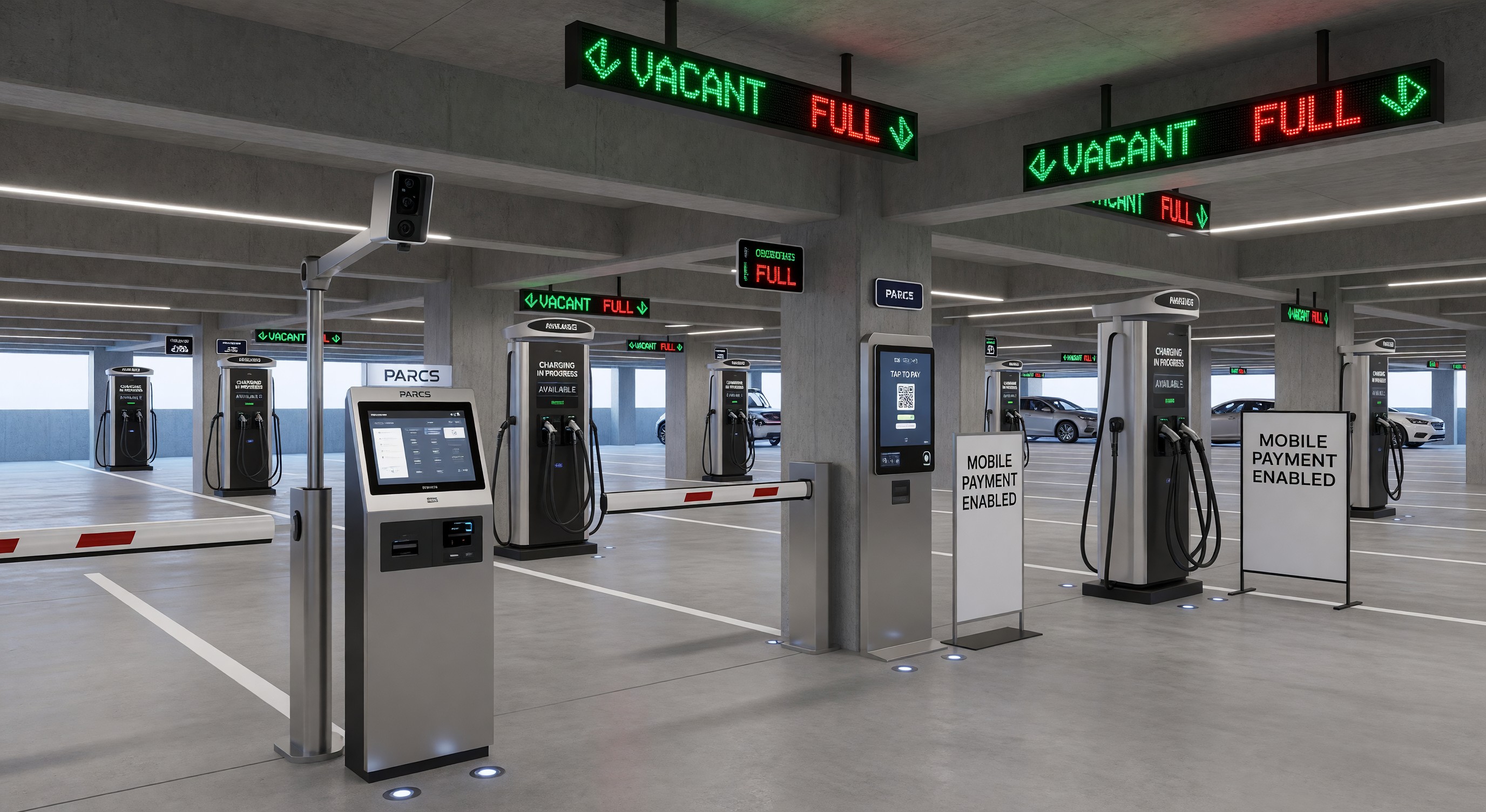
The parking technology landscape has evolved substantially over the past decade. Technologies that were exotic or cost-prohibitive for most facilities ten years ago — license plate recognition, real-time occupancy guidance, mobile payment, demand-based pricing — are now accessible to facilities of modest scale. At the same time, the proliferation of vendors and platforms makes evaluating technology options more complex.
This guide provides a structured overview of the major technology categories in parking facility management, what each does, and what questions to ask when evaluating specific products.
Parking Access and Revenue Control Systems (PARCS)
PARCS is the core platform for parking revenue operations. A PARCS handles access control (who is authorized to enter and exit), revenue collection (how payment is captured), and management reporting (how performance is measured).
Modern PARCS platforms are cloud-based or hybrid architectures with:
Entry and exit equipment: Gate arms, ticket dispensers, barcode or QR code scanners, and license plate recognition cameras that handle vehicle identification and access control at lane entry and exit points.
Payment stations: Pay-on-foot stations where customers pay before returning to their vehicles, exit cashiers (increasingly automated), and mobile payment integration that allows customers to pay from their phone.
Management software: Cloud-based dashboards that provide real-time and historical reporting on revenue, utilization, transaction counts, and equipment status. Modern platforms provide API access for integration with property management and financial systems.
Key evaluation questions for PARCS:
- What payment methods are supported (credit/debit, mobile, QR, LPR-based)?
- What reporting capabilities are native versus requiring custom development?
- How is data ownership handled — can you export all your data?
- What is the vendor’s support track record and response time commitment?
- How does the platform handle offline operation when network connectivity is lost?
License Plate Recognition (LPR)
LPR systems use cameras and image recognition software to identify vehicles by their license plates. In parking applications, LPR serves multiple functions:
Permit validation: Monthly permit holders register their license plates, and LPR cameras at entry lanes verify permit status automatically without physical credentials. Reduces the friction of permit-based entry and eliminates lost or stolen pass concerns.
Enforcement: Parking enforcement officers use handheld or vehicle-mounted LPR to check parked vehicles against permitted plate lists, flagging unpermitted vehicles for citation. LPR-based enforcement is 3 to 5 times faster than manual permit checking.
Post-payment exit: Customers who have paid at a pay station can be released at the exit gate by matching their plate to the payment transaction, eliminating the need to carry a physical ticket to the exit.
Frictionless entry and exit: In fully LPR-based facilities, there are no tickets, no cards, and no transactions at the gate — just a camera that captures the plate and triggers billing or validation lookup automatically.
Key evaluation questions for LPR:
- What is the recognition accuracy rate in your operating conditions (night, weather, dirty plates)?
- How are out-of-state or international plates handled?
- What is the data retention policy for plate images?
- How is the system integrated with your PARCS platform?
Mobile Payment and Parking Apps
Mobile parking payment platforms allow customers to pay for parking from their smartphones. Products range from single-facility apps to multi-facility networks that allow payment across thousands of locations.
Standalone facility apps are typically white-labeled products from PARCS vendors that allow payment and permit management for a single facility. They reduce hardware costs by shifting payment to the customer’s device.
Network apps (SpotHero, ParkMobile, etc.) aggregate multiple parking facilities on a single consumer platform. Listing your facility on these networks provides marketing reach to customers already using the app, at the cost of transaction fees and some degree of rate-setting flexibility.
License plate-based entry through mobile apps allows customers who have parked and paid via app to exit without a physical credential — the app payment transaction authorizes the exit gate to open when the plate is recognized.
Key considerations:
- Transaction fees (typically 2 to 10 percent of transaction value) affect net revenue
- Listing on consumer networks increases discovery but reduces rate control
- Mobile-only facilities require consideration of users without smartphones (accessibility)
Occupancy Guidance Systems
Occupancy guidance systems count vehicles in real time and direct drivers to available spaces, reducing search time and frustration.
Entry/exit counting: The simplest approach counts vehicles entering and exiting to calculate net occupancy. Provides zone-level or lot-level availability information.
Space-level sensors: Individual sensors (ultrasonic, magnetic, camera-based) at each space detect whether it is occupied. Enables precise space-level guidance and detailed utilization reporting.
Guidance displays: Variable message signs at facility entrances and within structures display available space counts by zone, directing drivers to areas with availability.
Applications: Occupancy guidance is most valuable in large structured facilities, multi-structure campuses, and facilities with significant search-time problems. For small surface lots, the investment may not be justified.
Smart Parking and IoT Integration
The Internet of Things has enabled a generation of parking facility sensors and connected devices that provide data for operational decision-making.
Environmental sensors: Temperature, humidity, CO, and air quality sensors in enclosed garages support demand-controlled ventilation and early detection of equipment problems.
Energy management integration: Smart meters and energy management platforms that track electricity consumption by circuit enable detailed energy use analysis and demand management.
Predictive maintenance: Connected equipment (gate arms, pay stations) that transmit performance data enable condition monitoring and predictive maintenance — identifying developing failures before they cause operational disruptions.
Parking Guidance for EV Charging
EV charging management platforms integrate with facility management and PARCS systems to monitor charging station availability, manage charging sessions, and optimize load.
Session management: Network charging platforms (ChargePoint, EVgo, Blink) provide session start, monitoring, and completion data to the facility operator. Real-time availability data can be displayed on parking guidance signs.
Load management: Smart charging management software coordinates charging sessions to prevent simultaneous peak load events that would trigger demand charge increases.
Fleet integration: Corporate and fleet EV charging management often integrates with fleet management systems to enable billing allocation, energy cost reporting, and charge scheduling.
FAQ
How do I avoid vendor lock-in when selecting parking technology? Look for systems with published APIs, open data standards, and contractual commitments to data portability. Avoid systems that store your data in proprietary formats with no export capability. Require contractual provisions that allow you to export all historical data in standard formats before contract expiration.
Should I buy all parking technology from one vendor or best-of-breed from multiple vendors? Single-vendor suites offer integration simplicity and a single point of accountability. Best-of-breed from multiple vendors allows you to select the best product in each category. For most facility managers, single-vendor simplicity is worth a modest capability premium, unless a specific capability gap is material to operations.
What is the difference between on-premises and cloud-based PARCS? On-premises systems store data and run software locally, requiring local servers and IT support. Cloud-based systems run in vendor data centers with web-based access. Cloud systems generally have lower IT infrastructure requirements, automatic updates, and better remote access. On-premises may be appropriate for high-security environments or facilities with unreliable internet connectivity.
How quickly is the parking technology market evolving? Rapidly. Mobile payment, LPR, and cloud-based management have moved from niche to mainstream in 5 to 7 years. EV charging integration and advanced analytics are following the same trajectory. When evaluating technology investments, factor in how quickly the platform evolves — vendors who release significant updates quarterly are better positioned to remain relevant than those who release annually.
Further Reading from Authoritative Sources
- International Parking and Mobility Institute parking technology resources — parking-mobility.org (IPMI) is on the whitelist as the primary parking industry authority with directly relevant technology landscape content for parking facility managers.
- Transportation Research Board parking technology research and practitioner guides — trb.org is on the whitelist and TRB’s applied parking technology research provides empirical support for the performance claims and technology comparison content in this article.