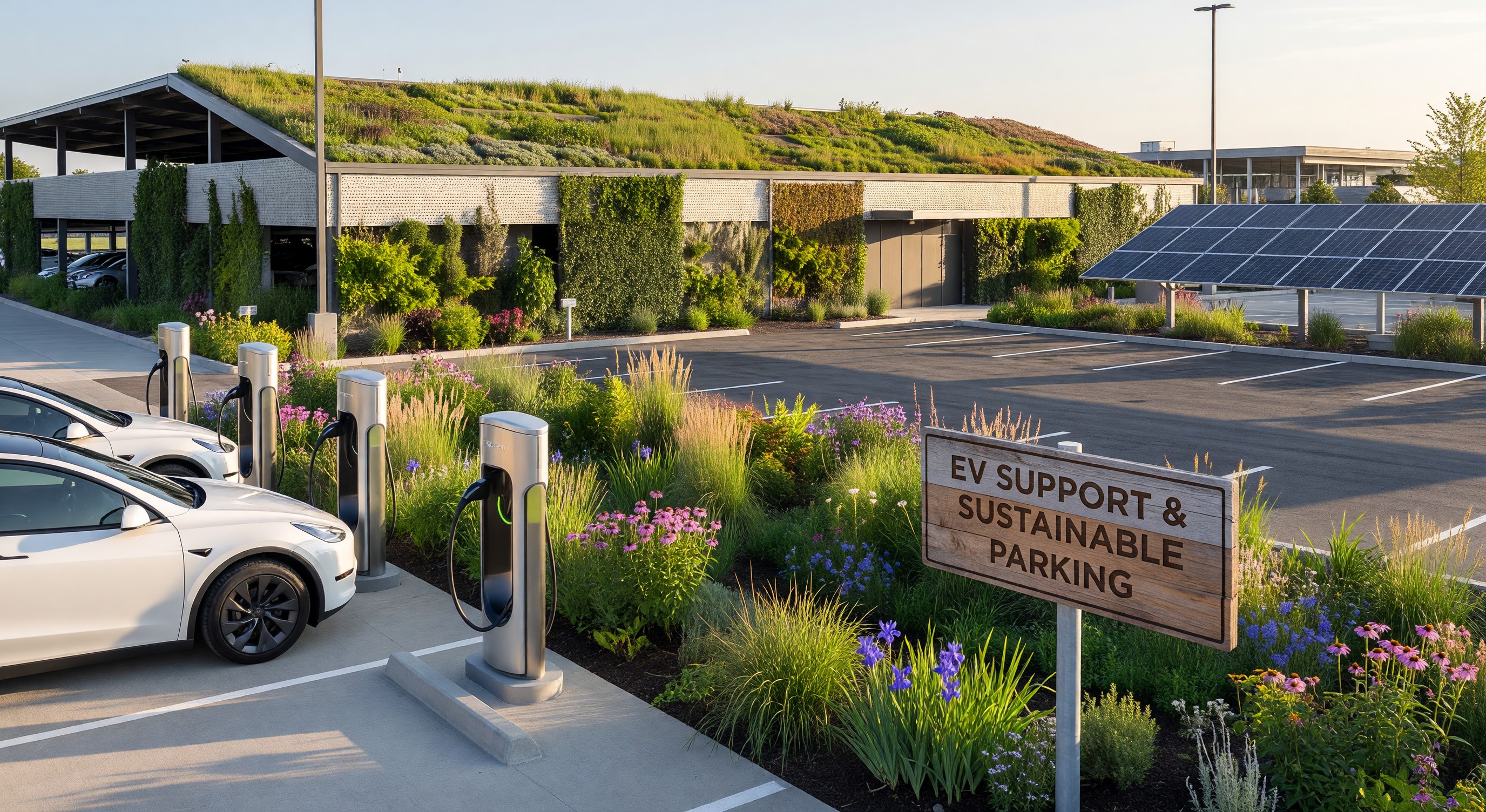
Parking facilities have historically been among the least environmentally friendly elements of the built environment — impervious surfaces that generate stormwater runoff, energy-intensive lighting systems, and infrastructure primarily designed to maximize vehicle accommodation. The sustainability imperative facing real estate and facility management has created both challenges and opportunities for parking operators who are willing to rethink their environmental footprint.
This guide covers the major sustainability dimensions of parking facility management and the practical strategies for improving environmental performance.
The Environmental Footprint of Parking Facilities
Understanding the environmental impact of parking facilities is the starting point for reduction.
Impervious surface and stormwater: A typical surface parking lot is 95 to 100 percent impervious — it generates nearly all of its rainfall as runoff, laden with vehicle fluids, heavy metals, and other pollutants. For comparison, a forested site generates less than 10 percent of rainfall as runoff. The stormwater burden of parking is one of the most significant environmental impacts of the built environment.
Energy consumption: Parking garages are energy-intensive operations. Lighting systems (often running 24/7), mechanical ventilation in enclosed structures, elevator systems, and revenue control equipment all draw power continuously. A typical enclosed parking structure consumes 8 to 15 kBtu per square foot annually.
Urban heat island contribution: Dark asphalt surfaces absorb solar radiation and re-radiate it as heat, contributing to urban heat island effects. Surface temperatures on asphalt parking lots can exceed ambient air temperatures by 20 to 40 degrees on hot summer days.
Vehicle emissions concentration: Enclosed parking structures concentrate vehicle exhaust. The CO and particulate matter from vehicles idling during entry, exit, and parking are a localized air quality concern.
LEED Credits Available for Parking Facilities
LEED (Leadership in Energy and Environmental Design) certification for parking facilities recognizes sustainable design and operations practices. Key credit categories relevant to parking:
Sustainable Sites: Credits for reduced parking footprint, alternative transportation support (bicycle facilities, EV charging, transit access), reduced heat island effect (light-colored pavement, shading, green roofs), and stormwater management.
Water Efficiency: Credits for stormwater capture and reuse, pervious pavement systems, and green infrastructure that reduces runoff.
Energy and Atmosphere: Credits for LED lighting with controls, demand-controlled ventilation, renewable energy, and energy management systems.
Innovation: Credits for exemplary performance on other credits and novel sustainability strategies.
For parking facilities that are part of LEED-certified buildings, parking operations contribute to the overall certification. Standalone parking structures can pursue LEED Core and Shell or LEED for Existing Buildings: Operations and Maintenance certification.
Energy Efficiency Strategies
Energy efficiency is the most accessible sustainability strategy for most parking facility managers because it reduces costs while reducing environmental impact.
LED lighting: LED retrofit is the single highest-impact energy reduction available for most parking facilities. See detailed guidance in the maintenance section on LED lighting. A full LED retrofit with occupancy controls typically reduces lighting energy by 60 to 75 percent.
Demand-controlled ventilation: For enclosed garages, CO sensor-controlled ventilation reduces ventilation energy by 50 to 70 percent compared to constant-speed operation. This strategy is both energy-efficient and LEED-creditable.
Solar PV on canopy structures: Surface lots with canopy structures over parking can support solar photovoltaic installations that generate renewable electricity. The canopy provides vehicle shade while generating power. PV installations on parking canopies have become a standard sustainability strategy in sun-belt markets.
Green power procurement: Purchasing renewable energy certificates (RECs) or entering power purchase agreements (PPAs) for renewable energy addresses Scope 2 emissions without physical changes to the facility.
Stormwater Management Improvements
Reducing the stormwater impact of parking facilities requires investment in green infrastructure, but the environmental benefit is substantial.
Permeable pavement: Permeable asphalt, permeable concrete, and permeable paver systems allow rainfall to infiltrate rather than running off. These systems are appropriate for lower-traffic areas (parking stalls rather than drive aisles, where the structural load is lower and maintenance is easier). Permeable pavement systems require regular maintenance (vacuuming of the permeable surface to prevent clogging) to maintain infiltration performance.
Bioretention cells and rain gardens: Landscaped depressions within or adjacent to parking areas that collect and infiltrate runoff. Bioretention areas remove pollutants through filtration and biological activity. They can be designed as landscape features that enhance visual quality while managing stormwater.
Tree canopy: Tree planting in and around parking facilities reduces impervious surface runoff, provides shade that reduces heat island effect, and sequesters carbon. Proper species selection and tree pit design ensure trees survive and thrive in the harsh parking environment.
Green roofs on parking structures: Parking garage roofs offer large impervious surface areas that can be converted to vegetated roofs, significantly reducing stormwater runoff, adding habitat, and reducing heat island effect.
Electric Vehicle Infrastructure
EV charging infrastructure is the parking industry’s most direct connection to the clean energy transition. Facilities with robust EV charging support accelerate the adoption of EVs among their users.
Sustainability-focused EV charging considerations:
Renewable energy sourcing for EV charging: EV charging powered by renewable energy (on-site solar or green tariff procurement) eliminates the vehicle tailpipe emission but also minimizes grid emissions from the charging itself.
Smart charging and grid integration: Networked EV chargers that participate in utility demand response programs can reduce charging during peak grid periods, lowering both cost and grid stress. This is one of the highest-value smart grid applications in commercial real estate.
Fleet charging programs: Organizations that operate vehicle fleets on-site benefit from fleet-specific charging infrastructure and management. Overnight charging during off-peak hours minimizes grid impact and reduces energy costs.
Reporting and Benchmarking Environmental Performance
Sustainability performance is increasingly tracked and reported by corporate real estate portfolios, REITs, and institutional property owners. Parking facilities that are part of these portfolios need to contribute to sustainability reporting.
ENERGY STAR Portfolio Manager: EPA’s ENERGY STAR Portfolio Manager provides benchmarking for commercial properties including parking facilities. Tracking energy use intensity (kBtu/sf/year) over time documents efficiency improvements.
GRESB reporting: The Global Real Estate Sustainability Benchmark (GRESB) is widely used by institutional real estate investors to assess portfolio sustainability. Parking facilities that are part of GRESB-reporting portfolios should track energy, water, waste, and carbon metrics.
GHG accounting: Scope 1 (direct emissions from natural gas or other on-site combustion), Scope 2 (purchased electricity), and Scope 3 (vehicle emissions from tenants and customers) can all be tracked for parking facilities. While Scope 3 is difficult to reduce directly, tracking it demonstrates awareness of the full environmental picture.
FAQ
Can a surface parking lot achieve meaningful sustainability improvements without major capital investment? Yes. LED lighting retrofits, oil-water separator maintenance, stormwater sweeping practices, and sustainable deicing practices are all achievable without major capital expenditure and make real environmental improvements. The high-impact green infrastructure strategies require capital but can be phased.
What is the payback period for a solar canopy over a parking lot? Payback periods for solar canopy installations currently range from 5 to 12 years depending on electricity rates, available incentives, and project costs. In markets with high electricity rates and strong solar incentives, paybacks of 5 to 7 years are achievable. Federal Investment Tax Credits (ITC) for solar installations are currently available at 30 percent of installed cost for commercial projects.
Are permeable pavement systems appropriate for cold climates? Yes, with proper design. Permeable pavement in cold climates requires: adequate sub-base depth to prevent frost heave damage, careful design of subsurface drainage, and consideration of deicing practices (some deicing chemicals can degrade permeable pavement systems). Consult with a civil engineer experienced in cold-climate permeable pavement for design guidance.
Does LEED certification for parking make financial sense? LEED certification for standalone parking facilities is less common than for mixed-use or office developments because the marketing benefit to parking operations is more diffuse. However, participation in the broader campus or portfolio sustainability program is valuable for institutional and corporate real estate owners. Evaluate the cost and benefit of formal certification against the value it delivers in your specific portfolio context.
Further Reading from Authoritative Sources
- EPA green infrastructure and parking lot stormwater management resources — epa.gov is on the whitelist and EPA’s green infrastructure and ENERGY STAR resources are directly cited in this article’s sustainability guidance for parking facility operators.
- U.S. Department of Energy commercial building energy efficiency and solar resources — energy.gov is on the whitelist and the DOE’s commercial building energy resources directly support the energy efficiency and solar canopy content in this article on parking sustainability.