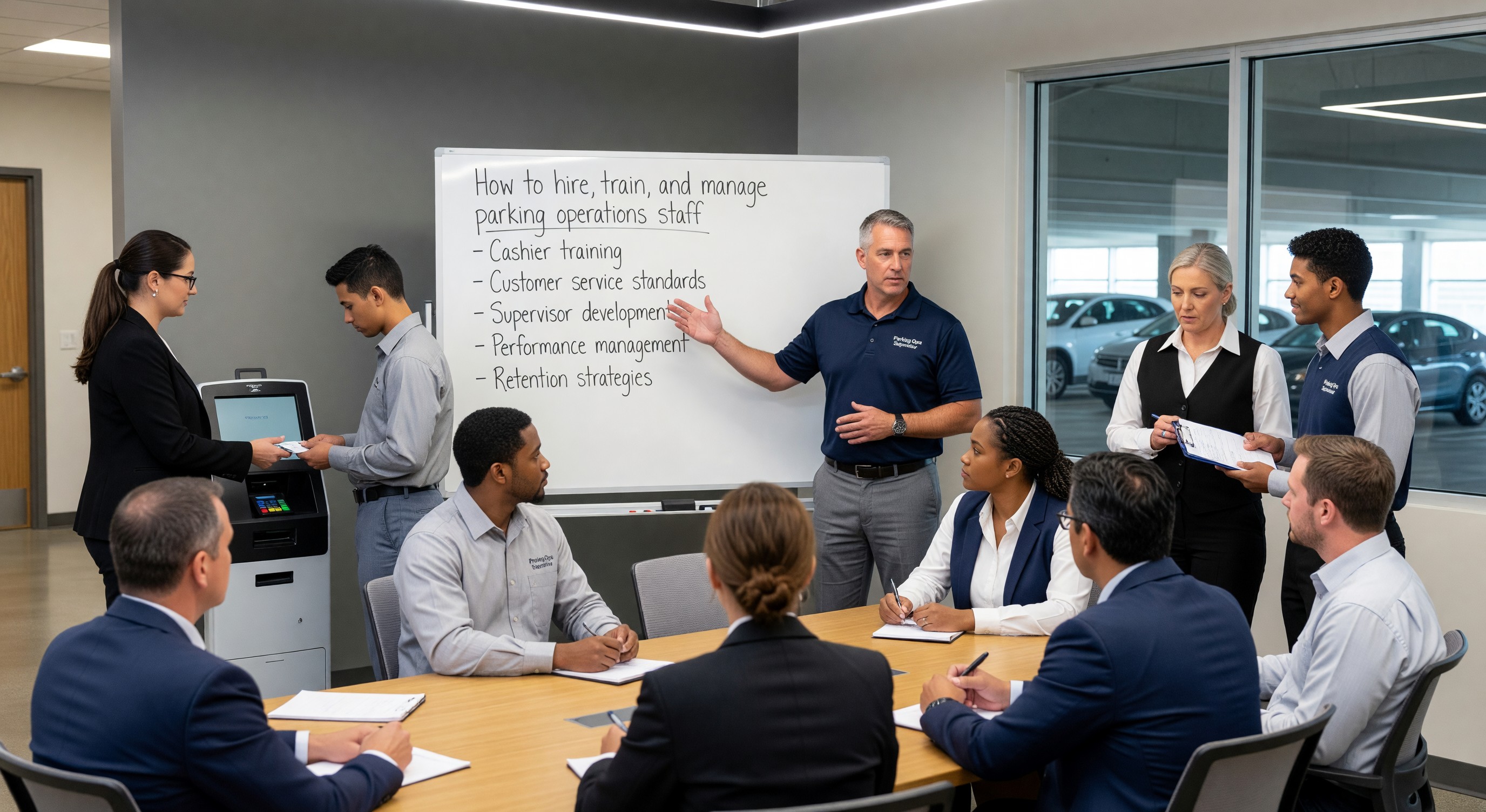
Parking operations are a customer-facing business. The quality of the staff who interact with customers, operate equipment, manage revenue, and handle incidents shapes the customer experience in ways that no amount of technology investment can substitute for. Facility managers who invest in staff selection, training, and retention outperform peers on customer satisfaction, revenue capture, and operational reliability.
This guide covers the human resources fundamentals specific to parking operations — from hiring criteria through ongoing performance management.
Defining Parking Staff Roles
Parking operations encompass several distinct roles with different requirements:
Cashier/Attendant: The front-line customer service role. Cashiers process transactions, assist customers, answer questions, and are the primary human contact for the parking experience. Skills required: cash handling accuracy, customer service demeanor, comfort with technology (PARCS interfaces), basic problem-solving.
Booth Supervisor / Shift Lead: Oversees cashiers during a shift, handles escalated customer issues, manages equipment problems, and ensures operational continuity. Skills required: leadership, problem-solving, escalated customer interaction, equipment troubleshooting basics.
Enforcement Officer: Monitors compliance, issues citations, manages unauthorized parking situations, and interacts with customers around enforcement. Skills required: conflict management, documentation accuracy, knowledge of applicable regulations.
Operations Manager: Oversees the day-to-day operation, manages staff, coordinates maintenance, manages financial reporting, and interfaces with building management and ownership. Skills required: management, financial reporting, vendor management, operational planning.
Hiring for Parking Operations
The best predictor of customer service performance in parking operations is prior customer service experience, not parking experience. Most PARCS operations can be taught; patience with frustrated customers, comfort with conflict, and consistent professional demeanor are harder to develop.
Interview screening: Ask behavioral questions about past customer service situations. “Tell me about a time when a customer was upset about something that wasn’t your fault, and how you handled it” reveals more about customer service aptitude than any technical question.
Background verification: Cash-handling positions require criminal background checks. Driving positions (valet) require motor vehicle record checks. These are non-negotiable minimum screening requirements.
Reference checks: Call prior employer references. Ask specifically about reliability, customer interaction, and cash handling. References who give enthusiastic, specific positive answers are more useful than those who confirm employment dates.
Shift availability: Parking operations often require coverage during early mornings, evenings, weekends, and holidays. Confirm availability for required shifts during the hiring process.
Training Programs for Front-Line Staff
New hire training for parking cashiers should cover:
PARCS system operation: Hands-on training with the specific equipment and software in use. How to process transactions, issue validations, handle exceptions (lost tickets, payment failures, requests for supervisor), and access basic reports.
Cash handling procedures: How to make change, process end-of-shift reports, handle discrepancies, and secure cash during the shift. This training should be documented and verified — untrained cash handling is a primary source of revenue discrepancy.
Customer service standards: What does professional customer interaction look like? How should staff greet customers? How do they handle complaints? What tone is appropriate for enforcement situations? Document your service standards and train to them explicitly — don’t assume staff will infer them.
Emergency procedures: What to do in a medical emergency, fire, security incident, or active threat. Staff should know who to call, how to communicate with emergency services, and what their specific responsibilities are in each scenario.
ADA and accessibility obligations: Front-line staff must understand accessible parking requirements and handle accommodation requests appropriately. Training should address how to assist customers with disabilities without assumptions or condescension.
Ongoing Training and Development
Initial training establishes competency; ongoing training maintains and develops it.
Quarterly refreshers: Brief (30 to 60 minute) training sessions on specific topics — updated equipment procedures, customer service scenarios, seasonal topics (winter safety, peak season protocols) — maintain skill currency without requiring extensive off-shift time.
Peer observation and feedback: Pairing experienced and new staff for observation periods provides real-world learning opportunities. Structured feedback after observation sessions (what the new staff member did well, what to develop) is more valuable than generalized praise.
Cross-training: Staff who can work multiple roles — cashier and enforcement, booth and administrative — are more flexible and have higher job satisfaction than single-role staff. Cross-training programs develop this flexibility.
Performance Management
Effective performance management in parking operations requires metrics that staff can see and influence.
Customer service metrics: Customer satisfaction scores from post-visit surveys, complaint rates, and compliment rates per shift provide objective customer service data. Share these with staff regularly.
Transaction accuracy: Cashier transaction error rates (cash overages or shortages, system entry errors) should be tracked individually. Address persistent inaccuracy early — it may indicate training gaps, process problems, or integrity concerns.
Attendance and reliability: Reliable attendance is essential in an operation that requires coverage. Track attendance patterns and address reliability issues consistently.
Feedback conversations: Regular one-on-one conversations (monthly for new staff, quarterly for experienced staff) between supervisors and front-line employees provide ongoing coaching, surface concerns before they become problems, and maintain engagement.
Retention: Reducing the Cost of Turnover
Turnover in parking operations is often high because the work is challenging, schedules are non-standard, and starting wages are modest. The cost of turnover — recruiting, hiring, training, and the productivity loss during learning curves — is real and often underestimated.
Retention strategies that work in parking operations:
Schedule consistency: Staff who can count on consistent schedules can manage personal commitments and are more likely to stay. Chronic unpredictability in scheduling is a leading driver of turnover.
Recognition: Acknowledge excellent customer service, perfect attendance, and reliability explicitly and specifically. Public recognition in team settings has disproportionate impact relative to cost.
Promotion pathways: Staff who see a path to supervisory or management roles are more likely to develop professionally and stay. Define promotion criteria explicitly — don’t leave advancement to guesswork.
Competitive wages: Review wages relative to local market for customer service and cash-handling roles. If you are paying below market, you are recruiting from the pool of candidates who could not find other work.
FAQ
How do I handle staff who are consistently rude to customers despite coaching? Document specific incidents, provide feedback with documented expectations, and apply a progressive discipline process. Staff who cannot meet customer service standards after coaching and documented opportunity to improve should not remain in customer-facing roles. Retaining staff who consistently damage customer relationships is more expensive than the cost of replacement.
Should parking staff be employees or independent contractors? In most parking operations, front-line staff are legally employees, not independent contractors, under IRS multi-factor tests. Misclassifying employees as independent contractors creates significant legal exposure. Consult employment counsel if your current classification is uncertain.
What is a reasonable target for cashier transaction accuracy? Most parking operations target cash overages and shortages of $5 or less per shift as acceptable variance. Consistent variances above $10 to $15 per shift warrant investigation. Zero-tolerance policies for any variance are counterproductive — small variances are inevitable in cash handling; the target is accuracy, not perfection.
How do I deal with staff on unusual shifts (overnight, holidays) who are isolated and may feel overlooked? Proactive communication from management — regular check-in calls, visits during unusual shifts, recognition of the sacrifice unusual hours require — maintains engagement among staff who work when management is not present. Overnight and holiday staffing that feels forgotten will tell you through their departure.
Further Reading from Authoritative Sources
- International Parking and Mobility Institute parking staff training resources — parking-mobility.org (IPMI) is on the whitelist as the primary parking industry authority and the source for the industry’s primary professional training and certification programs referenced in this article.
- BOMI International staff training and development resources for facility managers — bomi.org is on the whitelist as a facility management authority whose training and staff development resources complement IPMI’s parking-specific training content.