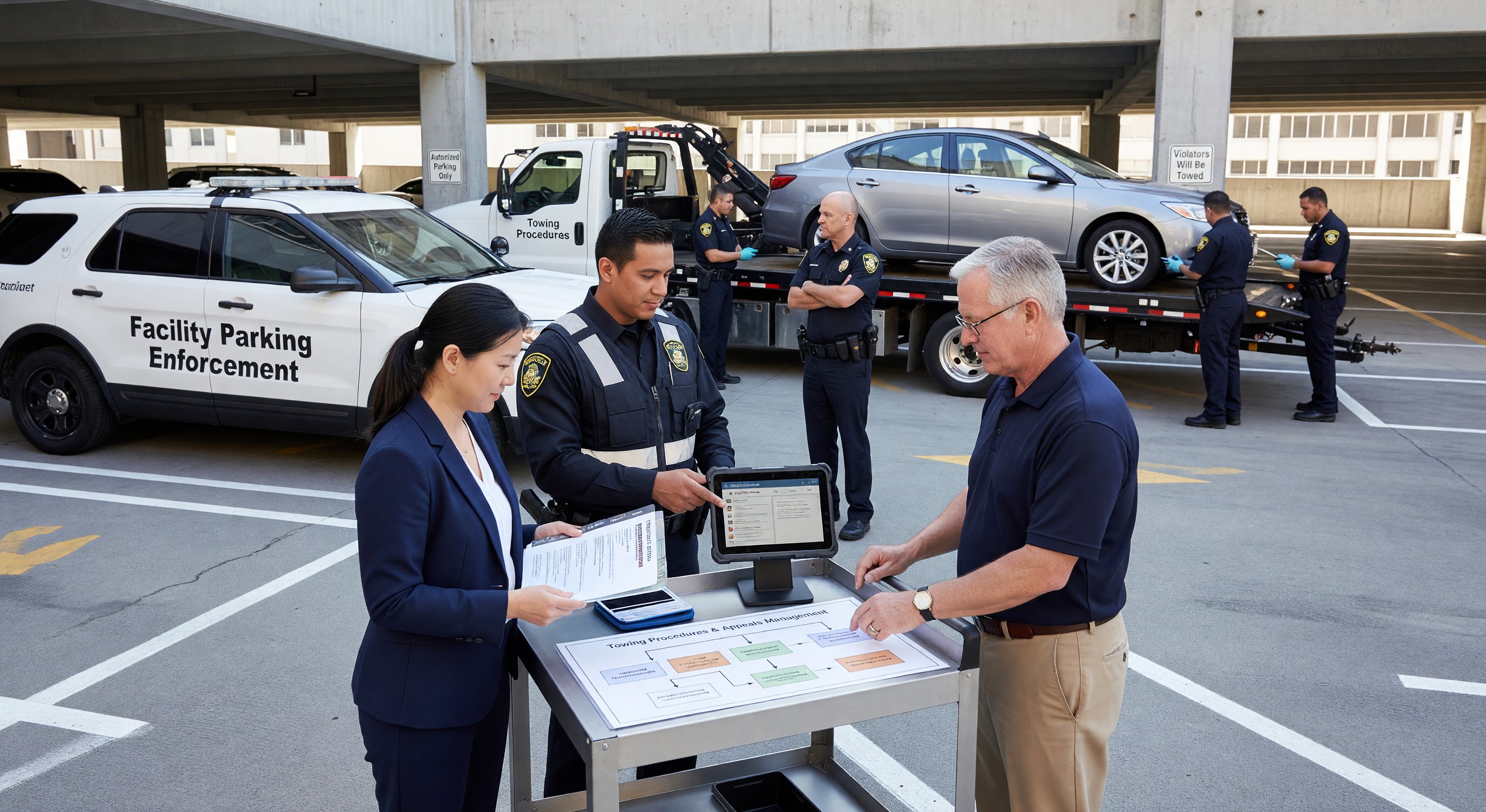
Parking enforcement is one of the most politically sensitive aspects of facility parking management. Enforce too aggressively and you create customer complaints, tenant friction, and a reputation for punitive management. Enforce too leniently and unauthorized parking consumes spaces that paying customers and permit holders need, revenue leaks, and the rules lose credibility.
The goal of parking enforcement is not maximum revenue from citations — it is behavior modification. An enforcement program that changes parking behavior, directs vehicles to authorized spaces, and protects the access rights of permit holders and paying customers has achieved its objective whether or not citations are issued.
Building an Enforcement Policy Foundation
Before deploying enforcement tools, establish a written enforcement policy that defines what is enforced, how, by whom, and with what consequences. An enforcement policy that exists only in the parking manager’s head is inconsistently applied and difficult to defend when disputes arise.
Key policy elements:
Violations subject to enforcement: Which rule violations result in enforcement action? Time limits exceeded, parking in unauthorized zones, accessible space violations without appropriate credentials, blocking access aisles, fire lanes, and loading zones are standard enforcement subjects.
Enforcement response by violation type: Not all violations warrant the same response. A fire lane violation (immediate hazard) warrants immediate towing authority. A time limit violation on a first offense might warrant a warning. Define the response for each violation type.
Authorized enforcement personnel: Who is authorized to issue citations? Who has authority to initiate a tow? Clear role definitions prevent unauthorized action and establish the chain of authority if disputed.
Appeals process: Define a fair, accessible appeals process with clear timelines and decision criteria. Published appeals criteria protect the process from arbitrary outcomes.
Staffed vs. Automated Enforcement
Enforcement can be staffed (personnel patrol on foot or in vehicles) or automated (LPR systems check plates against authorized lists) or a combination.
Staffed enforcement provides flexibility — an enforcement officer can exercise judgment, observe context, and handle situations that automated systems cannot. Staffed enforcement is appropriate for high-complexity environments where context matters and for facilities where human interaction with customers is valued.
Staffed enforcement costs more than automated enforcement at high citation volumes but provides capabilities that automated systems cannot: physical removal of blocking vehicles, communication with drivers, and contextual judgment.
LPR-based automated enforcement significantly increases enforcement throughput. A vehicle-mounted LPR system can scan hundreds of plates per hour — far more than a pedestrian officer. LPR-based permit verification (checking parked plates against the permit list) is particularly effective in large facilities with high permit volumes.
For time-limit enforcement, LPR-based systems record plates with timestamps and flag vehicles that appear in the same location beyond the time limit. This eliminates the chalk-marking labor of traditional time-limit enforcement.
Citation Programs: From Warning to Towing
A citation program should have escalating consequences for repeated violations:
Warning (first offense): A written notice that documents the violation and communicates the consequences of future violations. Warnings modify behavior without the financial penalty that generates the most customer friction.
Citation: A monetary penalty for the violation. Citation amounts should be set at a level that deters the behavior without being perceived as predatory. In competitive commercial parking markets, $30 to $75 for standard violations and $100 to $250 for accessible space violations are typical ranges.
Citation plus towing (repeated or egregious violations): Vehicles that repeatedly violate, or that are in immediate-hazard locations (fire lanes, blocking access), should be subject to towing. Towing authority requires compliance with state towing law requirements, including signage.
Collection: Citations that are not paid require a collection process. Many commercial parking programs send a follow-up letter, then refer to a collection agency for persistent non-payers. For facilities using LPR, unpaid citations can be linked to the plate, creating a boot or tow-on-return consequence.
LPR System Implementation for Enforcement
Deploying LPR for enforcement requires technical setup, policy decisions, and staff training.
Permit database management: The LPR system is only as effective as the permit database it checks against. Maintain the permit list with current plates, remove departed permit holders promptly, and add new permit holders before they begin parking.
Scan frequency: LPR enforcement for time limits requires multiple scans of the same area. Define the minimum time between scans that constitutes a time limit violation. Most programs scan each area every 30 to 60 minutes.
Operator training: LPR systems flag potential violations; enforcement officers must exercise judgment on each flag. Training on how to review alerts, verify violations, and issue citations accurately reduces both errors and disputes.
Privacy compliance: LPR systems collect license plate data that may be subject to state privacy laws. Establish a data retention policy, limit access to LPR data to authorized enforcement personnel, and comply with any applicable state LPR regulations.
Towing Procedures and Legal Requirements
Towing from private property is regulated by state law in most U.S. states. Non-compliant towing creates legal liability for the property owner and the towing company.
Signage requirements: Most states require specific towing signage as a condition of towing authority. Requirements vary — size, content, placement, and notification of tow company contact information are common requirements. Review your state’s towing law before posting any enforcement signage.
Towing company selection: Work with a licensed, reputable towing company. Confirm that the company carries appropriate insurance, complies with state regulations for storage and notification, and handles customer interactions professionally. A towing company that releases vehicles to owners in a contentious way generates complaints that reflect on your property.
Notification requirements: Most states require that the property owner or towing company notify local law enforcement when a vehicle is towed from private property. Comply with notification requirements to protect your towing authority.
Vehicle release procedures: Establish clear procedures for vehicle release: where vehicles are stored, what documentation is required, what fees are charged, and how disputes are handled. These procedures should be posted on your signage and on your facility website.
Managing Enforcement Customer Relationships
Enforcement interactions carry higher emotional stakes than routine parking transactions. A well-handled enforcement interaction maintains the customer relationship; a poorly handled one creates public complaints and reputation damage.
Train front-line staff on customer interaction. Enforcement personnel who are trained to de-escalate, acknowledge frustration, and communicate the appeals process clearly handle conflicts better than those who are defensive about citations.
Make appeals easy. An online appeals form, clearly referenced on the citation itself, reduces the friction of the appeals process and demonstrates commitment to fairness. Process appeals promptly — within 5 to 10 business days.
Review enforcement patterns. Quarterly analysis of citation data — where citations are being issued, for what violations, and whether repeat violators are being addressed — allows you to identify systemic issues and calibrate enforcement intensity.
FAQ
Can I tow a vehicle from my parking facility without any warning? In most states, fire lane and blocking violations allow immediate towing. For time limit and unauthorized zone violations, most states require posted signage but not individual warnings. Verify your state’s requirements for each violation category. Immediate towing without adequate legal basis creates liability.
What should I do if a towed vehicle owner disputes the tow? Provide documentation of the violation (LPR photograph with timestamp, or citation documentation). Direct the owner to your appeals process. Maintain a professional tone. If the documentation reveals an error on your part, offer to reimburse the towing fee. Winning a $150 towing dispute at the cost of a public review that reaches hundreds of potential customers is not a win.
How do I handle accessible space enforcement without violating disability rights? Enforce consistently — non-disabled drivers in accessible spaces are the target. Verify absence of a valid accessible parking placard or plate before issuing a citation. If there is any reasonable indication of disability (even if no visible placard), a courtesy inquiry is appropriate before enforcement. State DMV records can be queried (with appropriate authorization) to verify placard validity if presented.
Is it worth enforcing minor violations like over-the-line parking? Only if the over-the-line parking is interfering with other spaces. Minor parking position issues that do not affect adjacent spaces are better addressed with information (a note on the windshield) than with formal enforcement action. Reserve enforcement tools for violations that actually affect other users.
Further Reading from Authoritative Sources
- International Parking and Mobility Institute parking enforcement resources — parking-mobility.org (IPMI) is on the whitelist as the primary parking industry authority with directly relevant enforcement program content for facility managers.
- ADA.gov accessible parking enforcement guidance — ada.gov is on the whitelist and provides the DOJ’s guidance on accessible parking enforcement that is directly relevant to the accessible space enforcement section of this article.