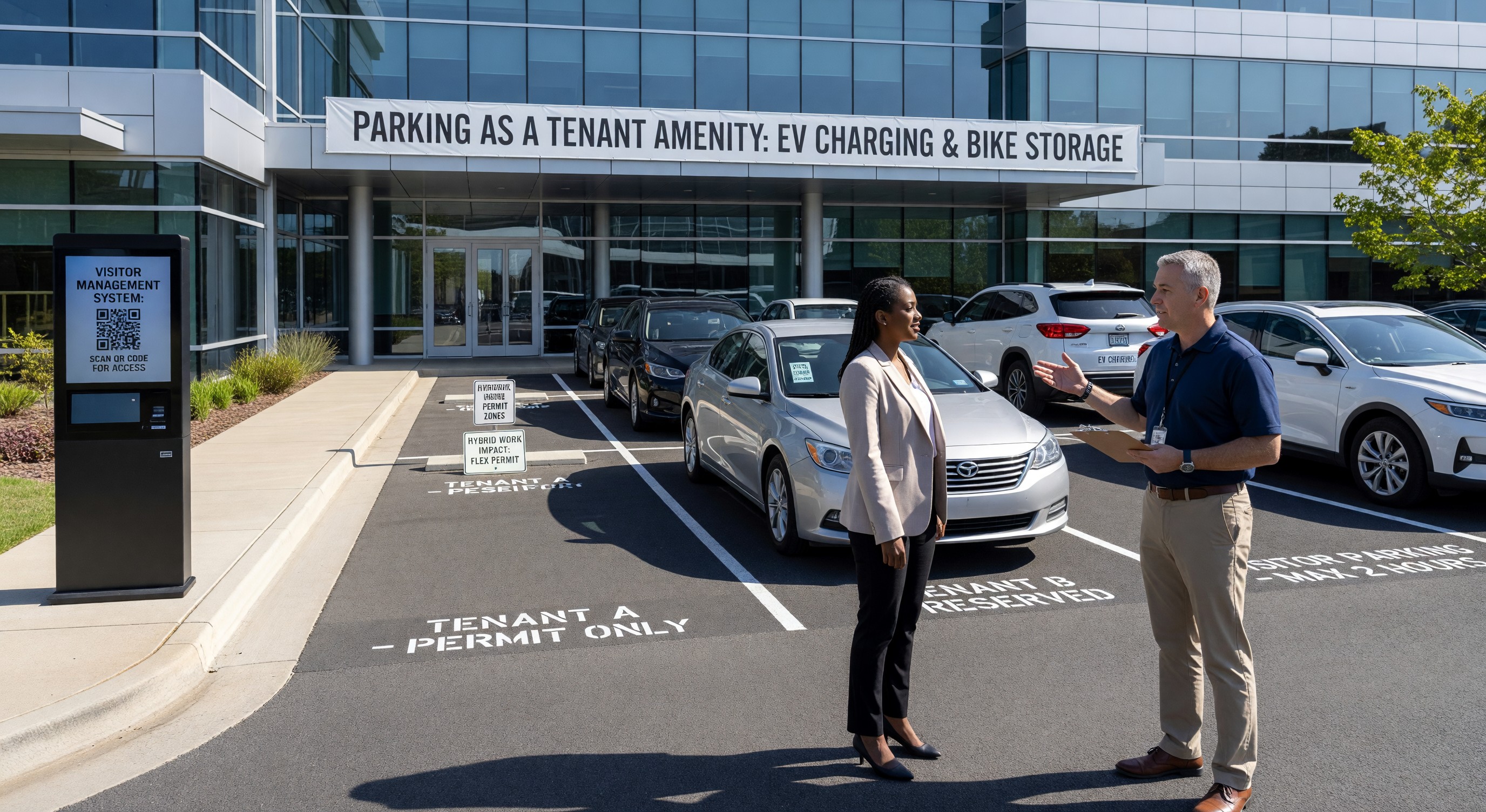
Office building parking management has changed significantly in the post-pandemic era. The shift to hybrid work schedules has transformed parking utilization patterns, creating opportunities to capture revenue from spaces that previously sat empty and challenges to right-size permit programs for demand that is no longer predictable on a Monday-to-Friday basis.
Understanding the new normal of office parking — and the enduring principles that apply regardless of hybrid trends — enables property managers to maximize parking revenue while maintaining the tenant relationship that keeps office buildings competitive.
The Hybrid Work Impact on Office Parking
Hybrid work has reduced average daily parking demand at office buildings nationally. The degree varies by market and by tenant type, but most office properties have seen a meaningful shift in parking utilization patterns.
The critical insight is that peak parking demand has not declined proportionally to average demand. Many organizations with hybrid policies have converged on Tuesday through Thursday as in-office days, creating peaks on those days that approach or exceed pre-pandemic levels while Monday and Friday are substantially lower.
This pattern has several implications for parking management:
Permit inventory management: Selling monthly permits at 120 percent of capacity (a common pre-pandemic practice based on predictable absence rates) may cause problems if hybrid work concentrations peak above the statistical absence assumption.
Day-of-week pricing opportunity: With lower Monday and Friday demand, time-of-day or day-of-week pricing can capture revenue from casual transient users on slow days while maintaining permit value on peak days.
Flexible parking products: Hybrid workers who are in the office only 3 days per week may not need a full monthly permit. Part-week permit products (3-day permits at a proportional rate) or day-pass products that allow casual access reduce barriers to paying for parking without requiring a full monthly commitment.
Tenant Parking Allocation and Lease Management
In multi-tenant office buildings, parking allocation is typically governed by the lease. Property managers must balance the contractual parking commitments in individual leases against the physical parking inventory.
Parking ratio tracking: Maintain a current ledger of parking ratios committed in each lease: number of spaces, type (reserved/unreserved), and pricing. This document is the authoritative record for resolving disputes and planning for lease renewals.
When demand exceeds allocation: If tenants are asking for more parking than their lease ratio provides, this is an upselling opportunity. Additional parking at a premium price serves the tenant’s need while generating additional revenue.
Lease renewals as reset opportunities: At lease renewal, parking can be renegotiated to reflect current market rates, updated space allocations, and new product types (reserved, flex, EV-equipped). Proactive renewal conversations about parking, rather than defaulting to prior terms, capture value.
Visitor Parking Management
Visitor parking creates operational complexity in office buildings: visitors need convenient access without a permit, but the visitor parking supply must not be consumed by employees exploiting the visitor designation.
Visitor validation systems allow building management to provide visitor parking access without creating an uncontrolled demand on the parking supply. Validation should require a tenant authorization — a specific employee or tenant vouching for the visitor.
Time limits for unvalidated visitor parking: In buildings where some transient visitor access is available without validation, time limits (typically 2 to 3 hours) prevent abuse while accommodating genuine short visits.
Visitor parking supply allocation: Reserve a specific number of spaces as visitor spaces in your most accessible parking area. Maintain these spaces for visitor use through enforcement — a building entrance with visible, available visitor parking sends a professional signal.
Parking as a Tenant Amenity
In competitive office markets, parking quality can be a differentiator in tenant acquisition and retention. Parking amenities that move the needle include:
EV charging availability. The fastest-growing amenity request from office tenants in survey after survey. A building with EV charging supports employees who drive EVs and signals environmental commitment that aligns with tenant sustainability goals.
Reserved parking programs. Senior executives, clients, and high-value employee groups benefit from reserved parking that eliminates arrival anxiety. Reserved programs generate premium revenue and are consistently viewed as high-value by the users.
Digital access and mobile payment. Parking that integrates with a mobile app — entering without a physical credential, managing permit billing online, receiving real-time availability information — improves the experience for tech-savvy tenants.
Secure bicycle parking. High-quality, covered, secured bicycle parking accommodates cycling commuters, which is a growing segment in many urban markets.
Parking Operations During Major Tenant Events
Office buildings occasionally host large tenant events — all-hands meetings, recruiting days, investor days — that can overwhelm normal parking operations. Proactive coordination prevents chaos.
Request advance notice from tenants for events that will significantly exceed normal parking demand. The notice provides time to activate overflow areas, coordinate traffic management, and communicate with other building tenants about the expected congestion.
For high-profile events, temporary parking staff or clear signage directing overflow traffic to secondary parking areas prevents the disorganized queue at the building entrance that reflects poorly on the property.
FAQ
How should I handle a tenant who consistently uses more parking spaces than their lease provides? Address directly with the tenant’s facility or property contact. Confirm the lease allocation, document the overuse, and present options: comply with the lease allocation, or formalize additional parking at the appropriate additional charge. Chronic overuse without resolution is both a lease compliance issue and a fairness issue to other tenants whose allocated spaces may be affected.
Is it worth installing parking occupancy counting systems in a moderate-size office building? For buildings above 200 to 300 spaces with significant transient or visitor parking, occupancy counting systems pay for themselves through better utilization visibility and the ability to implement availability guidance that reduces customer frustration. For smaller buildings with primarily permit-based parking, the investment may not be justified.
How do I set visitor parking rates? In most office buildings, visitor parking is either free (absorbed by the building) or charged at a modest rate designed to cover operating costs without creating a customer service issue. Visitor parking should not be a profit center — visitors to your tenants are indirectly your customers, and they remember their parking experience when they consider whether to visit again.
Should reserved spaces be priced by location or by level? Both factors are relevant. Spaces closest to elevator lobbies and building entrances command the highest premiums. In above-grade garages, level 1 spaces command a premium over upper levels. A tiered pricing structure that reflects both factors captures value while giving customers options.
Further Reading from Authoritative Sources
- BOMI International office building parking and lease administration resources — bomi.org is on the whitelist as a facility management authority whose office property management curriculum is directly relevant to the lease and tenant management content in this article.
- International Parking and Mobility Institute office building parking management resources — parking-mobility.org (IPMI) is on the whitelist and provides parking-specific content for the office building parking management challenges discussed in this article.