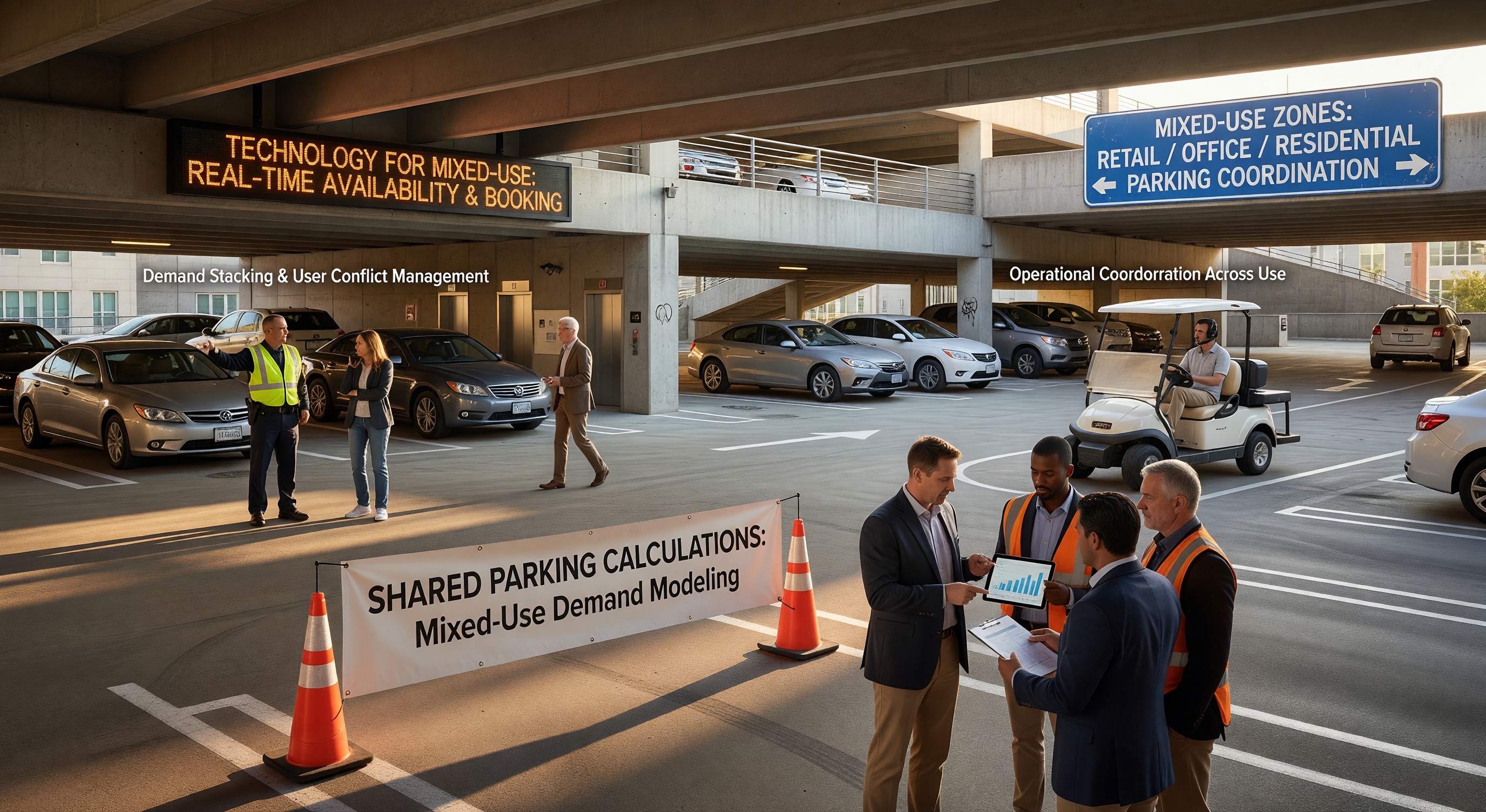
Mixed-use developments — combining retail, office, residential, hotel, or civic uses on a single site or in a single structure — create some of the most complex parking management challenges in facility management. The parking needs of each use are legitimate, they peak at different times, and they must be accommodated in a shared infrastructure that serves all uses simultaneously.
When mixed-use parking is managed well, the shared-use efficiencies reduce the total parking required compared to independently designed facilities for each use. When managed poorly, conflicts between user groups, enforcement failures, and capacity imbalances create friction that affects the entire development.
The Shared Parking Principle
The efficiency opportunity in mixed-use parking derives from demand complementarity — the fact that different uses peak at different times.
A classic example: a retail center peaks on Saturday afternoon when its office component is empty, while the office component peaks on weekday mornings when retail is at off-peak. A parking supply that would need to be X spaces for retail alone plus Y spaces for office alone needs only Z spaces (where Z < X + Y) when the two uses share facilities, because their peaks do not fully overlap.
The ITE (Institute of Transportation Engineers) Shared Parking methodology provides the industry-standard framework for calculating shared parking demand. The methodology adjusts individual land use parking demands by time of day, day of week, and season, then sums the adjusted demands to calculate the maximum concurrent requirement.
Shared parking calculations require:
- Accurate unit counts for each use (square footage, seats, rooms, units as applicable)
- The ITE parking generation rates for each use category
- The time-of-day and day-of-week demand adjustment factors for each use
- Seasonal adjustment factors if applicable
The resulting analysis shows peak demand by hour for a typical weekday, Saturday, and Sunday, and identifies the total shared parking needed.
Operational User Conflict Management
Mixed-use parking works on paper when demand peaks are complementary. It fails operationally when users from one use appropriate parking needed by another use.
Common conflicts:
- Office employees arriving early occupying retail customer parking that will be needed later in the day
- Evening restaurant patrons occupying resident parking spaces
- Hotel guests using restricted office parking areas on weekends
Management tools for conflict prevention:
Physical designation: Designated zones for each use, with clear signage, LPR-based monitoring, and enforcement. When office-only spaces are physically separate from retail spaces and enforcement is consistent, appropriation is minimal.
Time-of-day designation: The same spaces serve different users at different times — office parking during business hours, available to restaurant patrons in the evening. Clear signage that communicates the time-of-day rules is essential; inconsistent or confusing signage is a leading cause of violations.
Residential reserved parking: Residents of mixed-use developments with parking expect reliable, protected access to their spaces. Reserved residential spaces with access-controlled gates or LPR-based management are standard in market-rate mixed-use residential.
Residential Parking in Mixed-Use Contexts
Residential parking in mixed-use developments carries higher sensitivity than commercial parking because residents’ relationship with their parking is contractual (often part of their lease or purchase agreement) and 24/7.
Separation from commercial parking: When possible, physically separate residential parking from commercial parking. A dedicated residential garage connected to residential lobbies that is inaccessible to retail and office users eliminates the most contentious conflicts.
Visitor parking for residential: Residential components need visitor parking that is accessible to visitors without dedicated credentials. Short-term spaces (typically 2 to 4 hours maximum) in commercial areas that are underutilized during evenings and weekends often serve this function effectively.
Guest access management: How do residential visitors access parking? Resident-issued visitor passes, kiosk-based validation, or mobile access credentials all provide visitor access without requiring permanent credentials or staffing. Define and communicate the visitor access process clearly to residents at move-in.
Technology for Mixed-Use Parking Management
Single-facility technology platforms designed for simple transient or permit parking may not handle the complexity of mixed-use operations. Evaluate technology platforms on their ability to:
Support multiple credential types simultaneously: Residential monthly permits, office monthly permits, retail validations, hotel folios, and transient pay-per-use must all coexist in the same system without conflicts.
Manage time-of-day designations: Spaces that serve different users at different times require a management platform that handles the transition without manual intervention.
Provide use-specific reporting: Financial reporting that attributes revenue and costs to each use component is necessary for lease reconciliation, shared cost allocation, and performance evaluation.
Handle validation complexity: Multiple validation programs from multiple uses (retail tenants providing 2-hour validation, hotel providing full validation to guests, office tenants providing visitor validation) require a platform that can manage concurrent programs with different rules.
Parking Allocation in Mixed-Use Leases
Mixed-use development leases create long-term parking obligations that facility managers must honor and track. Key lease provisions to manage:
Space count commitments: Each component’s lease should specify the parking spaces allocated to that use. Track against actual inventory continuously.
Cross-use parking rights: Leases for each use should address what access rights (if any) that use has to parking allocated to other uses during off-peak periods. Vague cross-use rights create operational and legal uncertainty.
Enforcement obligations: Each use typically has an obligation to direct its users (employees, residents, guests) to authorized spaces and to cooperate with facility enforcement. Include these obligations in lease language.
Shared cost allocation: Maintenance, utility, and management costs for shared parking facilities must be allocated among uses. Allocation methods (square footage of allocated spaces, parking ratio, actual usage) should be defined in each lease.
FAQ
How do I determine whether a mixed-use development has adequate shared parking? Use ITE shared parking methodology or engage a parking consultant to conduct a shared parking analysis. The analysis will show peak concurrent demand by hour and day and compare that demand to available supply. If peak demand approaches or exceeds supply, a capacity problem exists.
What should I do when a specific use is consistently overusing its allocation? Address directly with the offending tenant or use operator. Document the overuse with utilization data. Escalate through lease enforcement channels if informal resolution fails. Habitual overuse by one use displaces parking from another — it is a real lease compliance issue.
Can I change parking allocations among uses as demand patterns shift? Only if lease provisions allow it. Most leases fix parking allocations for the lease term. Proposed changes require tenant consent and formal lease amendment. For flexibility, include provisions in original leases that allow reallocation with mutual consent, and avoid overly rigid allocations that cannot respond to actual use patterns.
How does the hybrid work trend affect mixed-use parking? For developments with significant office components, hybrid work has reduced weekday office parking demand. This creates opportunities: underutilized weekday office spaces can be offered as flexible hourly parking to retail and food and beverage customers, generating incremental revenue and improving overall parking utilization. The operational change requires technology that supports hourly transient access to spaces otherwise designated for permits.
Further Reading from Authoritative Sources
- Institute of Transportation Engineers Shared Parking methodology for mixed-use developments — ite.org is on the whitelist and ITE’s Shared Parking methodology is directly referenced throughout this article as the industry standard tool for mixed-use parking demand analysis.
- NACTO urban mixed-use development and parking policy resources — nacto.org is on the whitelist and NACTO’s mixed-use development and parking policy content provides the urban design context for the shared parking management issues discussed in this article.