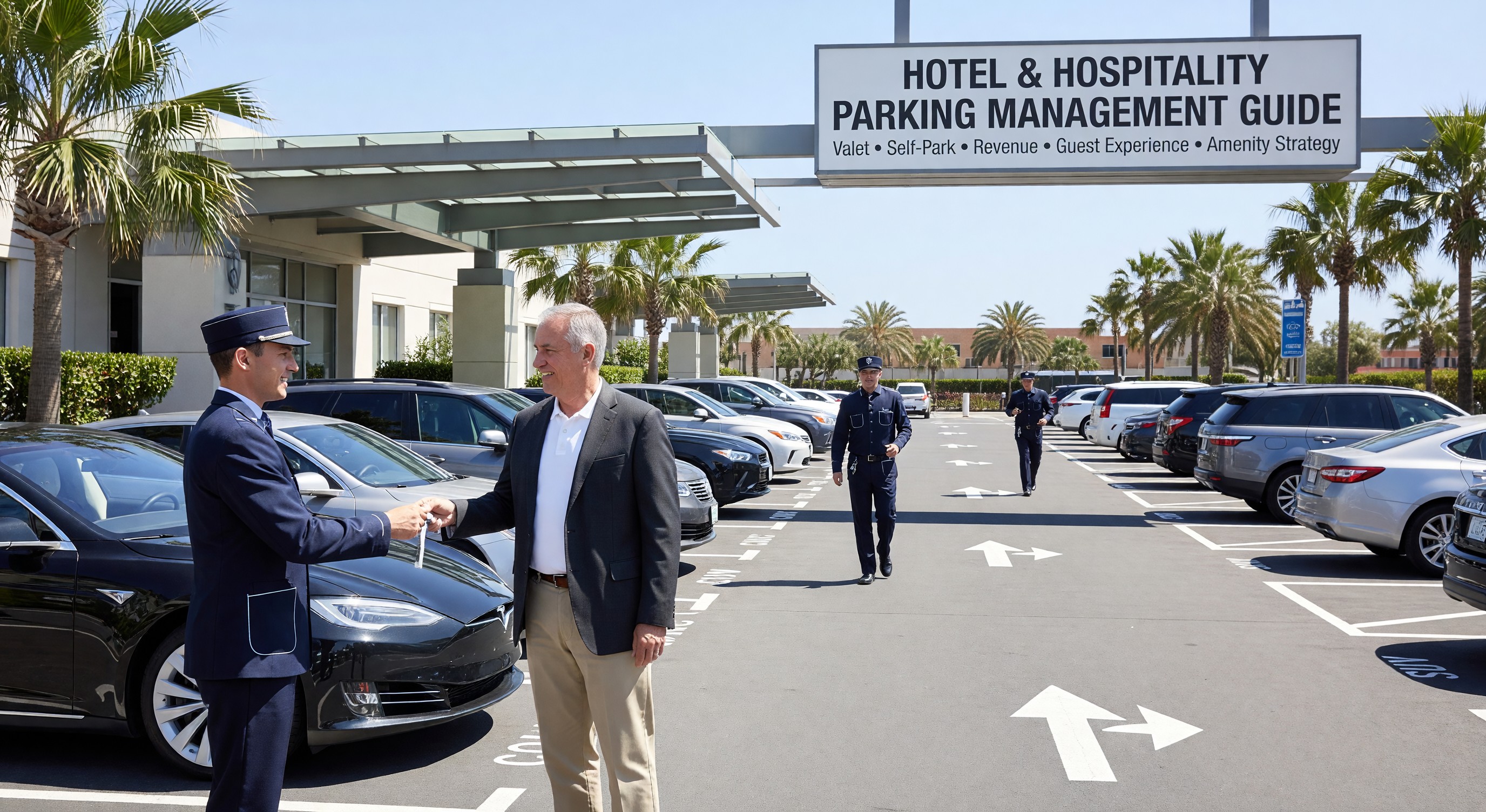
Hotel parking occupies a unique position in hospitality operations — it is both a guest service touchpoint that shapes the hotel experience and a revenue center that contributes meaningfully to property income. Hotels that manage parking well deliver a seamless arrival and departure experience while capturing revenue that makes a real difference to the property’s financial performance.
This guide covers the operational, financial, and guest experience dimensions of parking management for hotel and hospitality properties.
Understanding Hotel Parking Demand
Hotel parking demand is tied directly to occupancy and varies predictably with the hotel’s booking patterns, event calendar, and market.
Transient versus extended stay: A business traveler hotel with weekday-heavy occupancy has very different parking demand patterns than a resort hotel with extended leisure stays and consistent weekend occupancy. Understand your property’s occupancy patterns and how they translate to parking demand before designing your parking program.
Event-driven peaks: Hotels adjacent to convention centers, sports venues, or event facilities experience parking demand spikes that can exceed normal occupancy-driven demand. These events create revenue opportunities — but also crowd management challenges for guests trying to access the property.
Banquet and food and beverage guests: Guests using hotel banquet facilities, restaurants, and bars are not overnight guests but still need parking. Their parking demand peaks during the evening and on weekends, often complementing the weekday occupancy-driven demand of the hotel rooms.
Valet vs. Self-Park: Choosing the Right Model
The choice between valet parking, self-park, or a hybrid model has significant implications for cost structure, guest experience, and revenue.
Valet-only operations provide a premium arrival experience and allow tighter parking density — valet attendants can double- or triple-stack vehicles in ways that self-park cannot. Valet-only is appropriate for luxury properties, urban properties with very limited parking inventory, and properties whose brand positions around service excellence.
The cost structure of valet-only includes staffing (attendants, supervisors, dispatcher), insurance (garage keeper’s liability is essential — see the liability discussion below), and vehicle staging area maintenance.
Self-park operations eliminate attendant labor costs and place the parking experience in the guest’s hands. Self-park is appropriate for properties with adequate parking ratios, properties targeting cost-conscious travelers, and properties with physical layouts that support efficient self-park wayfinding.
Hybrid programs offer both options: valet for guests who want it, self-park for those who prefer it or want to pay less. Hybrid programs work well at hotels that serve mixed audiences — some business travelers who expense parking, some leisure guests managing travel budgets.
Hotel Parking Revenue Optimization
Parking revenue at hotels can be a significant income source. Urban properties in major markets can generate $20 to $60 or more per room per night in parking revenue. Even suburban hotels in moderate-rate markets may generate $8 to $15 per room per night.
Parking rate positioning: Hotel parking rates should be set relative to both self-park market rates for comparable facilities and the overall rate structure of the hotel. A $200-per-night hotel that charges $50 per night for parking sends a different message than a $300-per-night hotel that charges $45. Rate consistency with brand positioning matters.
Mandatory vs. optional parking fees: Some hotels bundle parking fees into the room rate (“resort fees” or equivalent); others charge separately. The mandatory bundling model guarantees parking revenue per occupied room but may increase price sensitivity among guests who don’t drive. Per-use charges are more transparent but require active management of guests who try to park without paying.
Event pricing: When major events drive demand for hotel parking from non-hotel guests, event-specific pricing captures the opportunity. Hotels adjacent to stadiums or convention centers routinely charge premium event parking rates that bear no relationship to their standard overnight rates.
The Arrival Experience: First and Last Impressions
The parking experience is the first and last touchpoint of a hotel stay for driving guests. It shapes their initial impression and lingers in their departure memory.
Porte-cochere design and management: The porte-cochere (covered entrance driveway) is where the hotel experience begins. A queued, slow valet operation or a confusing self-park entrance creates immediate guest frustration. Staff the porte-cochere to meet demand peaks — don’t use average demand as the staffing baseline.
Directional signage from the road: Guests arriving at a hotel for the first time are navigating in an unfamiliar environment. Clear directional signage from the street to the parking entrance reduces the anxiety of arrival and prevents the circling that frustrates guests and clogs local traffic.
Elevator and walkway connections: The walking experience from the parking facility to the hotel lobby should be direct, well-lit, weatherproof where possible, and clearly signed. A long, confusing walk from parking to check-in, especially with luggage, creates a negative first impression.
Valet Operations: Managing Liability and Service
Valet operations carry significant liability exposure through garage keeper’s legal liability (GKLL). When your staff takes possession of a guest’s vehicle, you are responsible for its safekeeping.
Insurance: Carry garage keeper’s legal liability insurance with limits appropriate for the value of vehicles you typically handle. Luxury hotel properties in affluent markets handle high-value vehicles regularly — insurance limits should reflect the realistic exposure.
Vehicle inspection at intake: Document the condition of each vehicle at intake with a written condition report and, ideally, photographic documentation. This protects the hotel from fraudulent damage claims and provides documentation for legitimate claims.
Key control: Valet key control procedures — how keys are tagged, stored, and released — are the foundation of vehicle security. Lost or mishandled keys are a recurring valet liability source.
Driver training and screening: Valet attendants drive guests’ vehicles. Background checks, driver’s license verification, and driving skills assessment are minimum standards for valet hiring.
FAQ
Should hotel parking be free for guests? This depends entirely on the market, hotel tier, and competitive positioning. In markets where competitive hotels charge for parking, offering free parking is a differentiator. In markets where all hotels charge for parking, free parking would require pricing elsewhere to compensate. Analyze your competitive set before deciding.
How do I prevent outside vehicles from using hotel parking without authorization? Controlled access through PARCS equipment (automated gates), valet staging, or staffed attendants at entry points prevents unauthorized access. In uncontrolled lots, LPR-based monitoring with time-limit enforcement and towing authority effectively deters unauthorized use.
What is a reasonable valet tip expectation and should the hotel have a tipping policy? Tipping norms for valet are $2 to $5 on retrieval in most U.S. markets. Some hotels have moved to tip-free valet with a higher service fee included in the valet rate, which simplifies guest expectations and ensures equitable compensation across the valet team. The decision should reflect the hotel’s service culture and brand positioning.
How do I manage parking during hotel construction when portions of the lot are offline? Develop a detailed construction-phase parking plan well in advance. Identify alternative overflow parking, coordinate with your valet operator on vehicle staging limitations, communicate clearly to guests at reservation and on arrival, and ensure the transition from normal to construction-phase operations is managed by staff who understand the plan.
Further Reading from Authoritative Sources
- International Parking and Mobility Institute hospitality parking resources — parking-mobility.org (IPMI) is on the whitelist as the primary parking industry authority with directly relevant hospitality parking operations content for hotel facility managers.
- BOMI International hospitality facility management resources — bomi.org is on the whitelist as a facility management authority whose hospitality facility management curriculum is relevant to the hotel parking operations audience this article serves.