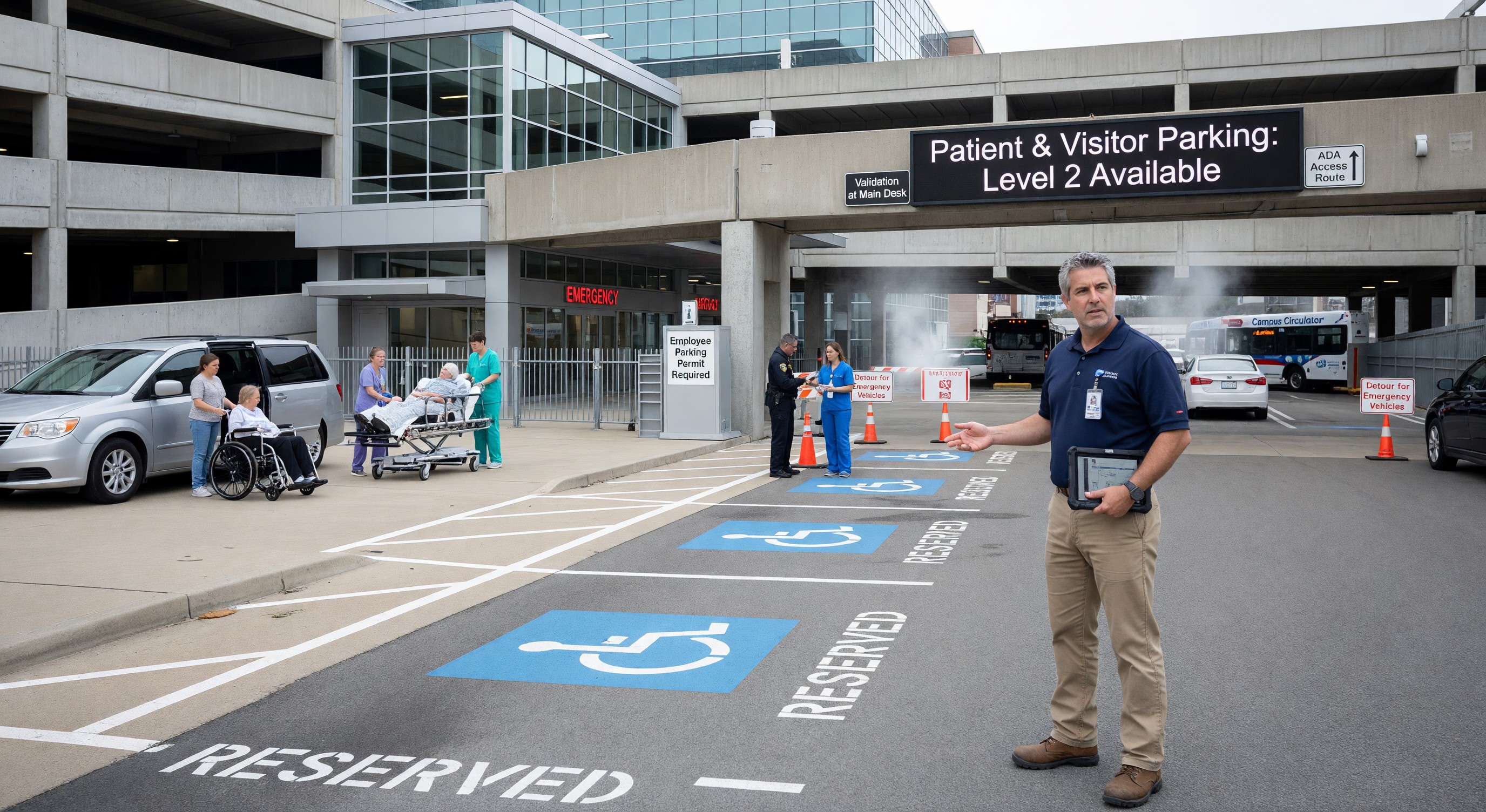
Healthcare facility parking is among the most operationally complex parking environments a facility manager will encounter. Patients arriving for medical procedures, visitors supporting family members in stressful situations, medical staff with irregular shift schedules, and administrative employees with 9-to-5 schedules all compete for the same parking inventory — and they all have legitimate needs.
The stakes are high. A patient who cannot find parking arrives late or stressed, which affects care quality and satisfaction scores. An employee who cannot park reliably considers other employers. A visitor who must walk a quarter mile in poor weather at midnight to reach a hospitalized family member is a person whose experience will be remembered and reviewed.
This guide addresses the operational, financial, and customer experience dimensions of healthcare parking management.
Understanding Healthcare Parking Demand Patterns
Healthcare campus parking demand is more complex than office or retail demand because it is driven by multiple overlapping user populations with very different arrival and departure patterns.
Outpatient surgery and procedure patients arrive in tight appointment clusters in the morning and depart throughout the day. They often require accessible parking close to the facility entrance and are accompanied by a driver who may wait several hours.
Emergency department visitors arrive at all hours with no predictable pattern. ED parking must be available 24/7 and should be as close to the ED entrance as operationally feasible.
Inpatient visitors tend to cluster in the late morning and evening. Visiting hours, if the facility has them, create predictable peaks. These visitors may stay for extended periods — 4 to 8 hours is not unusual.
Medical staff and nurses often work 12-hour shifts. Their arrival and departure patterns are concentrated into shift-change windows (typically 7:00 AM, 11:00 PM, 3:00 AM for many nursing schedules). Unlike 9-to-5 employees, healthcare workers on night and weekend shifts need reliable parking regardless of the time.
Administrative employees work more traditional hours. Their arrival and departure patterns are more predictable than clinical staff but add significant load during morning peak hours.
Understanding the overlap of these patterns at your specific facility is the foundation of a functional parking allocation strategy.
Patient and Visitor Parking: Pricing and Access
Pricing patient and visitor parking is a sensitive balance between cost recovery and patient experience. Healthcare organizations that optimize parking revenue at the expense of patient experience face satisfaction score impacts that far exceed any revenue gains.
Validation programs are the primary tool for managing patient and visitor parking costs. A robust validation program allows the healthcare organization to provide free or subsidized parking to patients and visitors while still operating cost-recovering parking for employees and other users.
Design validation programs with clear eligibility criteria: which patient and visitor types receive what level of validation (free, time-limited, discounted)? Outpatient surgery patients may receive full validation; extended visitors may receive a daily maximum that covers most visits.
Rate structure: Patient and visitor parking rates should be below or at market for the area, and daily maximums should be set at a level that does not create a significant financial burden for families with extended hospital stays. Many healthcare organizations have reduced or eliminated visitor parking fees for inpatient visitors entirely; the cost is modest relative to the patient experience and satisfaction impact.
Parking anxiety reduction: Healthcare facility parking anxiety — the fear of not finding parking when late for an appointment or in an emergency — is a real source of patient dissatisfaction. Occupancy guidance systems that show available spaces at the facility entrance, or pre-assigned parking spaces for scheduled procedures, reduce anxiety meaningfully.
Employee Parking Programs
Healthcare employee parking programs must accommodate the wide range of schedules and shift patterns across the organization.
Shift-differentiated pricing: Many healthcare organizations offer different monthly permit pricing by shift. Night shift and weekend workers, who have fewer transportation alternatives and face more personal safety concerns, may receive lower-priced permits as a recognition of their working conditions.
Reserved versus unreserved programs: Reserved parking appeals strongly to staff with irregular or unusual schedules who cannot risk arriving to find no available space. Consider offering a reserved program tier at a premium price point for staff with demonstrated need.
Carpooling incentives: Healthcare organizations with large employee parking programs often benefit from carpooling programs that reduce demand. Preferred carpool parking spaces close to building entrances, reduced permit rates for carpoolers, and guaranteed ride-home programs for employees who carpool but have unexpected schedule changes all support carpooling adoption.
ADA Compliance for Healthcare Facilities
Healthcare facilities have particularly important ADA parking obligations. Medical appointments are among the most likely occasions when people with mobility impairments need parking, and the accessible parking supply must serve that need reliably.
Healthcare campuses frequently need accessible parking supplies above the ADA minimums because of their user population demographics. Evaluate your accessible space usage data — consistent full occupancy of accessible spaces is a signal that the supply is inadequate for the actual demand, even if it meets ADA minimums.
Passenger loading zones and drop-off areas adjacent to building entrances reduce the distance that mobility-impaired patients must travel from their vehicle. ASHRAE and ITE standards for passenger loading zone design provide guidance on dimensions and circulation.
Parking Wayfinding for a Complex Campus
Large healthcare campuses with multiple buildings, multiple parking structures, and multiple parking surface lots create significant wayfinding challenges. A patient who arrives for a 9:00 AM appointment and parks in the wrong lot — a 15-minute walk from the correct building entrance — arrives late, stressed, and dissatisfied.
Effective healthcare parking wayfinding starts at the campus entrance. Directional signage that routes specific appointment types (outpatient clinic, emergency, main hospital entrance) to the correct parking facility prevents the wrong-lot problem.
Within the parking facility, wayfinding to the correct building entrance is equally important. Not every garage entrance connects to the building in an obvious way. Clear pedestrian wayfinding within the parking structure — and across the campus between parking and building destinations — is an investment in patient experience.
FAQ
How do I handle parking for patients in financial hardship? Establish a parking assistance program with clear eligibility criteria. Social workers and patient financial counselors should be able to refer patients for parking assistance. The program might include full or partial validation for extended stays, or a payment plan for patients who accumulate parking charges during long inpatient stays.
Should emergency parking be priced the same as general visitor parking? Many healthcare organizations provide complimentary or deeply discounted parking for emergency department users, recognizing that arriving for an emergency is not a planned event and charging for that parking creates unnecessary friction. The revenue impact of complimentary ED parking is typically modest compared to overall parking revenue.
How do I manage parking during major building projects when construction takes capacity offline? Develop a formal construction-phase parking plan well before work begins. Identify off-site overflow parking with shuttle service, communicate changes to staff and patients proactively, and increase wayfinding signage for temporary parking arrangements. The communication is as important as the parking itself — patients and staff who know about changes in advance tolerate them far better than those who discover them on arrival.
What technology helps most for healthcare campus parking? Occupancy guidance systems that direct drivers to available parking reduce search time and parking anxiety. For large campuses, real-time occupancy display at campus entrances (showing which lots/structures have availability) has the most immediate patient experience impact.
Further Reading from Authoritative Sources
- International Parking and Mobility Institute healthcare parking resources — parking-mobility.org (IPMI) is on the whitelist as the primary parking industry authority with healthcare facility parking content directly relevant to this article’s audience.
- Institute of Transportation Engineers parking generation and loading zone standards for healthcare — ite.org is on the whitelist and ITE’s healthcare facility parking demand publications are directly cited in this article as the basis for passenger loading zone design standards.