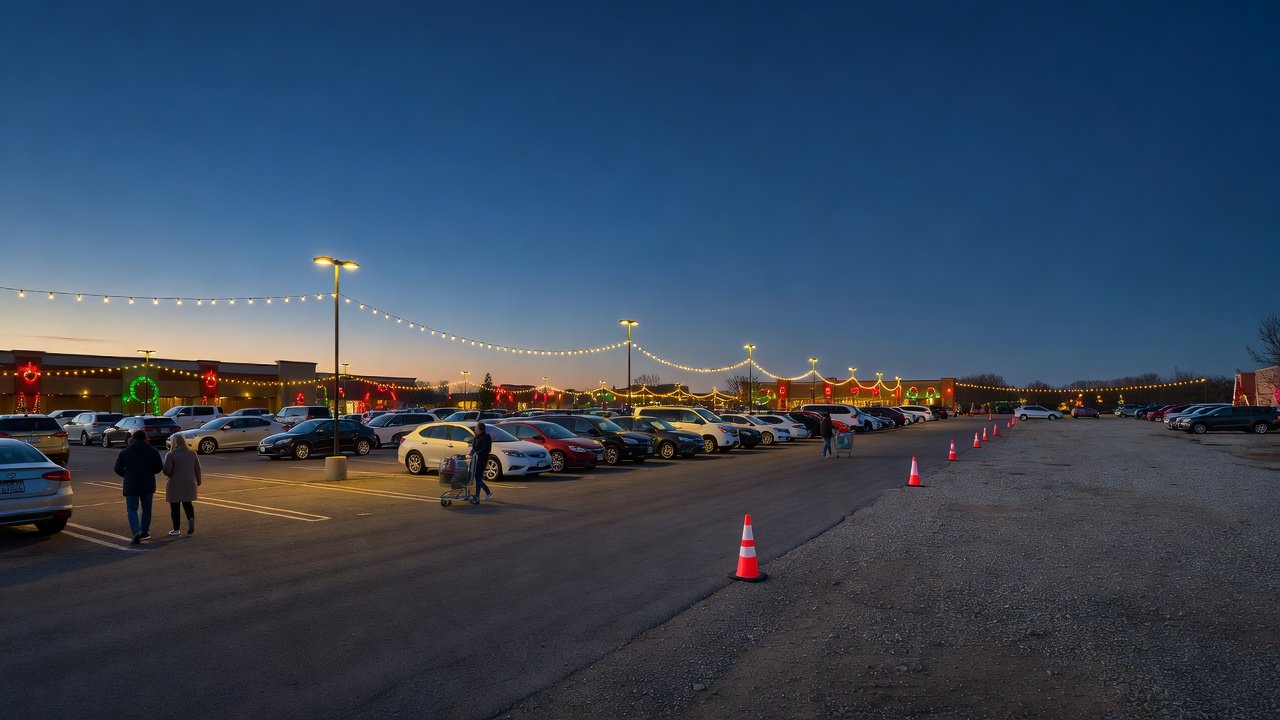
Holiday demand does not arrive evenly. It concentrates into a few predictable days, and a parking facility that runs well in October can fail on the Friday after Thanksgiving for reasons that were visible a month earlier: not enough staff at the right hour, no rule for when the lot is declared full, and an overflow site nobody has walked.
This year the calendar is clear. Thanksgiving falls on November 26, Black Friday on November 27, and Christmas on a Friday, December 25. Plan backward from those dates.
Size the plan to the demand signal you can verify
The National Retail Federation’s October 15 forecast projects November and December retail sales up 4.2% over 2025, to about $1.013 trillion, and expects retailers to hire 325,000 to 375,000 seasonal workers, in line with last year’s estimated 356,000. The NRF notes that nearly half of the growth comes from real spending rather than price increases. For a retail-adjacent facility, that points to demand at or modestly above last year, not a surge you cannot handle.
On the travel side, AAA’s most recent figure we could verify is last year’s: a projected 81.8 million people traveling at least 50 miles over Thanksgiving 2025, about 73.3 million of them by car. AAA had not published a 2026 Thanksgiving projection when we checked, and AAA typically releases it in mid-November. Treat the 2025 numbers as a baseline, and swap in the new forecast when it appears.
None of this replaces your own history. The strongest predictor of your holiday peak is your own ticket, transaction, or occupancy data from the last two Novembers and Decembers. Pull the hourly counts for the five busiest days and plan against those.
Decide what “peak” you are building for
A common planning principle in parking studies is to design for a high but not maximum day rather than the single busiest day. A municipal parking study in Steamboat Springs, Colorado, for example, notes that systems are typically designed to support demand on the 85th percentile busiest day rather than the extreme peak. That matters for a holiday plan: buying capacity for the one worst hour of the year is expensive, while a trigger-based overflow plan covers it for a fraction of the cost.
So split the problem in two:
- Base plan: the capacity and staffing that handles an ordinary busy day, including most of the holiday period.
- Surge plan: a set of pre-arranged actions, each with a trigger, that you activate only on the few peak days.
Build overflow around triggers, not hope
Overflow plans that work in other settings share a few features. Airports that run seasonal overflow lots post signs and direct traffic only once the main lots are full, run shuttles on fixed hours, and pick up and drop off at the same locations at both ends. Retail operators have used remote lots with free shuttles, and one UK outlet centre proposed a 340-space overflow site specifically for staff during November and December. Those are examples to adapt, not benchmarks, since we did not find a comparable mall plan with current figures.
For your own plan, write down the following and test it before the first peak day:
- The trigger. A measurable condition, such as the main lot reaching a stated occupancy for a stated number of minutes, that activates overflow. Name who makes the call.
- The overflow site. An agreement in writing with the owner, covering dates, hours, insurance, snow clearing, lighting, and who is liable for what. Walk it at dusk, since holiday peaks run into the evening.
- The route. Signs and cones staged ahead of time, a short path that does not cross your main entrance queue, and an exit plan.
- The shuttle, if one is needed. Loop time, headway, pickup point, and accessible vehicle availability. An overflow lot that is not accessible creates a compliance problem; see our ADA parking compliance checklist.
- Valet or attendant parking. If you consider it, define the hours, the staging area, and who carries the vehicle risk. Check this with your insurer first.
Staffing around arrivals
Schedule by the shape of the day. Most holiday demand has an arrival wave and a departure wave, and they strain different things: entries and ticketing in the first, exits and payment in the second.
- Put people where the queue forms. Place attendants at the entry decision point and at the exit lane, not spread evenly across the facility.
- Cross-train. A person who can handle payment troubleshooting, traffic direction, and customer questions is more useful on a peak day than a specialist, and our notes on parking staff training and management cover what to include.
- Send your own employees to the edge. Retail staff arrive earlier than customers and can be moved to a remote lot, which is the idea behind the staff overflow site mentioned above. Moving them is often the cheapest capacity you can add, and it frees the closest stalls for paying visitors.
- Plan breaks and relief. Cold, long shifts and short days are a safety issue. Document who covers during breaks.
- Brief everyone before the day. One page: trigger, contacts, escalation, what to do if equipment fails, and who speaks to customers.
Keep the equipment and lighting honest
Peak days are the wrong time to discover a lane that will not read tickets or a stair core with failed lights. Run a full test of entry, exit, and payment equipment in the week before Thanksgiving, confirm you have spare parts and a service contact who will answer on a holiday, and re-walk the lighting. If you have not already done a pre-winter inspection, see our guide to winter readiness for parking facilities. For the broader retail context, see our retail parking management guide; hotel operators should also read the hotel parking management guide.
Review afterward
On the first business day after December 26, record what happened: the hours the trigger was reached, how long overflow ran, the longest queue, complaints, incidents, and the labor hours spent. That record is the plan for next year, and it is worth more than any benchmark you can find online. The facilities that handle the holidays well are usually the ones that wrote down what went wrong the last time.