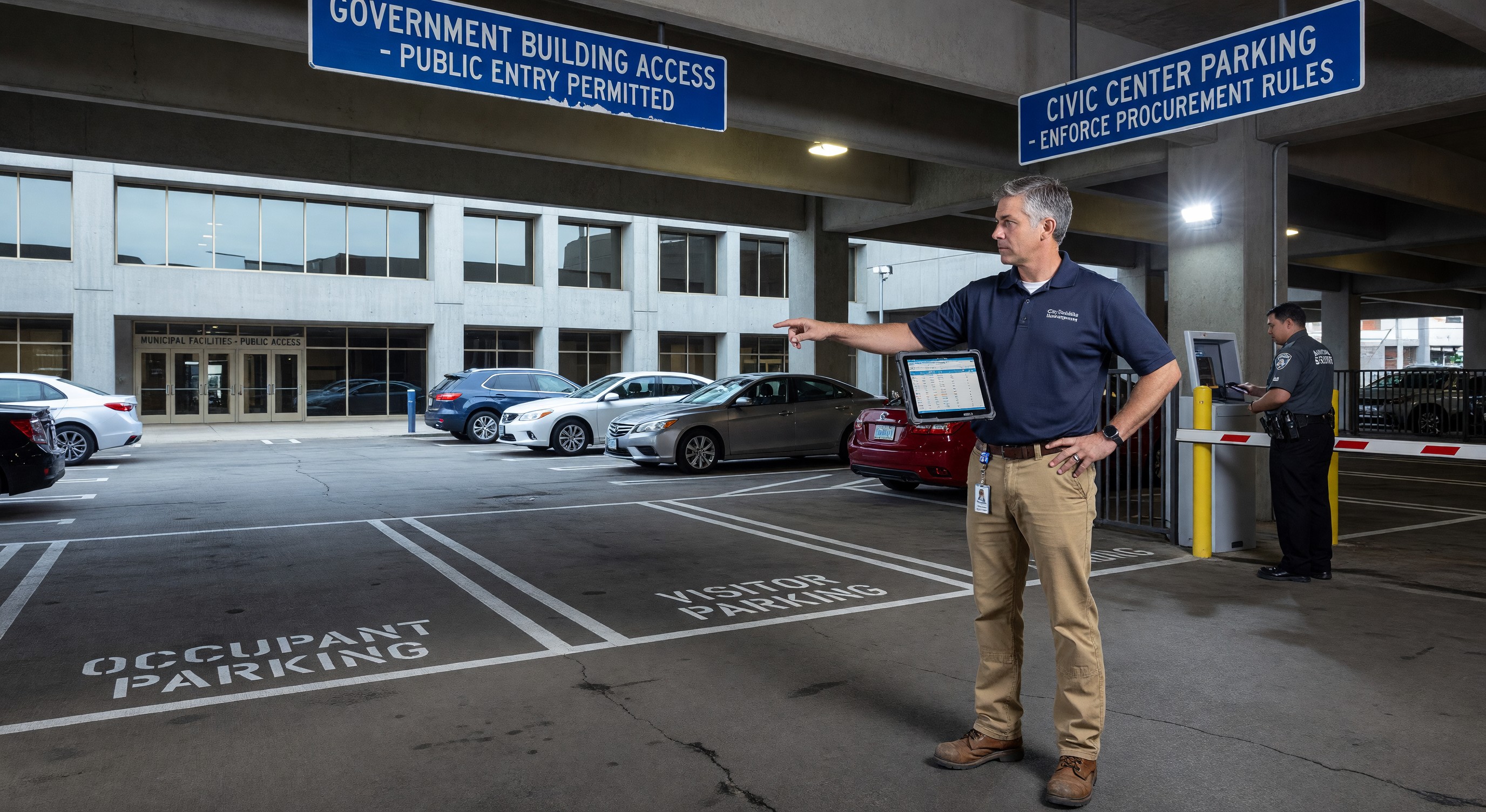
Government and municipal parking facilities operate within a framework of public accountability, procurement regulations, and public access requirements that private-sector parking managers rarely encounter. The transparency obligations, political visibility, and public service mission of government parking create management challenges that require a different approach than commercial parking.
This guide covers the key dimensions of government and municipal parking management — from operational practices through procurement, public access, and financial management.
The Unique Context of Government Parking
Several factors distinguish government parking from private commercial parking:
Public accountability. Parking at government facilities is paid for by taxpayers, and the decisions made about it — pricing, enforcement, vendor selection, capital investment — are subject to public scrutiny. Transparency in decision-making and documentation is essential.
Procurement requirements. Government procurement of parking services, equipment, and construction is typically subject to formal competitive procurement requirements (RFPs, IFBs, or equivalent) with mandatory evaluation criteria, public notice requirements, and documentation obligations. These requirements serve accountability goals but create processes that are slower and more complex than commercial procurement.
Public access obligations. Government facilities must be accessible to the public they serve. Parking pricing, availability, and accessibility accommodations must be designed with public service in mind, not profit optimization.
Security requirements. Government buildings face security threats that most commercial facilities do not. Parking management must coordinate with facility security programs, may involve credentialing requirements, and may include perimeter security measures that affect parking operations.
Occupant vs. Visitor vs. Public Parking
Government facility parking typically serves three distinct populations with different needs:
Agency occupants (employees and contractors): Regular commuters who need reliable daily parking access. Permit programs for government employees are common, often with agency subsidies. Government employee parking benefits may be governed by agency policy or collective bargaining agreements.
Visitors and the public: Citizens who come to the facility for government services — permits, benefits, court appearances, public meetings. Visitor parking should be convenient, clearly signed, and priced (if at all) at a level appropriate for occasional public use.
Official vehicles: Government fleet vehicles may be stored or staged at facility parking areas. Vehicle security, maintenance access, and pool vehicle management create requirements distinct from employee and visitor parking.
Designing parking allocation to serve all three populations requires demand analysis and clear policies about priority when demand exceeds supply.
ADA Compliance and Public Accommodation
Government facilities are subject to Title II of the ADA, which prohibits discrimination by state and local government entities and imposes affirmative obligations to ensure accessible programs and services.
For parking, Title II means that accessible parking must be provided and maintained to a standard that enables people with disabilities to access government services. Requirements include:
- ADA-compliant accessible space counts, dimensions, and signage
- Accessible routes from parking to all accessible building entrances
- Accessible passenger loading zones for visitors who need drop-off/pick-up assistance
- Regular maintenance and inspection to ensure ongoing compliance
Government facilities that fail to provide accessible parking face potential Title II complaints to the Department of Justice Civil Rights Division, which has mandatory remediation consequences.
Procurement of Parking Services and Equipment
Government procurement rules vary by entity type (federal, state, county, municipal) and by procurement category. Common requirements:
Formal competitive procurement: Contracts above a specified dollar threshold typically require formal competitive solicitation (RFP, IFB, or ITQ), public notice, and evaluation against documented criteria.
Small business and disadvantaged business preferences: Many government entities have procurement preferences or set-aside programs for small businesses, women-owned businesses, minority-owned businesses, or veteran-owned businesses. These preferences apply to parking equipment, services, and construction procurements.
Prevailing wage requirements: Public construction projects in many states are subject to prevailing wage laws that require contractors to pay workers at locally established wage rates. PARCS installations and parking structure construction at government facilities may be subject to these requirements.
Contract term limits: Government service contracts are often limited in term (typically 3 to 5 years, with optional renewal periods) by procurement policy. Long-term parking management agreements that might be appropriate in private commercial contexts may not be achievable in government settings.
Parking Revenue and Government Finance
Government parking revenue may be treated differently from private commercial parking revenue. In many jurisdictions:
Dedicated parking funds: Parking revenue may be required to be deposited in a dedicated fund that can only be used for parking-related expenditures (operations, capital, debt service). This affects budget planning and limits flexibility in using parking revenue for general government purposes.
Bond financing: Capital improvements for government parking structures may be financed through revenue bonds backed by parking revenue. Bond covenants create financial management requirements (minimum coverage ratios, reserve requirements, reporting obligations) that constrain parking financial management.
Budgetary oversight: Government parking budgets are typically subject to legislative or governing board approval. Significant operational or capital changes require budget amendments that involve the same approval process as the original budget.
Security Integration
Government facility parking operations must coordinate with the facility security program, which may include:
Vehicle credentialing: Government facilities with restricted access may require vehicles to display credentials for entry. Integration between PARCS and vehicle credentialing systems is important.
Anti-ram perimeter protection: High-security government facilities may require anti-ram bollards, vehicle barriers, or security booth architecture to protect against vehicle-borne threats. These requirements affect parking facility layout and access configurations.
Background check requirements for service workers: Contractors who work in or near government facilities may require background checks. Coordinate parking equipment service and maintenance contractor access with security requirements.
CCTV integration with facility security: Parking facility CCTV should integrate with the facility’s overall security monitoring program. Video management systems that are interoperable with the facility’s security platform are preferred.
FAQ
Can I implement dynamic pricing at a government parking facility? Yes, but it typically requires policy approval and public transparency about pricing rationale. Government parking rates are often set by ordinance, regulation, or governing board resolution. Changes require the same approval process. Dynamic pricing programs should be presented to governing bodies with clear documentation of expected revenue and public benefit outcomes.
How should I handle parking revenue sharing with a third-party parking operator at a government facility? Government contracts with third-party parking operators must be structured to ensure public accountability. Revenue reporting should be frequent (monthly at minimum), auditable by government auditors, and subject to contract compliance audits. Government entities should retain the right to audit the operator’s books for the managed facility.
Are government employees entitled to free parking? This depends on agency policy, applicable laws, and collective bargaining agreements. IRS rules limit the tax-free parking benefit that employers (including government agencies) can provide ($315 per month in 2024). Government entities that provide free parking above this limit should review the tax implications. Agency policy on employee parking benefits varies widely.
What records must be retained for government parking operations? Government records retention requirements are broader than private sector requirements. Contracts, financial records, audit reports, procurement documentation, and operational records may be subject to state public records retention schedules that require retention for 5, 10, or more years. Confirm applicable records retention requirements with your agency’s records officer.
Further Reading from Authoritative Sources
- International Parking and Mobility Institute government parking operations resources — parking-mobility.org (IPMI) is on the whitelist as the primary parking industry authority with directly relevant content for government facility parking management.
- U.S. Department of Transportation federal transportation facility guidance — transportation.gov is on the whitelist and provides the federal policy context for government parking operations, including transit benefit programs and transportation demand management requirements.