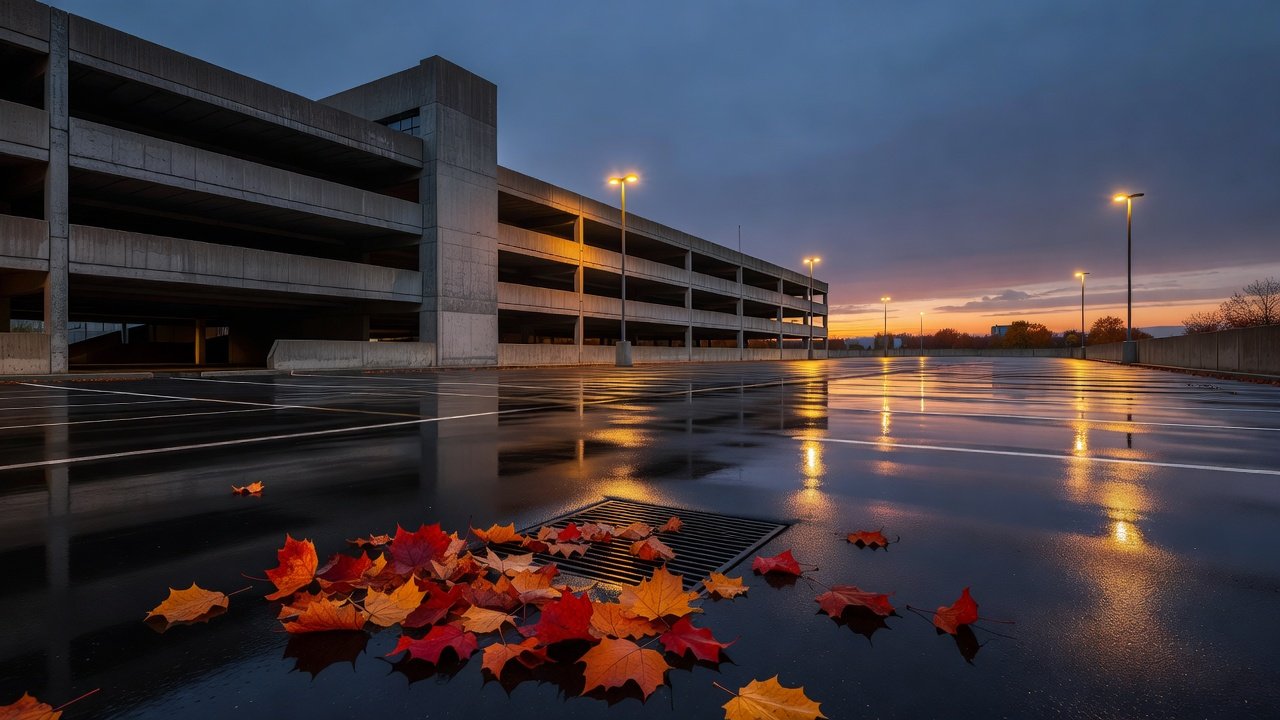
Winter does not create parking-facility problems so much as expose the ones that were already there. A drain that has been half-blocked since leaf fall, a luminaire that has been out for three weeks, a battery that tested fine in September: each of these is cheap to fix in October and expensive to discover in January, when the repair crew is booked and the surface is frozen.
This is the inspection order we would use, ranked by what a failure costs and how hard it is to reverse.
Know what kind of winter you are inspecting for
Do not size the effort to a generic winter. NOAA’s winter outlook, released October 16 and covering December through February, is built around a very strong El Niño, with warmer-than-average temperatures favored across much of the northern United States and wetter-than-average conditions across the southern tier and East Coast. The outlook was reported through news summaries; check the Climate Prediction Center’s own product for your region before you plan against it.
The practical reading is that the risk mix shifts rather than shrinks. A warm northern winter means more freeze-thaw cycling and more rain-on-frozen-ground events, which are harder on drainage and joints than steady cold. A wet southern winter means drains carry more water than they have in recent years. In both cases the first inspection item is the same.
Drains and decks first
Drainage is the highest-leverage check because water is what turns a small defect into a structural one. Sources that cover structured-parking maintenance consistently point to the same sequence: clear debris from drains, confirm water actually leaves the deck, and find ponding before it freezes. Freezing and thawing of standing water cracks concrete, and deicing salt that gets past a failed membrane or joint sealant reaches embedded steel. Rust staining near a drain is a symptom worth photographing.
Work through the deck in this order:
- Drain bodies and strainers. Remove leaves, litter, and silt. Pour water into each drain rather than assuming it flows. A drain that backs up under a bucket will not cope with a storm.
- Downspouts and trench drains. Confirm they are clear to the discharge point, not only at the grate.
- Ponding locations. After a rain, or with a hose test on a dry day, mark where water sits. Persistent ponding can be a blocked drain or insufficient slope; the first is a maintenance item, the second is an engineer’s.
- Expansion and control joints, and sealant. Snow plowing commonly damages joints and surface membranes, so sealant that is cracked, debonded, or missing should be repaired before the plow season, not after.
- Top deck and ramps. These are exposed surfaces. Check cracking and spalling there first.
Our guide to parking garage drainage maintenance covers inspection frequency and cleaning methods in more detail. If you hold a structure with known deterioration, record what you find against your last condition assessment. A dated inspection log also helps at insurance renewal, where documented maintenance is one of the few levers an owner controls.
Lighting before the short days arrive
Short winter days put a larger share of your operating hours after dark, so lighting stops being a background amenity and becomes the primary safety control. Walk the facility at dusk, not at noon, and record what you see rather than what the fixture schedule says.
- Count outages by zone. A single dark fixture matters less than a dark stair core or the path from the elevator to the exit.
- Check for lumen depreciation, not just failure. A fixture that still works may be putting out meaningfully less light than when it was installed. LED manufacturers publish lumen-maintenance data for each product, and design guidance for parking areas is expressed as average and minimum light levels with a uniformity ratio. One utility retrofit guide for garages lists 5 foot-candles average and 1 minimum with a 10:1 maximum-to-minimum ratio, while IES lot recommendations commonly fall in the 1 to 5 foot-candle range depending on the site. Those are reference points, not your legal standard; confirm the figures that apply to your jurisdiction and design basis.
- Test emergency and egress lighting. Battery-backed units are the ones most likely to have quietly failed. See our notes on emergency lighting compliance.
- Look at sightlines. Overgrown landscaping and stacked snow later in the season will block light that currently reaches the pavement.
For upgrade economics, our piece on parking lighting maintenance and upgrades lays out the retrofit case.
Entry and exit equipment
Gate arms, ticket and payment equipment, and the sensors that drive them fail in cold weather in predictable places. One parking-operations source identifies two main weak points for barrier gates: the arm pivot freezing, and ice accumulating over in-ground loop detectors. The Parking BOXX winter operations guide recommends a low-temperature lubricant for pivots rather than a general-purpose spray, and sealing the saw cuts around loops so water does not get in and cause false reads.
Before the first freeze, ask your service provider or in-house technician to cover these items and give you a dated record:
- Backup batteries. Lead-acid batteries lose capacity in the cold. The same source gives an example of a unit that ran about four hours in September and roughly an hour and a half in January. Load-test batteries now and replace the weak ones.
- Heaters and thermostats. Payment and control cabinets often have internal heaters. Verify the heating element and its cutoff, and check the manufacturer’s rated operating temperature against your local low.
- Gearboxes and lubrication. Cold thickens oil. Confirm the lubricant specified for your equipment’s temperature range.
- Photo-eyes and safety sensors. Clean lenses and confirm alignment. Safety sensors that fail closed or open at the wrong moment are a liability issue as well as a nuisance.
- Loop detectors. Test detection with a vehicle, and review sealant at the saw cuts.
- A manual-operation plan. Decide in advance what staff do when a lane fails: who opens it, who is notified, and how customers are informed.
Our preventive maintenance guide for parking equipment sets out the broader service schedule these checks belong in.
Close the loop with your snow plan
The inspection only pays off if what it finds reaches the people with the plow. Give the snow contractor a marked plan showing drain locations, sealed joints, bollards, sensors, and loops, so plows do not catch a protruding drain frame or a loop cut. If you have not finalized the contract, see our guidance on snow removal vendor contracts, and for the operating side, our broader winter parking lot maintenance guide.
The sequence is the point. Drains and joints protect the structure, lighting protects people after dark, and gate equipment protects revenue and access. Finish them in that order, keep the dated log, and book any repair you cannot do this week before the first freeze rather than after it.