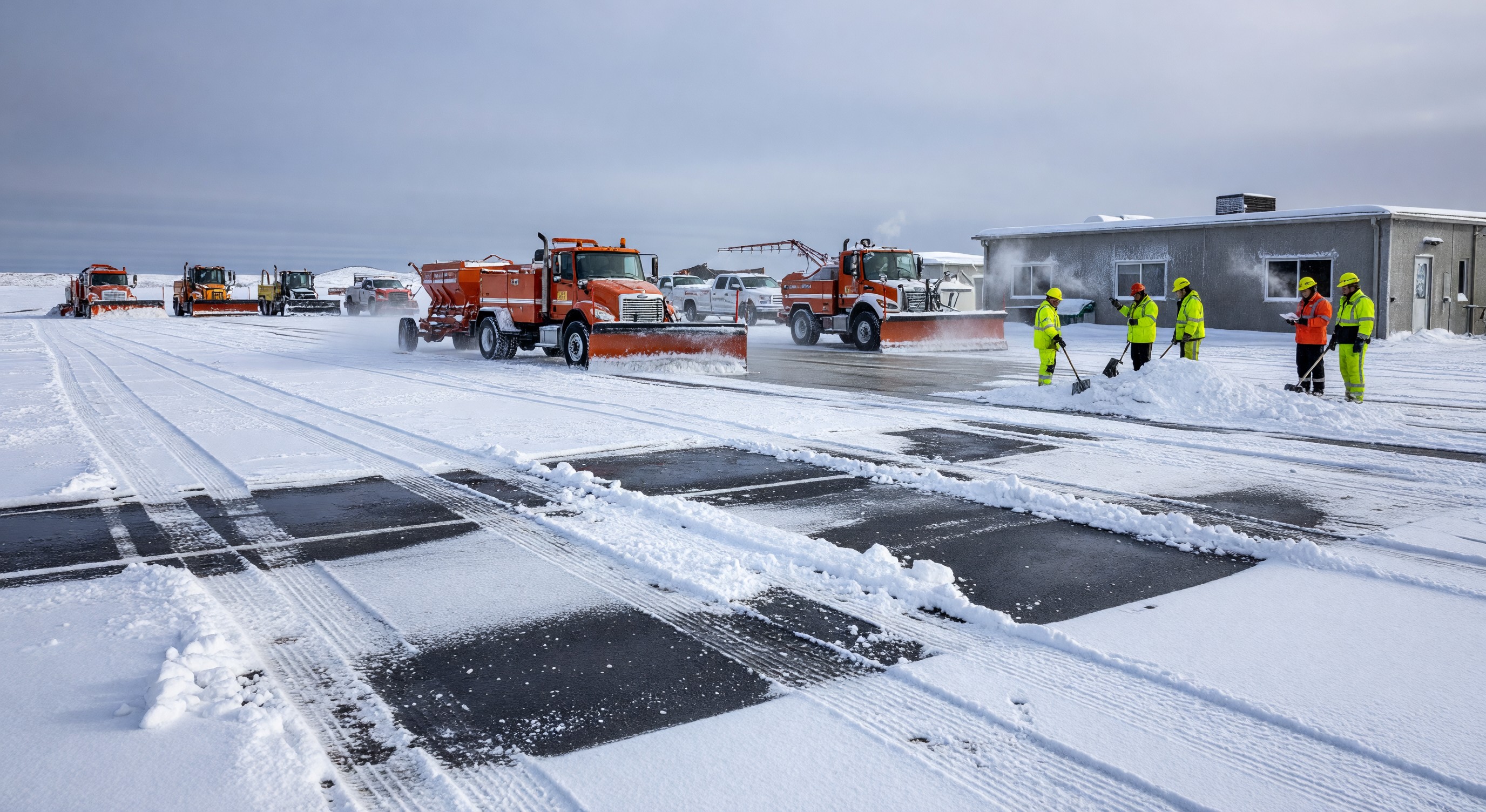
Winter maintenance is one of the highest-stakes operational responsibilities for facility managers in cold climates. Inadequate snow and ice removal leads to slip-and-fall incidents with significant liability consequences. Excessive or poorly timed deicing chemical applications create environmental liability and pavement damage. And the logistics of clearing a parking lot during an active storm while keeping it accessible for users require advance planning that cannot happen when the snow is already falling.
This guide covers the planning, operational, and regulatory aspects of winter parking facility maintenance.
Building Your Winter Operations Plan
A written winter operations plan, completed before the first snowfall of the season, is the foundation of effective winter maintenance. The plan should address:
Service level standards: Define what “cleared” means for your facility. Zero tolerance for snow or ice on all surfaces? Cleared drive lanes and walkways within four hours of storm end? The standard you adopt affects both service cost and liability exposure.
Trigger conditions: What meteorological conditions trigger pre-treatment? When does plowing begin during an active storm? When are walkways treated versus cleared? Trigger conditions should be objective (temperature, predicted accumulation) rather than judgment calls made during a storm.
Priority sequence: In what order are facility areas cleared? Primary drive aisles and accessible routes first, general parking areas second, snow storage management third. Accessible routes and accessible parking areas must receive priority attention.
Snow storage locations: Identify where plowed snow will be stored. Consider drainage implications — snowmelt from storage piles carries deicing chemicals and sediment that must be managed. Do not block drainage inlets or accessible routes with snow storage.
Contractor coordination: If using contractors, have signed contracts in place before the season, confirm equipment availability and operator experience, and establish communication protocols for storm activation and problem escalation.
Deicing Material Selection
Material selection has significant implications for surface protection, environmental impact, and cost.
Sodium chloride (rock salt): The standard deicing material. Effective down to approximately 15°F (-9°C). Lowest cost per unit of deicing effect. High chloride content damages concrete, steel, and vegetation. Environmental concerns from chloride in stormwater runoff are significant.
Calcium chloride: Effective to approximately -25°F (-32°C). Generates heat on contact with moisture, making it faster-acting than rock salt. Higher cost. Hygroscopic (attracts moisture), which can create wet surfaces after application. Appropriate for extreme cold events.
Magnesium chloride: Effective to approximately -13°F (-25°C). Less corrosive to concrete than sodium chloride when used appropriately. Often used in liquid form as a pre-wetting agent or anti-icer. Higher cost than sodium chloride.
Acetate-based materials (CMA, KA): Calcium magnesium acetate and potassium acetate are chloride-free alternatives with lower concrete corrosivity and lower environmental impact. Much higher cost; typically used in specialized applications (bridge decks, sensitive ecological areas) rather than general parking lot deicing.
Abrasives (sand, cinder): Provide traction without melting ice. Appropriate where temperatures are below the effective range of deicers, or as a complement to chemicals. Abrasives require spring cleanup; they are not a substitute for deicing on high-traffic surfaces.
Anti-Icing: Working Ahead of Ice Formation
Anti-icing — applying deicing materials before ice forms rather than after — is consistently more effective and economical than reactive deicing. A liquid anti-icer application of 20 to 40 gallons per lane-mile before a storm prevents ice bonding to the pavement surface, making removal faster and easier.
Anti-icing with liquid deicers (magnesium chloride solution, CMA) requires spreader equipment capable of liquid application (not all contractors have this). Establish whether your service provider has anti-icing capability before contracting.
Anti-icing is particularly effective for the freeze-thaw cycles common in late-fall and early-spring storms, when temperatures hover near freezing. A pre-treatment the night before a storm that arrives as sleet or freezing rain prevents the ice bonding that makes reactive deicing so much more difficult.
Accessible Route Winter Maintenance
Winter maintenance of accessible routes — accessible parking spaces, access aisles, and paths of travel to building entrances — deserves special attention. The ADA’s requirement that accessible routes be accessible is not suspended during winter, and uncleared accessible spaces are among the most common winter accessibility complaints.
Prioritize accessible space clearing in your operational protocol. Accessible parking areas should be cleared to the same standard as primary drive lanes, not treated as secondary areas addressed after general parking.
Access aisles: Cleared accessible parking spaces with snow-filled access aisles are not compliant. Access aisles must be cleared — snow storage in or adjacent to accessible space access aisles is a compliance failure.
Slip hazards on accessible routes: Packed snow and ice on accessible paths of travel create disproportionate hazards for users with mobility impairments. Accessible routes should be treated with anti-slip material and maintained to a higher standard than general parking surfaces.
Contractor Management
Most facility managers use snow removal contractors rather than self-performing. Contractor management is critical — a contractor who does not perform creates both operational and legal exposure.
Contract specifics: Contracts should specify response times (how quickly after trigger conditions does service begin?), service completion standards (what level of clearing is required?), frequency of service during active storms, and scope of work (plowing, shoveling, deicing, sand application).
Equipment verification: Before the season, verify that the contractor has functional equipment appropriate for your facility. A plow that breaks down during a storm with no backup creates significant problems.
Documentation requirements: Require the contractor to provide service logs documenting when service was performed, what materials were applied, and conditions at the time of service. These logs are critical documentation if a slip-and-fall incident occurs.
Performance monitoring: Visit the facility during or after winter events to verify that service meets contract standards. Address performance deficiencies promptly in writing.
Pavement and Infrastructure Protection
Deicing chemicals and plowing equipment both cause pavement and infrastructure damage over time. Minimizing unnecessary damage:
Calibrated spreaders: Salt spreaders should be calibrated to apply deicers at manufacturer-recommended rates, typically 150 to 300 pounds per lane-mile. Uncalibrated spreaders commonly apply 3 to 5 times the effective rate, wasting material, increasing environmental impact, and accelerating pavement damage.
Plow blade management: Steel plow blades can damage pavement markings, curbs, and drain grates. Rubber-edge blades are gentler on pavement surfaces. Mark drain grate locations with plow guides (flexible stakes) to prevent grate damage.
Spring cleanup: Remove sand and debris from parking surfaces as soon as conditions allow after winter. Accumulated sand and grit in drains and on parking surfaces carries deicing chemicals and debris into storm drains during spring runoff.
FAQ
What is my liability if someone slips and falls in my parking lot during a winter storm? Liability depends on jurisdiction. Some states apply the “natural accumulation” doctrine, which limits landowner liability for injuries from natural accumulation of snow and ice during active storms. Other states impose a duty of reasonable care that applies even during active storms. Post-storm liability is more widely recognized — property owners are generally expected to clear snow and ice within a reasonable time after a storm ends. Consult your insurance carrier and legal counsel for guidance specific to your jurisdiction.
How long after a storm do I have to clear snow before liability attaches? There is no universal standard. Courts evaluate whether removal occurred within a “reasonable time” given the nature of the storm, the resources available, and the foreseeability of harm. Most risk management guidance suggests beginning post-storm clearing within 24 hours and completing clearing within 48 to 72 hours of storm end for commercial facilities with regular public access.
Can I reduce deicing chemical use without sacrificing safety? Yes. Anti-icing strategies, calibrated spreader application rates, and pavement temperature-based application (rather than air temperature) all reduce chemical use while maintaining safety. Smart deicing practices can reduce salt use by 30 to 50 percent compared to uncalibrated reactive deicing with minimal or no reduction in safety outcomes.
Should I have a written snow removal contract even for a small lot? Absolutely. A written contract protects both parties by establishing clear service expectations, scope, pricing, and liability allocation. Without a written contract, disputes about what was agreed to are resolved based on expensive litigation rather than a clear document.
Further Reading from Authoritative Sources
- Federal Highway Administration winter road maintenance and deicing research — fhwa.dot.gov is on the whitelist and FHWA’s winter maintenance research directly supports the anti-icing, application rate, and material selection guidance in this article.
- EPA guidance on stormwater impacts of road salt and deicing materials — epa.gov is on the whitelist and EPA’s stormwater and chloride guidance provides the environmental compliance context for the deicing material selection discussion in this article.