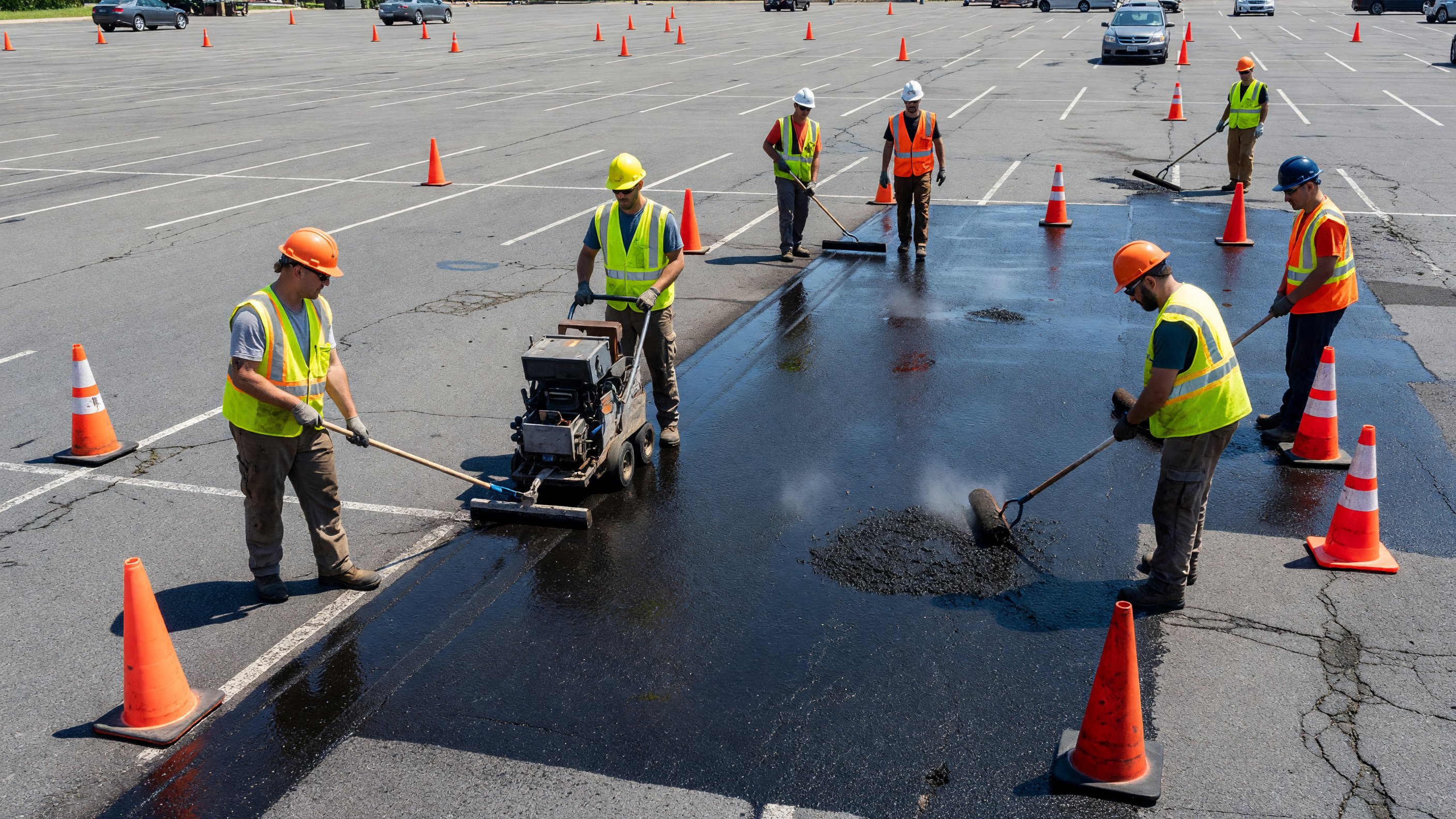
Every facility manager knows the feeling: a vendor calls in April to schedule summer work, and the first available slot is mid-September. You missed the window because you started planning in April instead of January.
The summer maintenance window — roughly June through August in most of North America — is the single best opportunity of the year to address parking structure upkeep. Temperatures are above freezing, concrete cures properly, pavement sealcoating adheres correctly, and traffic patterns in many facilities (especially corporate campuses, universities, and healthcare facilities with reduced summer census) allow for temporary lane or section closures. Missing this window pushes critical repairs into fall, when contractor availability tightens and costs rise, or into winter, when concrete patching and sealcoating chemistry simply don’t work.
This guide is a planning desk reference for the window: what to address, how far in advance to schedule, and how to time the spend for end-of-fiscal-year budget cycles.
Start Planning in Q1, Not When It Gets Warm
The most common mistake is treating summer maintenance as a summer project. By the time June arrives, quality pavement contractors and parking equipment service providers are booked solid. The planning cycle needs to start in January or February.
February: Complete your internal condition assessment — concrete walk-through, drainage inspection notes, lighting audit, equipment service records review. This is information-gathering before you go to bid.
March: Issue RFPs or quotes to contractors. Striping companies, concrete repair specialists, and paving contractors all book fast once the weather breaks in April and May. Asking for bids in March — before the rush — gives you better pricing and contractor choice.
April: Award contracts and confirm schedules. Get start dates in writing. For equipment service (pay stations, gates, access control), schedule preventive maintenance visits now. Many equipment service vendors book out 8–10 weeks for non-emergency PM visits during peak season.
May: Confirm contractor mobilization plans, order any materials with lead times (sealant, paint, replacement signage), and notify building tenants or parking users of upcoming work windows. Thirty days of advance notice prevents complaints.
June–August: Execute the work.
Concrete Inspection and Crack Sealing
Parking structures — especially open-deck and multi-story precast concrete garages — require annual concrete inspection. The summer window is ideal because dry conditions allow accurate assessment and proper crack sealant curing.
What to inspect:
- Deck surface cracking — width, depth, and pattern matter. Hairline cracks under 1/32" may be monitored; cracks wider than 1/4" with any vertical displacement need structural engineer review.
- Spalling — concrete fracturing off in chunks, especially at beam edges and column bases, often signals rebar corrosion beneath the surface.
- Joint sealant — expansion joints and control joints should be checked for sealant deterioration, since failed joints are the primary water infiltration path.
- Ramp and post-tensioned slab conditions — ramps get more wear from turning loads; post-tensioned structures have specific inspection requirements around cable end anchors.
- Efflorescence — white calcium deposits on concrete surfaces or dripping from joints indicate active water movement through the structure.
When to involve a structural engineer: If you observe significant cracking patterns, delamination (a hollow sound when the concrete is tapped), exposed rebar, or deflection in slab areas, do not attempt to spec the repair yourself. Engage a licensed structural engineer for an assessment before any repair work proceeds. Parking structures are life-safety structures — conservative is always correct.
Crack sealing — for non-structural surface cracks — should be done with a flexible polyurethane or epoxy sealant rated for vehicle traffic and thermal cycling. This is different from the materials used in building facades or floor applications. Specify correctly in your contractor scope. The International Concrete Repair Institute (ICRI) publishes guidance on selecting repair materials matched to crack type and environment.
For deeper coverage of the inspection process, see our article on parking garage concrete inspection for facility managers.
Line Striping and Signage Refresh
Line striping is one of the highest-ROI maintenance items in a parking facility. Faded markings create confusion, safety risks, and ADA compliance exposure — and fresh striping dramatically changes how a facility looks and functions. Yet it often gets deferred year after year because it feels cosmetic.
Typical restriping interval: 2–5 years for surface lots (weather exposure accelerates fading), 3–7 years for structured decks (less UV, less weather). That range is wide because traffic volume and paint quality at the original application both matter. A high-traffic entrance lane may need restriping every 18 months; an interior lower-deck stall row may last seven years.
What triggers an early restriping project:
- ADA space reconfigurations (van-accessible upgrades, access aisle additions)
- Fire egress lane re-routing
- Space reconfiguration (EV charging addition, space downsizing from compact-only to full-size)
- Parking equipment relocation (gate arms, pay station islands)
Line striping in summer: Thermoplastic striping (common on surface lots) requires pavement temperatures above 50°F and ideally above 60°F for adhesion — summer conditions are ideal. Coordinate striping with any sealcoating or resurfacing work: always sealcoat or resurface first, let cure per manufacturer spec (typically 24–72 hours), then stripe.
Signage: Walk the lot with fresh eyes during your summer inspection. Signs fade, warp, and shift. Regulatory signs (stop, speed limit, no parking) should meet MUTCD standards for reflectivity and mounting. Accessible parking signs must comply with current ADA Standards for Accessible Design — the sign must be mounted with the bottom edge at least 60 inches above the parking surface, and the International Symbol of Accessibility must appear on both the sign and the pavement.
For detailed striping specifications, refer to our article on parking lot striping standards and specifications.
Drainage Clearing and Inspection
Water is the primary enemy of parking structures and surface lots. Summer is the right time to clear and inspect the drainage system before fall storm season and winter freeze-thaw cycles.
Surface lot drainage: Check all catch basins for debris, sediment accumulation, and damaged grates. A clogged catch basin causes ponding that accelerates pavement deterioration and creates slip hazards. Jet-vacuum cleaning of catch basins and connecting pipes is typically $150–$400 per basin depending on condition and depth. If you have not cleaned basins in more than two years, plan for cleaning plus a camera inspection of underground runs.
Structured parking drainage: Deck drains on parking structures need to flow freely. Debris accumulation at deck drains is common — leaves, silt, and litter compact over time. Beyond the drains themselves, inspect the slope of each deck toward drain locations. If you see ponding areas (water stains, accelerated wear) that aren’t near drains, the drainage design may have been compromised by previous repairs or resurfacing that changed deck slope.
Drain trench liners and waterproof membranes: On decks with a waterproof membrane (common on lower levels of structured parking), check the membrane perimeter seals and penetration flashings during your summer inspection. A membrane failure is expensive to remediate and allows water into the structure below.
More detail on maintaining parking drainage systems is covered in our article on parking garage drainage maintenance.
Lighting Audit
Parking facility lighting affects safety, security, security perception, and increasingly, energy cost. Summer — with long days — is actually a good time for a lighting audit because you can walk the facility in daylight to check fixture condition, then return at dusk to observe actual illumination levels.
What the audit should cover:
- Fixture condition: broken lenses, corrosion, damaged mounting, bird nesting in fixtures
- Lamp outages: note locations; cluster outages (multiple out in a zone) may indicate a circuit issue, not just failed bulbs
- Illumination levels: IESNA RP-20 recommends minimum 0.5 footcandles for general parking areas and 2.0 footcandles for high-activity areas like entrances and pay stations. Low-cost light meter apps can give you a directional read; a formal photometric study from a lighting engineer provides documentation.
- Uniformity: dark pockets between fixtures, even if average footcandle levels look acceptable, create security risks and liability exposure
LED retrofits in summer: If your facility still has metal halide or high-pressure sodium fixtures (warm-up delay, lower efficiency), summer is a practical time for a retrofit project. LED replacement typically delivers 50–70% energy reduction and eliminates re-strike delay — important for safety in occupied facilities. Confirm whether your utility offers incentive rebates for commercial LED retrofits before spec’ing the project.
Our article on parking lighting maintenance and upgrades provides specification guidance for replacement projects.
Pay Station and Gate Preventive Maintenance
Parking access and revenue control equipment — pay stations, entry/exit terminals, barrier gates, loop detectors, intercoms — is the operational core of a managed parking facility. These systems fail in predictable ways, and most failures are preventable with scheduled PM visits.
What a thorough PM visit covers:
- Pay station: clean card reader contacts and validator heads, inspect receipt printer mechanism, test all payment modes, verify display screen condition, check door seals and cabinet weatherproofing, update firmware if pending, test UPS battery backup
- Barrier gate: lubricate pivot points and drive mechanism, inspect gate arm for stress cracks and proper balance, test obstruction detection loops and sensors, verify gate housing weatherproofing, check motor brushes (on brush-type motors) for wear
- Loop detectors: verify sensitivity settings, test vehicle detection and release-on-exit functions, check wiring condition at junction boxes
- Intercom: test audio quality and connection, inspect speaker grille condition, verify call routing is current
Scheduling PM visits: Contact your equipment service provider in March or April for summer PM slots. Equipment vendors typically offer semi-annual or annual PM contracts — if you are on a PM contract, confirm your summer visit is scheduled. If you are managing equipment without a service contract, get quotes for a summer PM visit from your equipment vendor or a qualified third-party service provider.
End-of-life planning: Use the summer PM visit as an opportunity to get a candid condition assessment from the service technician. Gate mechanisms with corrosion at the motor mounting plate, pay stations with cracked display lenses or persistent card reader failures, and loop detectors requiring repeated sensitivity adjustments are signals that replacement is closer than the equipment age alone would suggest. Document these assessments — they support CapEx requests for next budget cycle.
See our guide on preventive maintenance scheduling for parking equipment for a complete annual PM framework.
Vendor Scheduling: Lead Times to Know
Summer contractor availability in parking-related trades is tighter than most facility managers expect. The trades involved in parking maintenance all peak in warm months across every market.
| Service Type | Typical Lead Time (Summer) | Notes |
|---|---|---|
| Pavement sealcoating | 6–10 weeks | Books fast; most reliable contractors fill by May |
| Line striping | 3–5 weeks | Often done through same contractor as sealing |
| Concrete crack repair | 4–8 weeks | Structural repair (epoxy injection) longer |
| Catch basin cleaning | 1–3 weeks | Jet-vac companies less constrained than paving |
| LED lighting retrofit | 4–8 weeks | Material lead times drive scheduling more than labor |
| Parking equipment PM | 4–8 weeks | Emergency service much faster; PM slots book out |
| Structural engineering inspection | 2–4 weeks | Smaller firms may be faster |
Practical rule: If your project needs to be done by August 31, your contract should be signed by June 1 at the latest for paving and concrete work. For equipment and electrical work, June 1 sign gives reasonable August completion.
Multi-vendor coordination: When multiple contractors are working the same facility in the same season, sequence matters. Typical correct order: structural repairs first → waterproof membrane → drainage → sealcoat/resurface → stripe → signage → lighting (can often run in parallel with paving if on separate areas). Equipment maintenance is independent and can run concurrently.
Budget Timing: Summer Work and End-of-Fiscal-Year Spend
Many organizations — corporate real estate, healthcare systems, universities — run fiscal years ending June 30 or September 30. The summer maintenance window intersects directly with end-of-year budget dynamics, and facility managers who understand this can use it strategically.
June 30 fiscal year end: If your organization closes its books June 30, you need contracts executed and invoices generated before that date. Many maintenance projects allow for a purchase order in May/June (booking the spend against the current year) with work and final invoicing in July/August. Confirm with your finance team what constitutes a committed expense for budget purposes — some organizations recognize expense on PO date, others on invoice receipt.
September 30 fiscal year end (federal and many municipalities): This is nearly ideal timing. Summer work executes in June–August, invoices flow in July–September, and everything closes within the fiscal year. Late August is the peak period for end-of-year spending in these organizations — facility managers often have budget to use and contractors have availability as summer winds down.
Multi-year project phasing: For larger projects (full deck resurfacing, major drainage rehabilitation, comprehensive LED retrofit), consider phasing across two fiscal years deliberately. Phase 1 (design, engineering, mobilization) in the current year; Phase 2 (primary work) in the following year. This spreads the spend and gives you a second season to execute if Phase 1 reveals scope changes.
Reserve funding: The IFMA (International Facility Management Association) recommends that parking structures be included in a property’s capital reserve plan, with annual contributions based on a reserve study. If your facility does not have a current reserve study, a summer assessment by a structural or civil engineer can provide the condition data needed to build one.
Pre-Summer Planning Checklist
Use this as a quick reference before the season opens:
By January 31:
- Complete internal condition walk — concrete, drainage, lighting, signage, equipment records
- Identify priority items vs. deferred items (document deferral rationale)
- Begin vendor outreach for structural engineering if complex repairs suspected
By March 15:
- Issue RFPs for paving, concrete, and major project work
- Contact equipment vendor to schedule summer PM visits
- Confirm equipment firmware versions and any pending updates with vendor
By April 30:
- Award paving/concrete contracts; get scheduled start dates in writing
- Confirm all PM visits are on the service provider’s calendar
- Order materials with lead times (specialty sealants, replacement signs, lighting fixtures)
- Submit CapEx requests if major work requires capital approval
By May 31:
- Notify tenants/users of work windows (30+ days advance)
- Confirm contractor mobilization plans and site access requirements
- Verify budget approvals and PO issuance
June–August:
- Execute projects per schedule
- Document all work with photos and service records
- Collect warranties and product data sheets from contractors
- Log completed PM visits and technician condition notes
Frequently Asked Questions
When is the best time to sealcoat a parking lot?
Late spring through early fall — roughly May through September in most of North America — is the ideal window. Asphalt sealcoating requires pavement temperatures above 50°F and ambient temperatures above 50°F during application and for at least 24 hours after. Most contractors prefer pavement temperatures of 70°F or higher for best results, which typically means late June through August in northern climates. Avoid scheduling sealcoating when rain is forecast within 24 hours of application.
How far in advance should I book a pavement contractor for summer work?
For reputable pavement contractors — those with commercial references, proper equipment, and insurance — plan on 6–10 weeks of lead time for summer scheduling. In practice, this means reaching out in March or early April at the latest. Contractors who are available on short notice in June or July may be filling gaps in their schedule for a reason. Getting bids in March gives you contractor choice and typically better pricing before peak-season demand sets rates.
Do I need a structural engineer for routine parking structure maintenance?
Routine preventive maintenance — crack sealing, drain cleaning, line striping, lighting replacement — does not require a structural engineer. However, any work involving structural concrete repair (spalling, rebar exposure, joint rehabilitation), changes to load paths, or post-tensioned slab elements should involve a licensed structural or civil engineer in both the assessment and the repair specification. If you are uncertain whether an observed condition is structural, a consulting engineer’s assessment is inexpensive relative to the risk of misclassifying a structural issue as cosmetic.
How often should parking facility lighting be audited?
A full lighting audit — including footcandle measurements and fixture condition inspection — should be conducted every 3–5 years for stable facilities, and after any security incident, tenant complaint, or significant change in facility use. Annual visual inspections to note outages and fixture damage are good practice between formal audits. If you are considering an LED retrofit, commission a photometric study as part of the retrofit design process; this gives you pre- and post-installation documentation.
What should a parking equipment preventive maintenance contract include?
A complete PM contract for parking access and revenue control equipment should include: cleaning of all card reader heads and coin acceptors, printer mechanism inspection and adjustment, software/firmware updates, full functional test of all payment modes, barrier gate lubrication and mechanism inspection, loop detector verification, UPS battery load test, and a written service report documenting technician findings. Contracts that only cover labor (not parts) or exclude firmware updates are providing incomplete PM coverage. Request a sample service report before signing.
How do I use the summer maintenance window for end-of-year budget purposes?
If your fiscal year ends June 30, execute contracts by mid-May to allow invoices to arrive before June 30, or confirm with finance whether a purchase order constitutes a commitment for budget purposes. For September 30 fiscal year ends, summer work aligns naturally — work executes in June–August and invoices close within the year. For any major capital project, consult with finance on whether project phasing across fiscal years creates budget flexibility without losing the summer window for the primary work.