Carbon monoxide is colorless, odorless, and fatal at concentrations that can build in an enclosed parking structure within minutes if ventilation fails. For facility managers, parking structure ventilation is not a background systems issue — it’s a life safety obligation backed by code requirements, monitoring mandates, and regular maintenance demands.
This article covers the regulatory framework, system types, monitoring requirements, and maintenance practices facility managers need to understand.
Why Enclosed Parking Structures Require Active Ventilation
Vehicle combustion engines emit carbon monoxide (CO) and nitrogen oxides (NOx) as exhaust byproducts. In open-air surface lots, these gases disperse immediately. In enclosed or semi-enclosed structures, they accumulate. The occupational safety threshold for CO is 35 parts per million (ppm) as a time-weighted average; symptoms appear above 70 ppm, and concentrations above 200 ppm are acutely hazardous.
Modern vehicles emit far less CO per mile than older models, and the growth of electric vehicles is beginning to change the risk calculus in some facilities. But mixed fleets — including delivery vehicles, older internal combustion cars, and propane-powered equipment — mean that ventilation requirements remain in force for the foreseeable future.
Beyond CO, ventilation controls heat buildup (which accelerates equipment degradation), manages humidity (which contributes to concrete corrosion), and exhausts combustion products from fires.
Applicable Codes and Standards
ASHRAE 62.1 and 62.2
ASHRAE Standard 62.1 establishes minimum ventilation rates for acceptable indoor air quality in commercial buildings. For parking garages, it specifies 1.5 CFM per square foot for enclosed garages as the baseline ventilation rate, with demand-controlled ventilation (DCV) permitted where CO monitoring is installed.
IBC and IMC Requirements
The International Building Code (IBC) and International Mechanical Code (IMC) govern ventilation system design for new construction and major renovations. The IMC requires enclosed parking garages to provide a minimum of 0.75 CFM per square foot of gross floor area, with provisions for CO-based demand control.
Local jurisdictions frequently adopt modified versions of these model codes. Always verify the specific adopted code edition and local amendments in your jurisdiction — requirements vary materially between states and municipalities.
NFPA 88A
NFPA 88A, Standard for Parking Structures, addresses fire protection requirements including ventilation for smoke management. Smoke control systems in parking garages must be capable of clearing a fire compartment within defined time parameters, which has implications for fan sizing and zone design.
System Types
Natural Ventilation
Open parking structures — those with sufficient wall openings on two or more sides — often rely on natural ventilation and may be exempt from mechanical ventilation requirements under many code interpretations. The IBC defines an open parking structure by specific opening area ratios (typically at least 1/6 of the total perimeter area on each tier).
Facility managers inheriting existing structures should verify whether the structure was designed and classified as naturally ventilated. Changes to perimeter openings — enclosures, screening additions, infill — can inadvertently change the code classification and trigger mechanical ventilation requirements.
Mechanical Ventilation
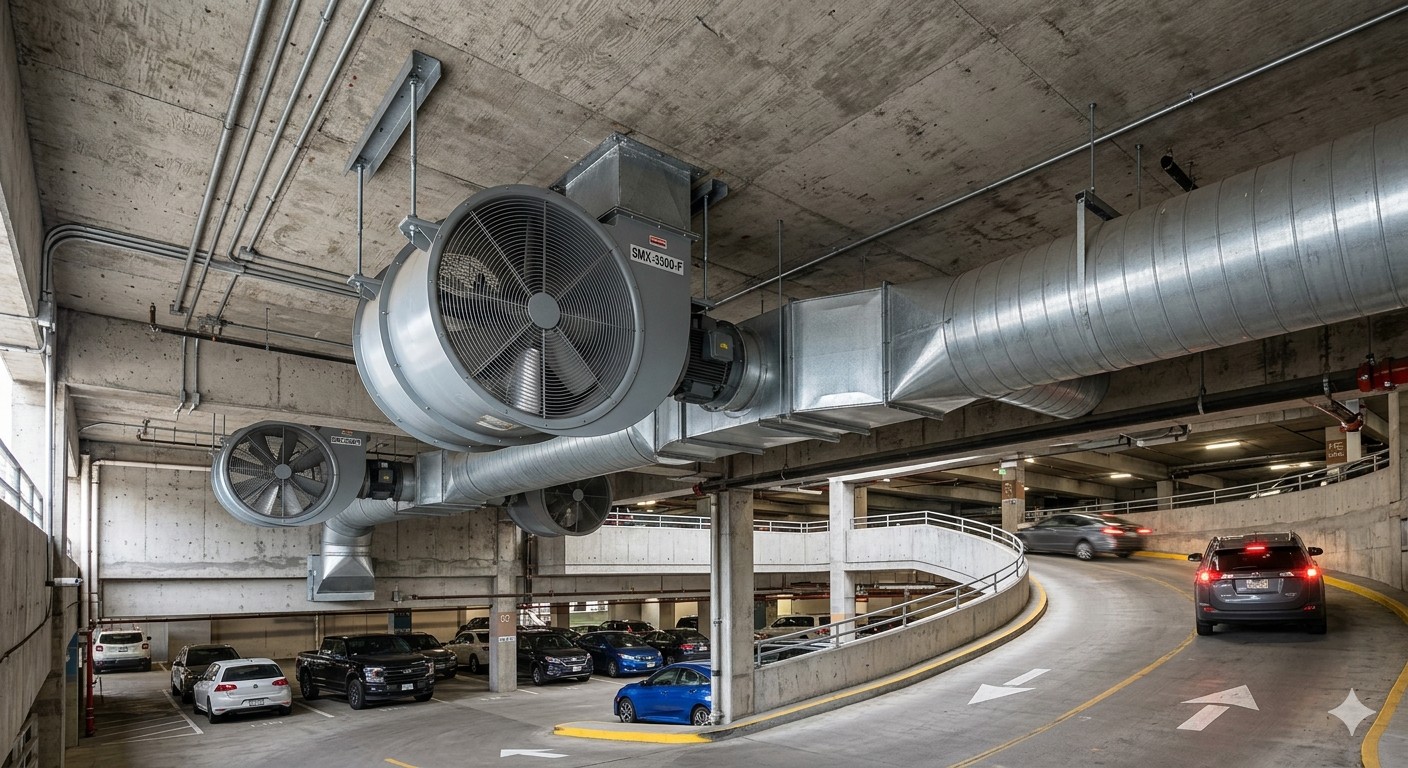
Enclosed structures require mechanical systems: supply fans, exhaust fans, and ductwork designed to achieve the required air changes per hour. These may be configured as central systems serving the entire structure or as distributed systems with multiple fan units serving defined zones.
Jet fans — ceiling-mounted axial fans that move air horizontally across a floor level — have become common in low-clearance garages where traditional ductwork is impractical. They improve air distribution without requiring extensive duct systems but introduce more mechanical components requiring maintenance.
Demand-Controlled Ventilation (DCV)
DCV systems pair CO sensors with variable-frequency drives (VFDs) on fan motors, modulating ventilation rate based on measured CO concentration rather than running fans at full capacity continuously. When properly calibrated, DCV systems reduce energy consumption significantly — often 30–50% compared to constant-volume operation — while maintaining air quality compliance.
ASHRAE 62.1 and most current codes permit DCV as an alternative to continuous full-rate mechanical ventilation. Some jurisdictions require DCV for new construction above a certain size threshold.
Parking Tech covers emerging DCV control technologies and integration with building management systems, which is useful context for facilities planning system upgrades.
CO Monitoring: Requirements and Practice
Sensor Placement
CO sensor placement follows code requirements and engineering judgment. The IMC requires sensors to be located no more than 10 feet from potential CO sources — typically vehicle entry/exit ramps, drive lanes, and queue areas. Most codes require a minimum of one sensor per 5,000–10,000 square feet, though the specific standard varies.
Sensors should be mounted at vehicle exhaust height — typically 12 to 18 inches above the floor — not at ceiling level, where CO concentration will lag significantly behind floor-level concentrations.
Alarm Setpoints
Standard alarm setpoints for CO monitoring are typically:
- Low alarm (fan activation): 25–35 ppm
- High alarm (strobe/audible alert, possible evacuation): 50–100 ppm
Setpoints should be configured to match local code requirements and life safety system integration. Document setpoints in your building systems manual and verify them during annual inspection.
Sensor Calibration and Replacement
Electrochemical CO sensors drift over time and must be calibrated on a regular schedule — typically annually at minimum, with bump testing quarterly. Most sensors have a service life of 3–5 years and require replacement regardless of apparent function. Sensors that have exceeded their rated service life may continue to display readings while losing accuracy.
Maintain a calibration log for each sensor. Include date, technician, calibration gas concentration, pre- and post-calibration readings, and next scheduled calibration date.
Maintenance Practices for Ventilation Systems
Fan and Motor Inspection
Inspect fans quarterly. Check for:
- Belt tension and wear (for belt-driven units)
- Bearing condition — listen for grinding or excessive vibration
- Blade condition and cleanliness — dust and debris buildup reduces efficiency
- Damper operation — verify dampers open fully on activation
- VFD operation and error codes (for DCV-controlled units)
Document the inspection and any deficiencies found. Fan failure in a ventilation system is not a cosmetic issue — it’s a life safety gap that requires prompt correction.
Ductwork and Louver Condition
Inspect visible ductwork annually for corrosion, mechanical damage, and connection failures. Clean intake louvers and exhaust grilles to maintain design airflow. In coastal or high-humidity environments, stainless steel or coated ductwork may be required to control corrosion rates.
Controls and Interlock Testing
Test CO monitor-to-fan interlocks annually. Introduce a CO test source at each sensor location and verify that:
- The correct fan zone activates within the required response time
- Alarms activate at configured setpoints
- BMS or building automation system receives the signal correctly
- Fans deactivate when CO level drops below the reset threshold
Fire Mode Testing
If the ventilation system serves a dual role as a smoke management system, test fire mode operation per the requirements of your fire protection engineer and the authority having jurisdiction (AHJ). This typically requires coordination with the fire alarm contractor and may require AHJ observation.
Facility Manager Checklist
A condensed reference for annual review:
- Verify current adopted ventilation code standard and local amendments
- Confirm structure classification (open vs. enclosed) is still valid
- Calibrate all CO sensors; replace any beyond service life
- Test CO-to-fan interlock for each zone
- Inspect all fans, motors, and belts; document condition
- Clean intake louvers and exhaust grilles
- Review VFD settings and verify DCV setpoints are unchanged
- Test smoke management / fire mode (if applicable)
- Confirm alarm setpoints match current code and life safety plan
- Update maintenance log and calibration records
Parking Professional provides technical resources on mechanical system standards for parking structures, including guidance on DCV implementation and CO monitoring best practices.
Ventilation failures in parking structures produce liability exposure, regulatory penalties, and — at their worst — fatalities. Treating this as a routine HVAC maintenance category rather than a life safety system is a management error. Know what you have, maintain it systematically, and document everything.
Frequently Asked Questions
What ventilation rates do ASHRAE 62.1 and the IMC require for enclosed parking garages? ASHRAE Standard 62.1 requires 1.5 CFM per square foot of floor area for enclosed parking garages when continuous mechanical ventilation is used. The International Mechanical Code (IMC) sets a minimum of 0.75 CFM per square foot. Demand-controlled ventilation (DCV) systems that use CO sensors to modulate ventilation rates can comply with these standards while reducing energy consumption by 50 to 70 percent compared to continuous operation at the minimum rate.
At what height should CO sensors be mounted in parking garages? CO sensors in parking garages should be mounted at 12 to 18 inches above the floor level, because CO from vehicle exhaust is slightly heavier than air and concentrates near the floor before mixing. Sensors mounted at typical outlet height (4 to 5 feet) detect CO later in the concentration buildup, providing less response time before alarm thresholds are reached. Low mounting is especially important in facilities with poor natural air mixing.
What CO concentration levels trigger fan activation and evacuation alarms? DCV systems typically activate fans at low CO alarm levels of 25 to 35 ppm. A high alarm level of 50 to 100 ppm triggers a more aggressive ventilation response and, depending on the system configuration, may activate a building evacuation alarm. These thresholds are set below OSHA’s PEL of 50 ppm (8-hour TWA) to provide a safety margin for employees and users with extended exposure.
How often should parking garage CO sensors be calibrated and tested? CO sensors require annual calibration using certified calibration gas to verify accuracy — sensor drift over time can produce false readings that either fail to trigger alarms at true CO concentrations or generate false alarms that disrupt operations. Quarterly bump testing (exposing the sensor briefly to a known CO concentration to confirm the alarm activates) verifies sensor and alarm circuit function between annual calibrations. Sensors that fail calibration or bump testing must be replaced immediately.
What is the recommended replacement interval for CO sensors in parking garages? CO sensors in parking garages should be replaced every 3 to 5 years. Electrochemical sensors — the most common type in parking applications — degrade over time through exposure to vehicle exhaust, humidity, and contaminants. Sensors approaching end of their rated service life become less reliable even when they appear to pass calibration checks. Proactive replacement on a schedule is more reliable and less expensive than waiting for sensor failure.
Further Reading from Authoritative Sources
- OSHA carbon monoxide exposure standards and parking garage guidance — osha.gov is on the whitelist as the federal workplace safety authority and provides the regulatory basis for CO exposure limits that drive parking garage ventilation requirements.
- U.S. Department of Energy demand-controlled ventilation energy savings resources — energy.gov is on the whitelist and the DOE’s DCV resources directly support the energy savings claims and implementation guidance for CO-sensor-controlled ventilation in this article.