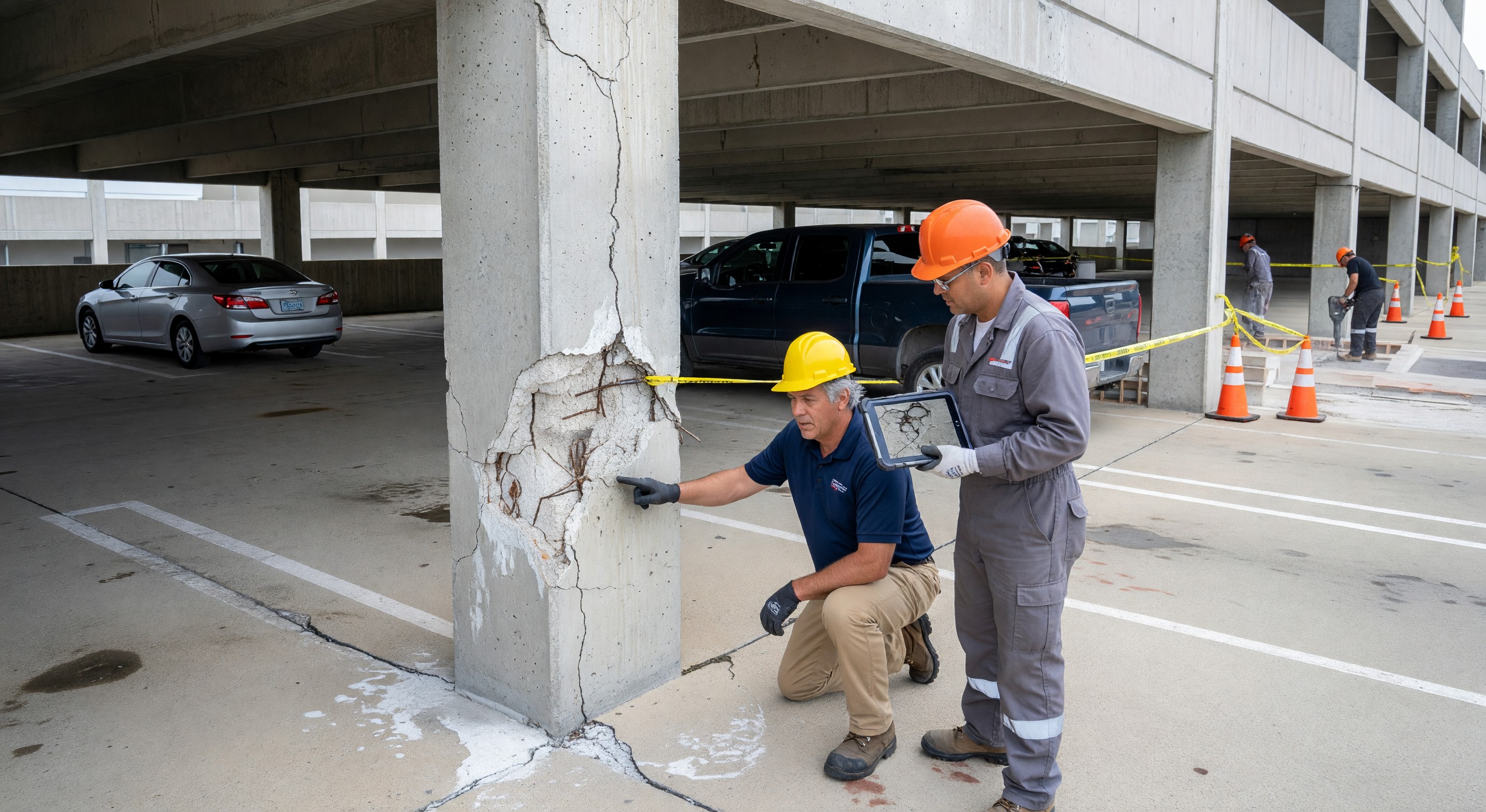
Concrete repair in parking structures is a specialized discipline that many facility managers encounter without formal preparation. When a structural engineer reports “moderate delamination with spalling potential” or recommends “full-depth repairs with chloride extraction,” understanding the terminology, the urgency, and the remediation options is essential to making good decisions about a significant capital commitment.
This guide explains the major types of concrete deterioration in parking structures, the repair methodologies for each, and how to manage a concrete repair project from assessment through completion.
Why Parking Structures Are Particularly Vulnerable
Parking structures face an unusually aggressive combination of deterioration mechanisms. The two dominant mechanisms are chloride-induced corrosion and carbonation-induced corrosion, both of which attack reinforcing steel rather than the concrete itself.
Chloride attack: Deicing salts applied to parking decks or tracked in by vehicles contain chloride ions that migrate through concrete and reach reinforcing steel. Chlorides destroy the passivating oxide layer on steel, initiating active corrosion. As reinforcing steel corrodes, it expands to several times its original volume, creating internal tensile stress that fractures and spalls the concrete cover above it.
Carbonation: Atmospheric CO₂ reacts with concrete to form calcium carbonate, lowering the pH of the concrete pore solution. Below a pH threshold of approximately 9, the passive protection of reinforcing steel is lost and corrosion begins. Carbonation proceeds from the surface inward at rates of 1 to 3 mm per year in typical conditions.
Freeze-thaw: Water trapped in concrete pores expands approximately 9 percent when it freezes, creating tensile stresses in the concrete matrix. Repeated freeze-thaw cycles cause progressive scaling of the concrete surface.
Understanding which mechanism is active in your structure informs the appropriate repair strategy.
Recognizing Concrete Deterioration
Facility managers who can recognize developing concrete deterioration catch problems before they escalate to safety hazards.
Spalling: Chunks of concrete breaking away from the surface, exposing reinforcing steel. Spalling is a late-stage symptom — the underlying deterioration has been developing for years. Exposed reinforcing steel requires immediate remediation to prevent continued deterioration and personnel hazard from falling concrete.
Delamination: Separation of the concrete into horizontal layers, often with the delaminated layer intact but hollow when tapped with a hammer. Delamination that has not yet spalled is a near-term hazard — identify and repair before it breaks into falling pieces.
Map cracking (crazing): A network of fine surface cracks in a map-like pattern, indicating freeze-thaw damage to the concrete surface. Early-stage map cracking can be addressed with penetrating sealers; advanced crazing indicates scaling damage that may require surface restoration.
Longitudinal cracks: Cracks running parallel to reinforcing steel, often indicating reinforcement corrosion. This pattern is a signal that chloride or carbonation attack has initiated active corrosion.
Staining: Brown rust staining on concrete surfaces indicates active reinforcement corrosion. Rust staining without visible cracking or spalling is an early warning that delamination and spalling will follow.
Concrete Repair Methodologies
Partial-Depth Repairs
Used for surface deterioration where the deterioration does not extend to the reinforcing steel level. The deteriorated concrete is removed to a specified depth by saw-cutting, jackhammering, or scarifying, and replaced with repair mortar or concrete.
Selection criteria: Partial-depth repairs are appropriate where soundings (hammer tapping) reveal delamination extending no more than approximately 1/2 inch from the surface, where no corrosion of reinforcing steel is present, and where the deterioration mechanism does not extend to reinforcing steel depth.
Materials: Cementitious repair mortars, polymer-modified mortars, and epoxy mortars are the major material categories. Material selection depends on service environment, required cure time, and structural requirements.
Full-Depth Repairs
Used where deterioration extends to or beyond the reinforcing steel. Full-depth repairs remove all concrete within the repair boundary to below the reinforcing steel, allowing inspection and treatment of the steel before placing new concrete.
Selection criteria: Full-depth repairs are required wherever reinforcing steel is exposed, corroded, or where chloride content at the steel level exceeds the initiation threshold.
Reinforcement treatment: Corroded reinforcing steel must be cleaned by abrasive blasting to a near-white condition (SSPC SP-10 or better) before patching. Severely corroded bars may require replacement. Applying a corrosion-inhibiting coating to cleaned bars before patching extends repair service life.
Electrochemical Treatments
For structures with widespread chloride contamination that has not yet advanced to active corrosion, electrochemical treatments — cathodic protection and electrochemical chloride extraction — can treat the entire structure systematically.
Impressed current cathodic protection (ICCP): A low-level electrical current is maintained continuously through the concrete and reinforcing steel, shifting the steel potential to a range where active corrosion is thermodynamically unfavorable. ICCP systems require ongoing monitoring and maintenance.
Electrochemical chloride extraction (ECE): A short-duration high-current treatment that drives chloride ions from the concrete. ECE is typically a one-time treatment rather than a continuous system.
These methods require engineering analysis to evaluate suitability and design the treatment system.
Managing Concrete Repair Projects
Contractor Selection
Concrete repair in parking structures requires contractors with specific knowledge and experience. General concrete contractors without parking structure experience may not apply the preparation standards and material specifications that parking structure repairs require.
Evaluate contractors on: experience with parking structure repair specifically (not just general concrete), ability to provide references from similar projects, in-house core competencies (some general contractors subcontract the specialty work), and familiarity with applicable standards (ICRI, ACI).
Request detailed work plans that describe surface preparation methods, repair material specifications, quality control testing, and cure protocols before awarding work.
Scope Definition
Define repair boundaries with engineering input. Repairs that are too small miss deteriorated concrete adjacent to the repair, leading to early repair failure. A common failure mode is repairing obvious spalled areas while leaving delaminated concrete adjacent to the patch — the adjacent delamination will spall shortly after, requiring another repair cycle.
Engineering sounding surveys (typically performed with a hammer or chain drag) should define the full extent of deterioration before repair boundary markup.
Quality Control
During repair execution, verify: soundness of concrete removal (no remaining delaminated or hollow areas at repair edges), cleanliness of repair area before patch placement, reinforcing steel preparation meets specification, repair material matches specification, and proper curing protocol is followed.
Document repairs photographically — before, during, and after. Photographs that show reinforcing steel condition before patching are valuable for future condition assessments.
FAQ
How long should concrete repairs last? Properly executed concrete repairs in parking structures should last 10 to 20 years or more. Premature repair failure (1 to 5 years) typically indicates inadequate preparation, wrong material selection, or an active deterioration mechanism that is continuing to undermine the repair.
Is it better to do small repairs continuously or save up for a major repair project? Immediate hazards (spalled areas with loose or falling concrete, exposed steel at head height) must be addressed promptly. Broader deterioration benefits from a programmatic approach — accumulated repairs in a single mobilization are much more cost-effective than individual calls for each new spall.
Can I paint over deteriorated concrete to extend repair cycles? Coatings can slow carbonation and provide some protection, but they do not address existing deterioration or active corrosion. Painting over structurally deteriorated concrete provides cosmetic improvement at the cost of obscuring the true condition.
When should I close a parking area versus making emergency repairs? Close the area whenever: there is a realistic risk of concrete falling on vehicles or personnel, spalled areas have exposed sharp steel reinforcement that could injure pedestrians, or engineering assessment indicates structural capacity is compromised. When in doubt, close and consult a structural engineer before reopening.
Further Reading from Authoritative Sources
- International Parking and Mobility Institute concrete repair and structural maintenance resources — parking-mobility.org (IPMI) is on the whitelist as the primary parking industry authority with directly relevant structural maintenance content for parking garage operators.
- Transportation Research Board parking structure concrete deterioration and repair research — trb.org is on the whitelist and TRB’s research on concrete deterioration and repair directly supports the technical guidance on corrosion mechanisms and repair selection in this article.