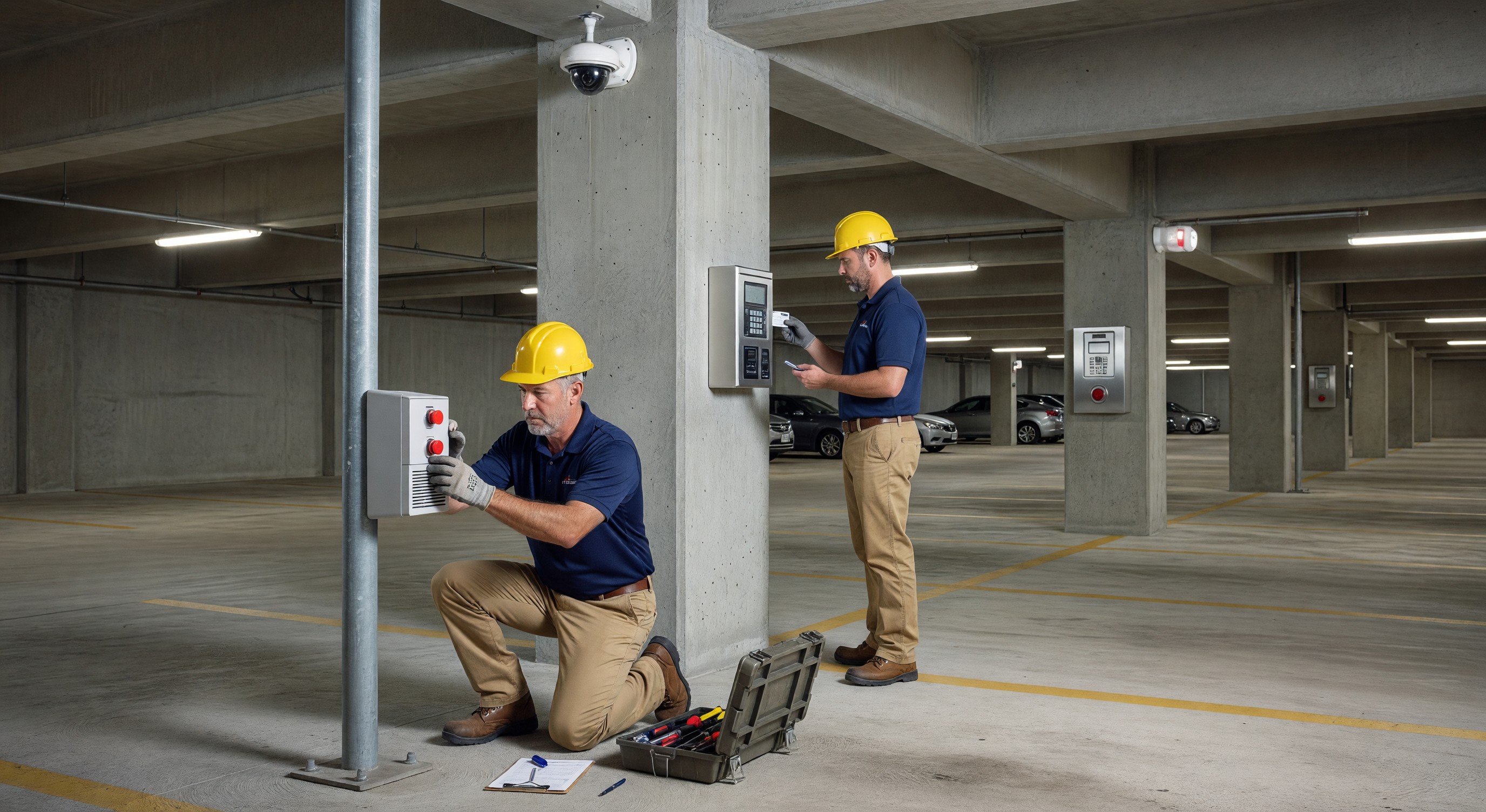
Security systems in parking facilities are only as good as their maintenance programs. A CCTV camera whose lens is obscured by spider webs, an emergency call station with a dead battery, or a card reader that intermittently fails provide a false sense of security while creating real liability exposure. When an incident occurs and the security system did not function as intended, the documentation trail of missed maintenance is discoverable.
This guide covers the maintenance requirements for each major security system category in parking facilities, the inspection intervals that represent reasonable practice, and the documentation framework that supports both effective operations and legal defensibility.
CCTV and Video Surveillance System Maintenance
Video surveillance is the most commonly deployed parking security technology and the most frequently neglected in terms of maintenance. Many parking facilities have cameras that are positioned, activated, and then not touched again until an incident reveals they have not been recording properly for months.
Monthly maintenance tasks:
- Visual inspection of each camera: lens clean and unobstructed, housing intact, no visible physical damage
- Spot-check recording function: pull up live view for each camera from the management station and verify active image
- Verify recording storage (NVR or DVR): confirm recording media has not failed and retention schedule is functioning
- Check for camera error alerts in the system management software
Quarterly maintenance tasks:
- Clean camera lenses with appropriate cleaning solution — outdoor cameras accumulate atmospheric contamination that degrades image quality
- Test pan-tilt-zoom (PTZ) function on PTZ cameras
- Verify night vision function for cameras with IR illumination — test after dark
- Confirm that camera field of view has not been obstructed by vegetation growth, new signage, or structural changes
- Verify time synchronization — cameras with incorrect timestamps are problematic for incident investigation
Annual maintenance tasks:
- Full system health report from the VMS (Video Management System): camera uptime statistics, recording failure events, storage capacity and usage
- Physical inspection of cable conduit at roof penetrations and in areas with moisture exposure
- Image quality assessment for all cameras against original installation documentation — compare field of view to intended coverage
- Battery backup test for UPS units serving camera systems
Storage verification: Confirm that your recording retention settings match your policy. A policy of 30-day retention requires verification that all cameras are actually recording continuously at the specified quality, that the storage system has adequate capacity, and that oldest footage is being overwritten correctly.
Emergency Call Station Maintenance
Emergency call stations (also called blue light stations, emergency phones, or help phones) are critical safety infrastructure. Their entire value depends on functioning properly when needed — which is precisely when you cannot discover they are broken.
Monthly test protocol:
- Activate each emergency call station and verify connection to the receiving station or call center
- Verify audio quality in both directions
- Verify that the visible indicator (LED, blue light) activates when the call button is pressed
- Verify that the station identifies its location correctly to the receiving station (location ID transmission)
- Log the test result — both successful tests and any failures
Annual maintenance:
- Battery inspection and replacement on stations with battery backup
- Physical housing inspection for damage, corrosion, and weatherproofing integrity
- Communication pathway test (cellular, VoIP, or copper depending on system type)
- Review of any pending updates from the manufacturer for software or firmware
Response time measurement: An emergency call station that connects to a call center is only as effective as the response time on the other end. Conduct periodic blind tests (notify your security team afterward) to measure actual response times.
Access Control System Maintenance
Card readers, credential scanners, and access control panels are security infrastructure that also directly affects revenue operations when they control parking access.
Monthly inspection:
- Verify correct operation of all access-controlled entry and exit points — test with valid and invalid credentials
- Review access control system event logs for error messages, door held alarms, or anomalous access events
- Inspect card readers for physical damage or tampering
- Verify that denied access responses (gate does not open, alarm triggers) function correctly
Annual maintenance:
- Battery backup test for access control panels and door controllers
- Contact inspection on door contacts and request-to-exit devices
- Firmware update review — install approved updates from manufacturer
- User credential audit — remove inactive credentials from the system
- Review alarm recipient list and contact information
Integration testing: If your access control system integrates with PARCS or other building systems, test the integration annually. Integration failures are often silent — the systems appear to operate independently while failing to communicate properly.
Lighting as a Security System Component
Parking facility lighting is both a safety system and a security countermeasure. For security purposes, maintain IES-recommended illuminance levels at all times and ensure lighting failures are identified and corrected promptly.
Daily checks (for attended facilities): Staff or security personnel who observe lighting failures should report them through a defined process that results in same-day or next-day correction.
Monthly patrol: Walk the facility after dark monthly to identify burned-out or dim luminaires, lights that have been physically damaged, and areas where vegetation or structural changes have created new shadowed areas.
Failure response: Establish a maximum acceptable downtime for lighting failures in security-critical areas. Main drive lanes and accessible routes: same-day correction. Secondary areas: within 48 hours. Remote corners: within one week. This policy, documented and followed, demonstrates active light management.
Intercom and Assistance Systems
Customer intercoms at parking pay stations, garage entrances, and assistance call points require maintenance to remain effective.
Monthly testing: Call from each customer intercom and verify connection to the staffed station or call center. Verify audio quality. Verify that the intercom correctly identifies its location.
Quarterly maintenance: Clean microphone and speaker openings with compressed air. Inspect housing weatherproofing. Check mounting hardware for looseness.
Annual service: Full audio system test with level calibration. Weatherproofing inspection and replacement of degraded seals. Review and update call routing if contact information has changed.
Documentation and Record Keeping
Security system maintenance documentation serves two purposes: operational tracking to ensure nothing is missed, and legal evidence of reasonable care if an incident results in litigation.
Maintain a security system maintenance log that records: the date of each inspection or test, the name of the person performing it, the outcome (pass/fail with description of failures), and corrective action for failures.
Retain these records for a minimum of three years. If your jurisdiction has a statute of limitations on premises liability claims longer than three years (some states permit claims up to six years), retain records accordingly.
FAQ
How do I justify the cost of security system maintenance to ownership? Frame it in terms of liability risk. A premises liability claim arising from a security incident at a facility with documented neglected security systems creates far greater financial exposure than the annual cost of maintenance. Insurance carriers also increasingly require demonstrated security system maintenance programs as a condition of favorable terms.
Should I use a single vendor for all security system maintenance? A single-vendor approach for security system maintenance has coordination advantages but creates dependency on one contractor. Where a single vendor has competence across all systems, consolidation simplifies procurement and accountability. Where systems span multiple brands (common in older facilities that have added systems over time), multi-vendor maintenance may be necessary.
What response time should I expect from security system service technicians? Critical systems (emergency call stations, access control, CCTV in high-traffic areas) warrant same-day or next-business-day emergency service. Non-critical repairs can wait for scheduled service visits. Establish response time expectations in service contracts before signing.
When should I consider upgrading rather than maintaining aging security systems? Consider upgrading when: maintenance costs approach 15 to 20 percent of replacement cost annually, system capabilities no longer meet your security needs, manufacturer support has ended for major components, or integration with new PARCS or building systems requires modern security infrastructure.
Further Reading from Authoritative Sources
- International Parking and Mobility Institute security system maintenance resources — parking-mobility.org (IPMI) is on the whitelist as the primary parking industry authority with directly relevant security system maintenance content for facility managers.
- BOMI International security system management and maintenance resources — bomi.org is on the whitelist as a facility management authority whose security system management curriculum directly applies to the parking security maintenance framework in this article.