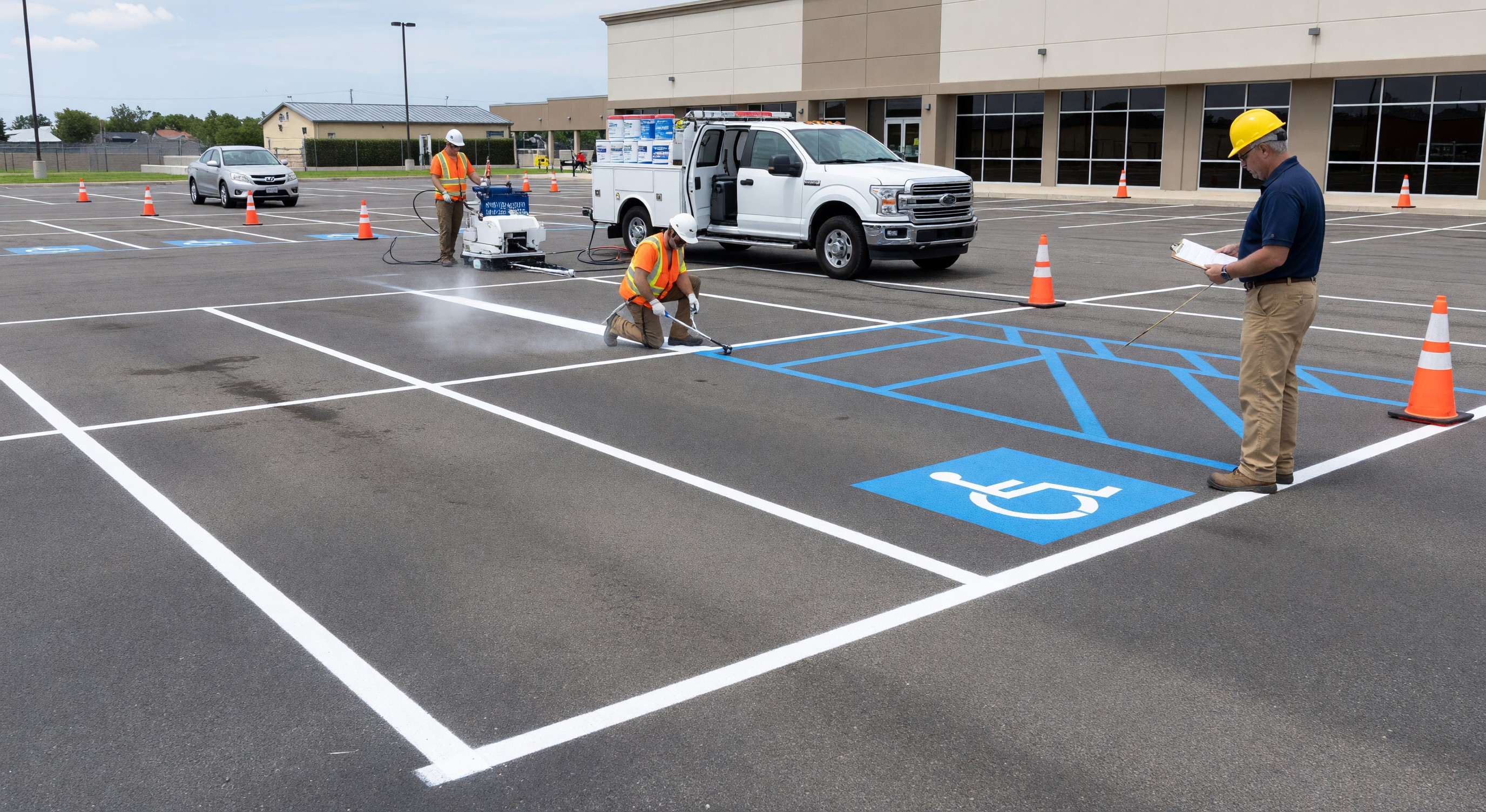
Parking lot striping is one of those maintenance items that tends to slide on the priority list until it is embarrassingly overdue. Faded stalls, worn accessible space markings, and illegible directional arrows do not cause immediate failure — they just gradually erode the professionalism, safety, and compliance of the facility.
A systematic approach to striping maintenance prevents the situation from getting ahead of you. This guide covers the standards that govern parking lot markings, the specifications that determine how long they last, and the project management practices that get good results from restriping contractors.
Stall Dimension Standards
Parking stall dimensions in the United States are governed by local zoning ordinances and building codes, which draw from model codes and industry guidance. There is no single national standard, but dimensional ranges are fairly consistent.
Standard parallel-park stalls: Rarely used in new facilities, but where present, 8 to 9 feet wide by 20 to 24 feet long is typical.
90-degree stalls: The most common configuration. Standard width is 8.5 to 9.5 feet, with 9 feet being the most common standard in commercial facilities. Stall depth (perpendicular distance from drive aisle to back of stall) is typically 18 to 19 feet.
Compact stalls: Some zoning codes permit compact stalls of 7.5 to 8 feet wide and 16 to 17 feet deep, with a percentage cap (often 20 to 30 percent of total stalls).
Drive aisle widths: Two-way drive aisles serving 90-degree parking should be 24 feet wide minimum (per ITE standards). One-way aisles serving 90-degree parking can be 20 to 22 feet.
Accessible stall dimensions: ADA-compliant accessible stalls are 8 feet wide minimum with a 5-foot access aisle, or 11 feet wide with a 5-foot access aisle for van-accessible spaces. Van-accessible spaces must have passenger-side aisles.
Before any restriping project, verify that your stall layout is consistent with current zoning requirements and ADA standards. A restriping project is the ideal time to correct any layout deficiencies.
ADA-Required Markings
Accessible parking markings are mandatory, specific, and failure to maintain them creates ADA compliance risk.
Required pavement markings:
- Accessible stall boundary: white or blue pavement markings defining the stall
- Access aisle: marked with “NO PARKING” in letters at least 12 inches high, and hatch lines or a contrasting color to distinguish the aisle from the parking stall
- International Symbol of Accessibility (ISA): painted on accessible stall surface (required or recommended by many jurisdictions; verify local requirements)
Color: Blue paint for accessible stall markings is standard in California and is becoming more common nationally. White marking is acceptable under federal ADA standards. Check local requirements.
Access aisle markings are the most commonly deficient element of accessible parking. Faded “NO PARKING” text and worn aisle markings are frequently cited in ADA enforcement complaints. Include access aisles in your restriping schedule on the same interval as stall markings.
Paint Specifications
Parking lot paint comes in traffic-grade latex (water-based) and alkyd (oil-based) formulations, with performance differences that affect service life.
Traffic latex: Water-based, low VOC, faster drying, environmentally cleaner to use. Service life of 2 to 4 years in moderate-traffic lots. Preferred for most commercial applications due to ease of use and environmental compliance.
Alkyd: Oil-based, higher durability, better adhesion to new asphalt. Service life of 3 to 6 years. Higher VOC content; some jurisdictions restrict use. Better performance in harsh weather climates.
Thermoplastic: Preformed or hot-applied thermoplastic provides the longest service life (5 to 10 years) and is highly visible. Higher cost limits use to high-priority locations such as accessible stalls, stop bars, and crosswalks.
Paint thickness (wet mil) affects service life. Commercial traffic paint applied at 15 to 20 wet mils produces better service life than thin applications. Specify paint at minimum 15 wet mils in contractor scope documents.
Color standards:
- Standard stall lines: white (most common) or yellow
- Drive lane markings (arrows, text): white
- Fire lanes: red (yellow curb in some jurisdictions)
- Accessible spaces: blue (in California and other states) or white with blue ISA
- Reserved space indicators: yellow
Restriping Intervals
How often should you restripe? The answer depends on traffic volume, climate, and paint quality.
Low-traffic surface lots (under 200 vehicles/day): Every 3 to 5 years with quality traffic latex.
Moderate-traffic commercial lots (200-600 vehicles/day): Every 2 to 3 years.
High-traffic lots (600+ vehicles/day): Every 1 to 2 years.
Structured parking: Deck surfaces with traffic coatings applied typically see paint wear faster than surface lots due to the abrasive nature of coated deck surfaces. Budget for striping every 1 to 2 years in heavily trafficked garages.
ADA markings: Inspect accessible parking markings more frequently. Access aisle “NO PARKING” text wears faster than stall lines; it may need touch-up or restriping between full lot restriping cycles.
Managing a Striping Project
Layout verification before marking: Before any new striping or restriping project, walk the lot with the contractor and verify the layout. Confirm accessible space locations, count and type; fire lane locations and requirements; directional arrows and stop bar locations; and any changes from the previous layout. Small changes are easy to implement before striping; corrections after the fact are expensive.
Surface preparation: Striping applied to dirty, wet, or newly sealed surfaces fails prematurely. Require the surface to be clean and dry before paint application. If seal coating was recently applied, allow 48 to 72 hours of cure time before striping.
Measurement documentation: Document stall count and accessible space count before and after the project. This confirms that the layout was reproduced correctly and provides updated facility records.
Traffic control: Coordinate striping work during low-traffic periods. Morning and evening commuter peaks, loading dock hours, and event periods should be avoided. Some lots require overnight work or weekend scheduling to minimize disruption.
FAQ
Can I restripe over old markings, or do I need to remove them first? If the old markings are in substantially the same location as the new markings, painting directly over them is acceptable. If the new layout differs from the old — changed stall angles, relocated accessible spaces, new directional patterns — old markings must be removed (by grinding or sandblasting) or blacked out before the new markings are applied. Ghosted old markings confuse drivers and undermine the effectiveness of the new layout.
How do I handle striping near trees that have damaged the pavement? Tree root damage creates uneven surfaces where paint application is difficult and drainage grades may have changed. Address tree root damage and pavement repairs before restriping. Restripe the repaired areas after pavement has stabilized.
What specifications should I require from striping contractors? Minimum specifications: paint type and specification (meet APWA or state DOT traffic paint specs), application rate (15 wet mils minimum), stall dimensions (verify against your layout), ADA compliance documentation, and warranty (1 year minimum for standard applications).
Should I consider changing from 9-foot stalls to 8.5-foot stalls to add spaces? Evaluate carefully. Narrower stalls generate more door-ding complaints, reduce accessibility for larger vehicles, and may not meet local zoning minimums. For a 100-space lot, changing from 9-foot to 8.5-foot stalls might add 5 to 8 spaces. Weigh the revenue from additional spaces against the customer experience impact. Accessible spaces cannot be reduced below ADA minimums regardless of layout changes.
Restriping projects are typically easiest to execute as part of a coordinated summer maintenance window plan — sequenced after any sealcoating or resurfacing, and alongside signage refreshes and drainage clearing.
Further Reading from Authoritative Sources
- Institute of Transportation Engineers parking design and striping standards — ite.org is on the whitelist and ITE’s parking design publications are the industry standard reference for stall dimensions and drive aisle geometry discussed in this article.
- U.S. Access Board accessible parking space marking requirements — access-board.gov is on the whitelist as the authoritative source for ADA accessible space marking requirements that are a core compliance dimension of parking lot striping.