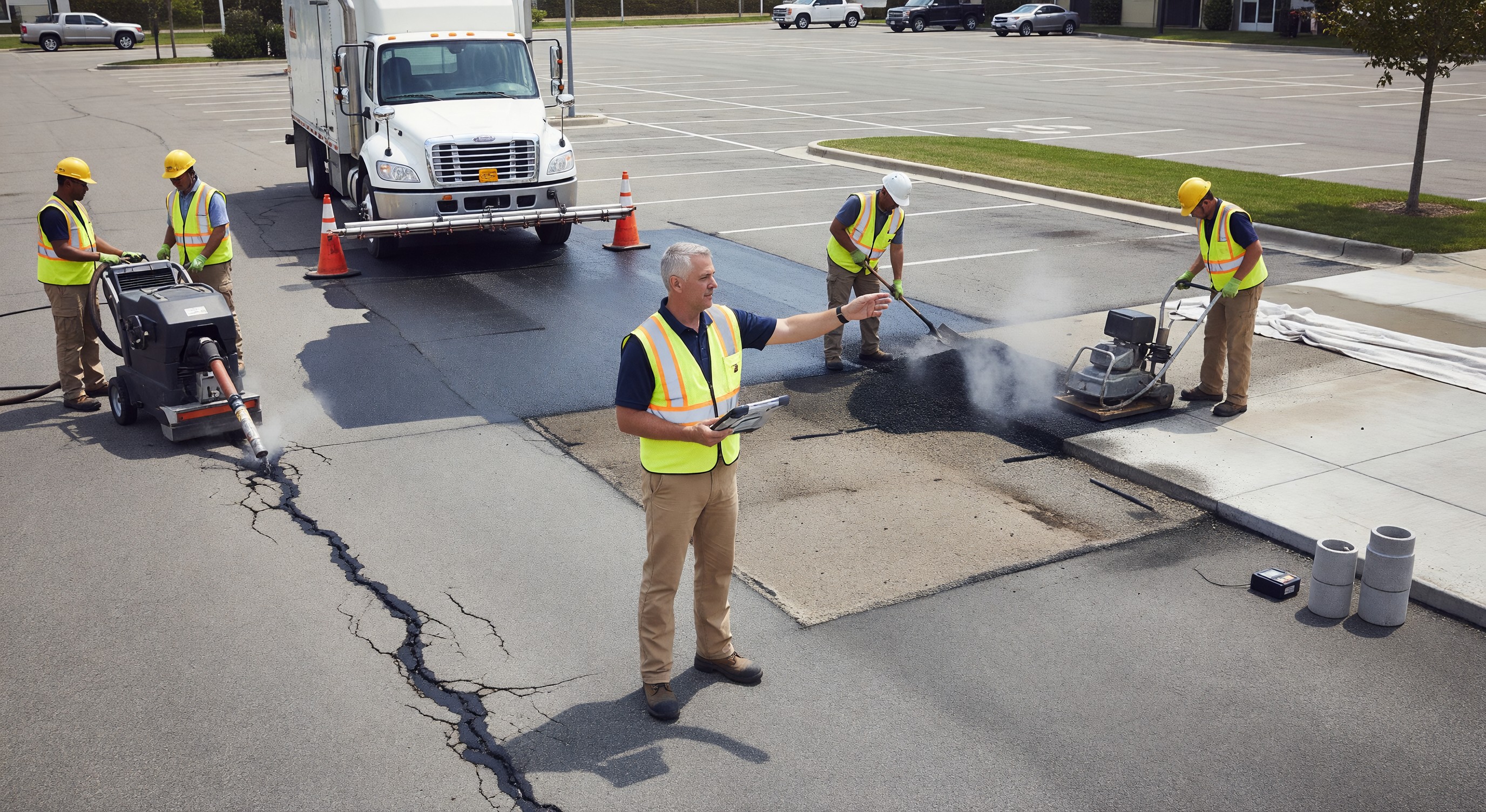
Asphalt pavement represents one of the largest capital assets in a surface parking facility. A properly maintained parking lot can deliver 20 to 30 years of serviceable life before requiring full reconstruction. A neglected lot may need reconstruction in 12 to 15 years. The difference between these outcomes is a consistent preventive maintenance program — applied at the right intervals, using the right materials.
This guide covers pavement maintenance fundamentals, the sequence of interventions that extend asphalt life, and how to build a maintenance program that protects your asset.
Understanding Pavement Deterioration
Asphalt deteriorates through a combination of three mechanisms: oxidation (from UV exposure and air), water intrusion (through surface cracks), and traffic loading (from vehicle weight). Understanding the interplay between these mechanisms explains why early intervention is so much more cost-effective than late-stage repair.
Fresh asphalt is dense, flexible, and resistant to water. As it oxidizes over its first two to five years, it loses flexibility and becomes brittle. Thermal cycling — expanding and contracting with temperature changes — causes fatigue cracking in brittle pavement. Once cracking begins, water enters the pavement structure and begins attacking the base from below. Freeze-thaw cycles in cold climates accelerate base deterioration dramatically.
The cost relationship between pavement condition and repair follows an exponential curve. A crack sealing treatment at year 3 to 5 that costs $0.10 to $0.20 per square foot prevents deterioration that would require $3 to $8 per square foot in resurfacing five years later. At year 15, the same lot may require full reconstruction at $8 to $15 per square foot because water damage has destroyed the base.
Pavement Maintenance Interventions in Sequence
Crack Sealing (Years 1-8)
Crack sealing is the most cost-effective pavement intervention. Applied to cracks wider than 1/8 inch that have not yet connected into alligator cracking patterns, crack sealing prevents water from entering the base and inhibits crack propagation.
Hot-applied rubberized crack sealer is the standard material for crack sealing in parking lots. The sealer is heated to application temperature, routed (if cracks are wide enough) or direct-applied into the crack, and allowed to cool. Properly applied, crack sealing extends pavement life by 3 to 7 years.
For crack sealing to be effective, cracks must be clean and dry. Applications to wet, dirty, or contaminated cracks fail prematurely. Best practice is to power-blow cracks with compressed air and apply sealer on a dry day with moderate temperature.
Seal Coating (Years 3-7, Then Every 5-7 Years)
Seal coating applies a protective film over the pavement surface that blocks UV oxidation, improves water resistance, and restores surface flexibility. Properly applied seal coat extends pavement life and improves appearance.
Coal tar emulsion and asphalt emulsion are the two primary seal coat materials. Coal tar emulsion provides better fuel and oil resistance and longer durability; it is the standard choice for most parking facilities. (Note: some jurisdictions have restricted coal tar sealer due to polycyclic aromatic hydrocarbon content in stormwater runoff — verify local restrictions.)
Do not apply seal coat to new asphalt before it has cured for 90 days minimum, or to pavement with active structural cracking (seal coat is a surface treatment, not a structural repair). Seal coat applied over structural problems temporarily hides them and may accelerate underlying deterioration.
Surface Milling and Overlay (Years 10-18)
When pavement has oxidized beyond the reach of seal coating but the base structure is still sound, surface milling (removing the top 1.5 to 3 inches of the existing pavement) and placing a new asphalt overlay extends service life at a fraction of full reconstruction cost.
Mill and overlay works best when: the existing base is solid (no base failure or severe alligator cracking), the elevation can accommodate additional pavement thickness (drainage grades and curb heights are adequate), and utilities, curbs, and drainage inlets do not create prohibitive edge treatment costs.
A mill and overlay costs $2 to $5 per square foot and can extend service life 10 to 15 years.
Full Reconstruction (Years 20-30)
Full reconstruction removes all existing pavement and base material and installs a new pavement section from the subgrade up. Full reconstruction is warranted when base failure has occurred, when grades need significant correction, or when the cumulative cost of repair exceeds the replacement cost value.
Full reconstruction costs $8 to $15 per square foot depending on depth and local market. Plan for reconstruction in your long-term capital reserve plan.
Concrete Parking Lots
Concrete parking lots have different maintenance requirements than asphalt. They last longer (30 to 40 years or more with proper maintenance) but have higher initial cost and different failure modes.
Joint maintenance: Concrete pavement has control joints and expansion joints that require periodic sealant replacement. Joint sealant prevents water intrusion and debris infiltration that causes joint cracking and spalling. Joint sealant should be replaced every 7 to 12 years.
Crack repair: Cracks in concrete pavement are repaired with epoxy or polyurethane grout injection for structural cracks, or with flexible sealant for non-structural surface cracks.
Surface deterioration: Concrete surface scaling (loss of the wear surface) from deicing chemicals or freeze-thaw damage is addressed with concrete resurfacing or panel replacement in severe cases.
Lifecycle Planning for Pavement Assets
Effective pavement management requires a lifecycle approach: assessing current condition, forecasting deterioration, scheduling interventions at the optimal point in the deterioration curve, and funding the maintenance program through reserves.
Document your pavement inventory — square footage of each lot, pavement type, construction date or estimated remaining life, and current condition rating. Update this inventory after each maintenance cycle. Use it to project when each lot will reach the threshold for different interventions and build the maintenance schedule and associated costs into your capital reserve plan.
FAQ
How often should I seal coat my parking lots? The optimal seal coat interval depends on traffic volume and UV exposure. For moderate-traffic commercial lots, every 5 to 7 years is typical. For high-traffic lots in sun-intensive climates, every 3 to 5 years may be warranted. Recoat when the surface appears oxidized (grey, dry appearance) and before significant cracking develops.
Can I seal coat a lot that has existing cracks? Fill and seal cracks first, then seal coat after the crack sealer has fully cured. Applying seal coat without sealing cracks first provides surface protection but does not address the water intrusion pathway that the cracks represent.
What causes alligator cracking and how is it repaired? Alligator cracking (interconnected cracking resembling an alligator’s back) indicates base failure or severe pavement fatigue. Surface repairs are only temporary fixes — alligator cracking areas require full-depth patch or reconstruction of the affected section. Seal coating over alligator cracking hides the problem without fixing it.
How do I know if my pavement needs overlay or full reconstruction? A pavement condition survey, which can be performed by a pavement engineering firm, provides a quantitative condition rating and repair recommendations. Rule of thumb: if less than 30 percent of the lot has alligator cracking or significant base failure, and the remainder is in fair to good condition, overlay is likely viable. Above 30 percent, reconstruction economics typically favor full removal.
Further Reading from Authoritative Sources
- Federal Highway Administration pavement maintenance guidance — fhwa.dot.gov is on the whitelist and FHWA’s pavement maintenance guidance provides the technical basis for the deterioration mechanisms, treatment selection, and cost data in this article.
- International Parking and Mobility Institute pavement maintenance resources — parking-mobility.org (IPMI) is on the whitelist and provides parking industry application of pavement maintenance principles that complements the FHWA technical guidance.