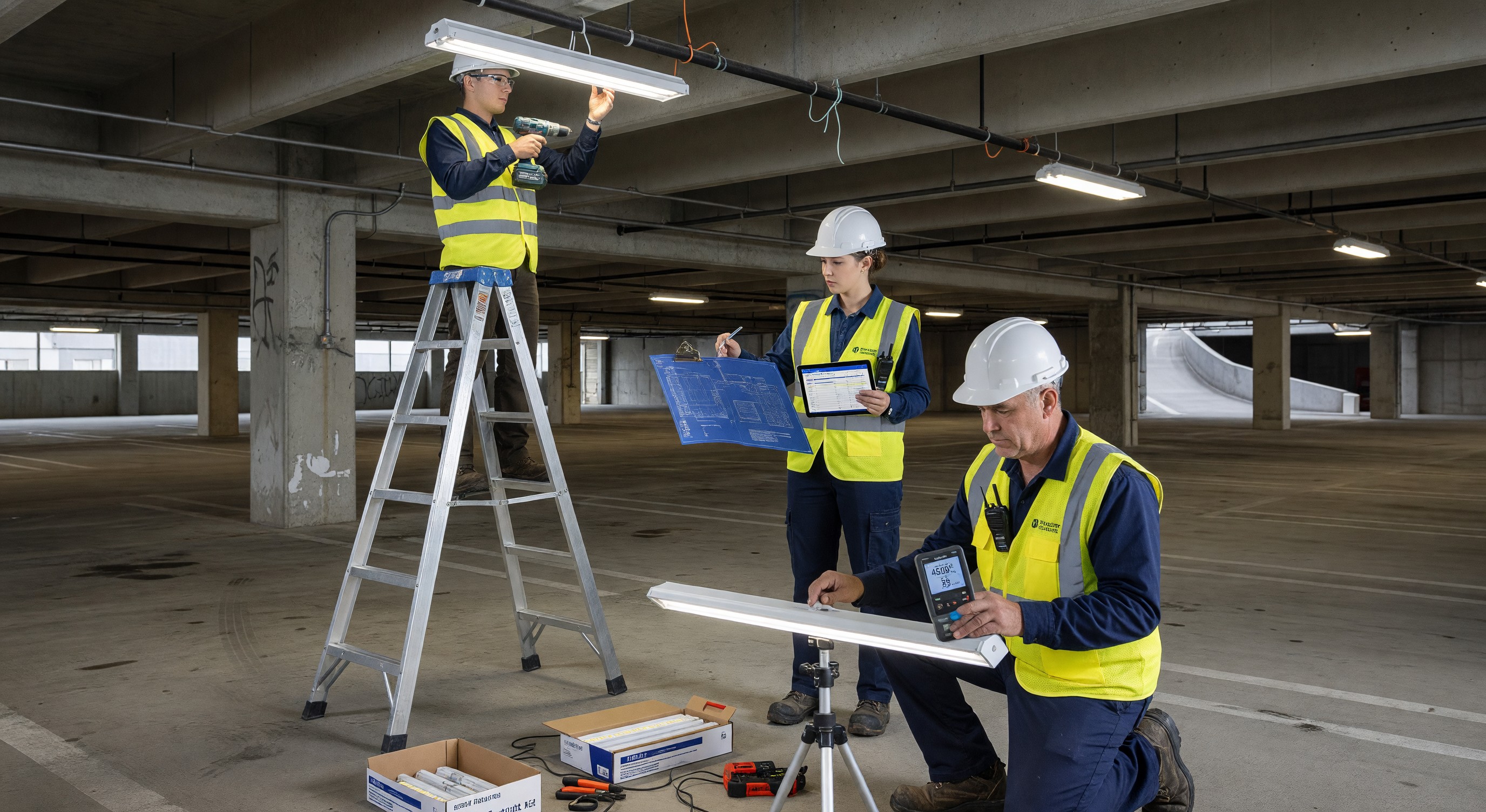
Parking facility lighting maintenance sits at the intersection of safety compliance, energy management, and customer experience. A proactive lighting maintenance program keeps illuminance levels where they need to be for safety and compliance, extends equipment life, and prevents the reactive scramble of responding to lighting failures after they occur.
This guide covers the maintenance requirements for parking lighting systems — including both legacy high-intensity discharge (HID) systems and modern LED systems — and the project management considerations for LED retrofit projects.
Lighting Maintenance for HID Systems
High-intensity discharge fixtures (metal halide, high-pressure sodium) remain in service at many parking facilities that have not yet completed LED retrofits. These systems require more active maintenance than LED systems due to lamp life characteristics and lumen depreciation patterns.
Lumen depreciation: HID lamps produce progressively less light as they age. A metal halide lamp at end of rated life may produce only 55 to 70 percent of its initial output. Parking facilities that were designed to meet illuminance standards at initial installation may fall below compliance levels before lamps visually fail.
Group relamping: The most economical maintenance approach for HID systems is group relamping — replacing all lamps in a facility on a scheduled cycle, before they fail individually. Group relamping at 70 to 80 percent of rated lamp life prevents illuminance decline below standards and eliminates the higher labor cost of one-at-a-time spot replacement.
Monthly walkthrough: Conduct monthly visual inspections of all lighting. Note any dark fixtures, flickering lamps (a sign of impending failure), or visibly damaged fixtures. Create a work order for identified issues within 48 hours.
Ballast maintenance: Electronic ballasts and magnetic ballasts in HID fixtures require periodic inspection. Ballast failures produce dead fixtures and, in some cases, fire risks if ballast failures are thermal in nature. Replace failed ballasts promptly; do not allow parking areas to remain poorly lit while awaiting scheduled service.
LED Lighting Maintenance
LED fixtures have dramatically different maintenance requirements than HID. Rated L70 service lives of 50,000 to 100,000 hours mean that in most parking applications, LEDs will not require lamp replacement for 15 to 25+ years of operation.
What LED maintenance actually involves:
- Cleaning lens surfaces annually — atmospheric dirt and insect accumulation reduces light output and can trap heat
- Inspecting mounting hardware for looseness or corrosion annually
- Verifying that controls (photocell, motion sensor, dimming) are functioning correctly
- Checking wire connections at fixtures annually in areas with vibration (near heavy equipment, high wind exposure)
- Monitoring for early-life failures — LED failures are typically random early failures, not end-of-life wear-out
Dimming control maintenance: LED fixtures with occupancy-sensing dimming controls require that sensors remain clean and unobstructed. Dust accumulation on PIR sensors can cause delayed or missed detection. Include sensor cleaning in annual lighting maintenance.
Driver failures: LED fixture drivers (the electronic component that converts AC power to DC power for the LEDs) are the most common failure point in LED fixtures. Driver failures produce either complete fixture failure or partial output reduction. Maintain a small stock of replacement drivers for common fixture models to enable rapid restoration.
Photometric Testing and Compliance Verification
Annual photometric field testing verifies that actual illuminance levels in the facility meet IES RP-20 recommended levels and any applicable code requirements. This testing is more important for HID systems (due to lumen depreciation) but remains relevant for LED systems over time.
Measurement protocol: Use a calibrated lux meter. Take measurements at the floor level at a systematic grid of points. IES recommends grid spacing of five feet maximum for detailed assessments.
Documentation: Record measurement date, time, sky conditions (for open facilities), ambient temperature, and measurements at each grid point. Calculate average illuminance, minimum illuminance, and uniformity ratio (average/minimum). Compare results to prior years and to applicable standards.
When to respond: If measurements reveal average illuminance levels below IES recommendations or uniformity ratios above recommended limits, investigate the cause. For HID systems, lumen depreciation is the likely cause — check whether relamping is due. For LED systems, fixture failure, control malfunction, or lens contamination may be causes.
Managing an LED Retrofit Project
For facilities still using HID lighting, LED retrofit is the most impactful single maintenance investment available. The project management process:
Audit your existing system: Document existing fixture count, type, mounting height, and location. Note any fixtures with unusual mounting conditions, non-standard mounting hardware, or access challenges. This data drives the retrofit scope document.
Photometric design: Engage a lighting designer or use manufacturer-provided photometric tools to model the proposed LED replacement and verify that the new design meets IES standards. Do not assume that a 1:1 lamp substitution (replacing each HID fixture with an LED of nominally equivalent wattage) will produce compliant results — ceiling heights, fixture spacing, and optical distributions vary significantly.
Specification development: Specify LED fixtures on performance criteria: minimum initial lumens, minimum CRI (70 or above for security camera compatibility), maximum wattage, minimum L70 life rating (50,000 hours), operating temperature range appropriate for your climate, and warranty duration (minimum 5 years, 10-year warranty preferred).
Contractor qualification: Specify licensed electrical contractors with commercial lighting experience. Parking structure retrofits involving conduit work, wire replacement, or photocell and control installation require electrical permits in most jurisdictions.
Control integration: LED systems offer dimming and occupancy sensing capabilities that HID systems lack. Decide before the retrofit whether you are implementing dimming controls, and specify control-compatible fixtures accordingly. Retrofitting controls after the fact is significantly more expensive than including them in the initial project.
Emergency Lighting Integration
Emergency lighting in parking garages must function independently of the normal lighting system. Monthly and annual testing of emergency lighting systems is required under NFPA 101. Coordinate LED retrofit projects with emergency lighting to ensure:
- Emergency lighting coverage patterns are verified after any normal lighting changes
- Emergency lighting fixtures are not inadvertently de-energized during normal lighting maintenance
- Emergency lighting batteries are on their own testing and replacement schedule
FAQ
My parking garage has some areas with very high ceilings. What fixtures are appropriate? High-bay LED fixtures designed for mounting heights of 20 to 40 feet are the appropriate product for tall garage structures. Standard surface-mount or recessed fixtures designed for 10 to 15-foot mounting heights will not achieve adequate illuminance at higher mounting. Confirm with photometric analysis that your proposed fixture achieves IES recommended levels at the floor.
How do I handle lighting maintenance in a parking garage that has areas with limited access? For fixtures in difficult-to-access locations, factor access requirements into the maintenance schedule. Boom lift access may be needed for high fixtures. Coordinate with the parking operation to schedule access during low-traffic periods. Consider whether difficult-to-access areas justify longer-life fixtures (higher upfront cost) to extend service intervals.
What should LED fixture warranties cover? Quality LED parking fixtures should carry at minimum: 5-year comprehensive warranty covering fixture and driver (10-year is better), L70 life rating certification to LM-80 testing standards, and appropriate IP (ingress protection) rating for outdoor or garage environments (IP65 or higher for exposed outdoor fixtures).
How do LED retrofit projects affect my energy contract or utility rate? LED retrofits substantially reduce electrical load. Before completing a large retrofit, review your utility rate structure. If you are on a demand-charge rate, the reduced peak demand from LED retrofits translates directly to lower demand charges. Some utilities offer time-of-use rates that may be more favorable post-retrofit when EV charging load is the new dominant load.
Lighting audits and LED retrofit projects fit naturally into a structured summer maintenance window plan — the longer daylight hours let you assess fixture condition by day and verify illumination levels at dusk in a single visit.
Further Reading from Authoritative Sources
- U.S. Department of Energy commercial LED lighting technical resources — energy.gov is on the whitelist and the DOE’s lighting resources are the primary federal technical authority on LED performance claims and energy savings calculations referenced in this article.
- International Parking and Mobility Institute lighting maintenance and upgrade resources — parking-mobility.org (IPMI) is on the whitelist and provides parking industry application of lighting standards and upgrade methodology that complements the DOE’s technical guidance.