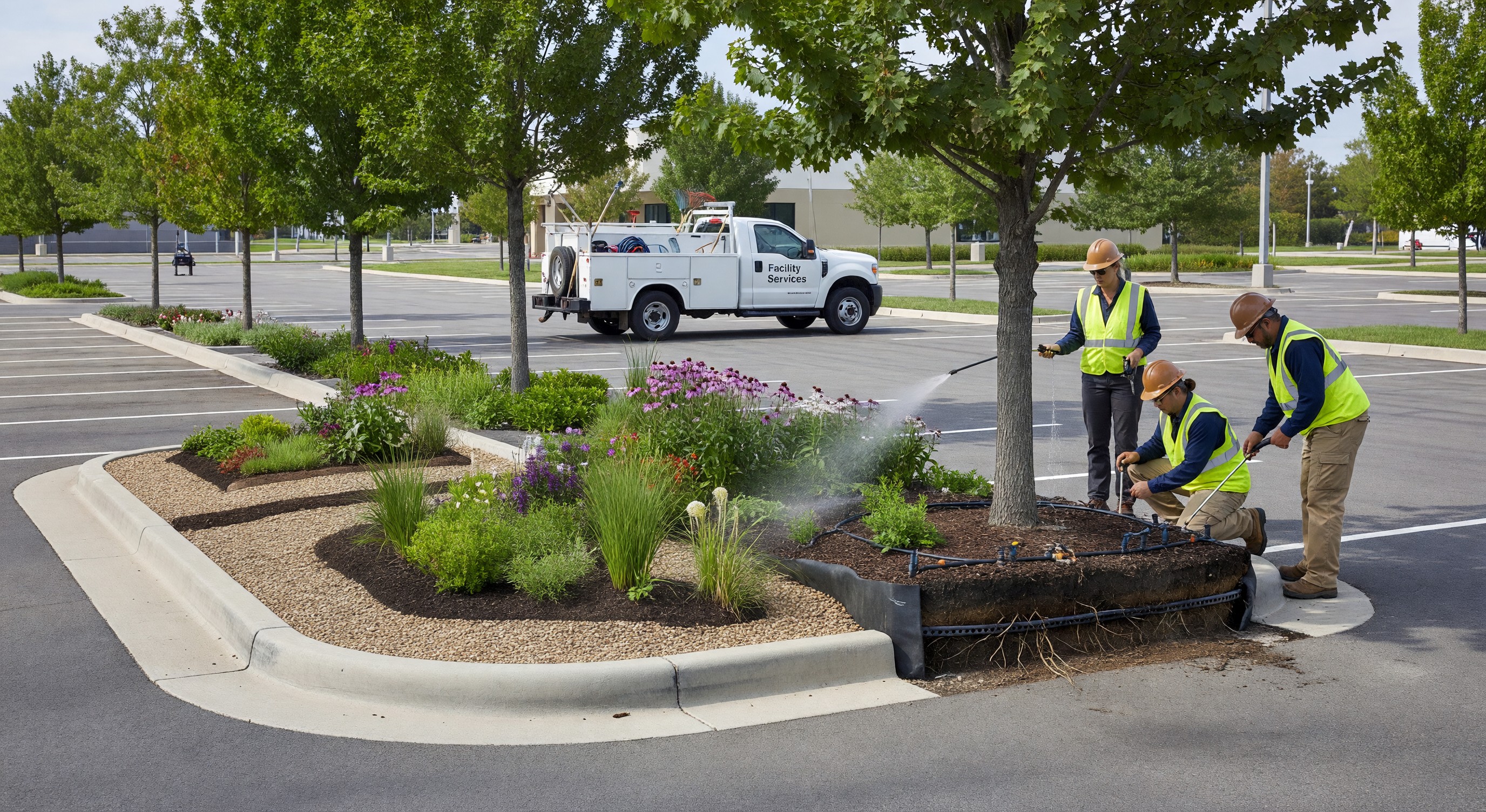
Landscaping in parking facilities serves multiple purposes: aesthetic quality that affects the perception of the property, stormwater management through bioretention and permeable areas, shade that reduces heat island effect and protects vehicles, and screening that mitigates the visual impact of parking on adjacent properties.
Managing parking facility landscaping requires attention to the intersection of aesthetics, operational requirements, and the specific challenges that parking environments create for plant material and landscape systems.
Parking Lot Islands: Maintenance Essentials
Parking lot islands — the planted medians and end islands between rows of parking — are among the most abused landscape areas in any commercial facility. They receive concentrated runoff with road salts, vehicle fluid contamination, and compaction damage from vehicles that cut corners.
Plant material selection: Species in parking island applications must tolerate salt spray, compaction, drought stress, and air quality from vehicle exhaust. Consult with a local landscape architect or cooperative extension service for regionally appropriate, parking-tolerant species. Attempting to grow non-tolerant species in parking islands is a maintenance cost sink.
Curb and edge maintenance: Island curbs that are damaged by vehicles should be repaired promptly. Damaged curb edges allow vehicles to drive over islands, compacting soil and killing plant material. Physical curb protection — higher curb profiles, wheel stops, or bollards — reduces damage in areas with persistent problems.
Mulch management: Organic mulch in parking islands should be maintained at 2 to 3 inches depth. Deep mulch (more than 4 inches) creates anaerobic soil conditions harmful to plant roots. Thin or absent mulch allows weed establishment and increases irrigation demand. Annual mulch refresh is typically needed.
Irrigation: Most parking lot islands benefit from drip or low-volume irrigation during establishment of new plantings (first 2 to 3 years) and during drought periods. Overhead irrigation in parking islands creates maintenance problems by spraying cars and hardscape. Check irrigation system function at the start of each growing season.
Tree Management: Roots and Structure
Trees in or adjacent to parking facilities create long-term maintenance issues that small-stature trees selected at planting cannot avoid. Root systems of full-size trees inevitably interact with pavement structures.
Root intrusion: Tree roots growing under pavement surfaces eventually lift, crack, and heave asphalt and concrete. This is not a failure of the pavement — it is an inevitable result of the tree’s growth. Management options include: root barriers installed during tree planting to direct roots downward; structural soil systems (engineered soil mixes that support both pavement and root growth); periodic root pruning to remove encroaching roots; and, ultimately, removal of trees whose root systems have caused significant structural damage.
Branch clearance: Tree branches that overhang parking areas create cleaning burden (sap, seed pods, flowers, leaf litter), can damage vehicles in wind events, and may obstruct lighting and signage. Prune parking-adjacent trees to maintain minimum clearance of 14 feet over drive lanes and adequate clearance over parked vehicles.
Storm damage response: Establish a procedure for responding to storm-damaged trees in parking areas. A partially uprooted or broken tree in a parking area is a safety hazard requiring immediate assessment and removal if necessary. Maintain a contact for emergency tree services with response availability outside business hours.
Species selection for new plantings: Select parking-appropriate tree species that have predictable growth habits, minimal problematic root patterns, and appropriate ultimate size for the planting space. Columnar and fastigiate cultivars that grow tall and narrow are often appropriate for parking island applications.
Bioretention Areas and Rain Gardens
Many newer parking facilities include bioretention areas — engineered landscape features that capture and treat stormwater runoff. These areas require maintenance that is distinct from conventional landscape maintenance.
Sediment removal: Bioretention inlet areas accumulate sediment deposited by runoff. When sediment accumulation exceeds 6 inches, it reduces the infiltration capacity of the system. Annually or after major storm events, remove accumulated sediment from inlet areas.
Plant maintenance: Bioretention plant communities require establishment management (weed control, supplemental irrigation if needed) in the first two to three years. After establishment, maintenance requirements decrease but do not disappear — invasive plant removal, storm damage repair, and periodic replanting of failed areas are ongoing needs.
Mulch replacement: Mulch in bioretention areas washes out during storm events and must be replenished periodically. Use appropriate mulch that does not float out of the basin.
Overflow management: Bioretention overflow structures must remain unobstructed. Inspect overflow devices after major storm events and remove any accumulated debris.
Inspections: NPDES permit holders who use bioretention as a stormwater BMP are typically required to inspect and maintain these features per the applicable permit. Document inspections and maintenance activities as part of your permit compliance record.
Seasonal Grounds Maintenance Schedule
Effective grounds maintenance for parking facilities follows a seasonal rhythm:
Spring:
- Remove sand and debris deposited by winter operations from landscape areas
- Assess winter damage to plant material — remove dead, damaged, or diseased plants
- Refresh mulch in island and bioretention areas
- Inspect and activate irrigation systems
- Schedule tree trimming to maintain clearances
- Apply pre-emergent herbicide in islands to reduce weed pressure
Summer:
- Mowing and edging on regular cycle
- Irrigation management during drought periods
- Weed control in islands and bioretention areas
- Monitor for pest and disease issues in trees and shrubs
Fall:
- Leaf removal from parking surfaces and drains
- Seasonal cleanup of annual plant material
- Winterize irrigation systems before freeze
- Tree risk assessment — identify trees with structural concerns before winter storm season
Winter:
- Monitor for snow/ice damage to trees and shrubs adjacent to treated areas
- Avoid directing deicing chemical applications into sensitive plant material
FAQ
How do I prevent salt damage to parking lot landscape areas? Salt damage to plants adjacent to deiced pavement is a chronic problem in cold climates. Mitigation options: plant salt-tolerant species in high-exposure areas; install physical barriers (curbs, snow fencing) that reduce salt spray drift; minimize deicing application in areas adjacent to sensitive plant material; and flush salt-contaminated soil with fresh water in spring. For newly planted areas, consider delaying planting until late spring so establishment occurs in the post-salt season.
What maintenance should bioretention areas receive after major storms? Inspect inlet structures for blockage and clogging, check that overflow devices are unobstructed, assess for erosion at inlets or outlet structures, and remove large debris from the bioretention basin. Document the inspection and any corrective actions for permit compliance records.
How do I handle a parking lot tree that has caused significant pavement damage? Assess the tree’s value (aesthetic, shade, ecological) against the cost of ongoing pavement repairs. If the root system is extensive and repairs are recurring, removal may be the most economical long-term choice. Where the tree has significant value, consult an arborist about root management options before deciding on removal.
Is landscape maintenance typically included in parking management contracts? Varies by contract. Some parking management agreements include basic grounds maintenance (trash removal, sweeping) but exclude landscaping. Others explicitly exclude all grounds maintenance from the operator’s scope. Review your contract carefully. Landscape maintenance for parking facilities may be more appropriately contracted separately through a grounds maintenance firm with horticultural expertise.
Further Reading from Authoritative Sources
- EPA green infrastructure and bioretention guidance — epa.gov is on the whitelist and EPA’s green infrastructure guidance directly supports the bioretention and stormwater landscape content in this article.
- IFMA facility grounds maintenance standards — ifma.org is on the whitelist as a facility management authority whose grounds maintenance guidance applies directly to the parking facility landscaping maintenance framework in this article.