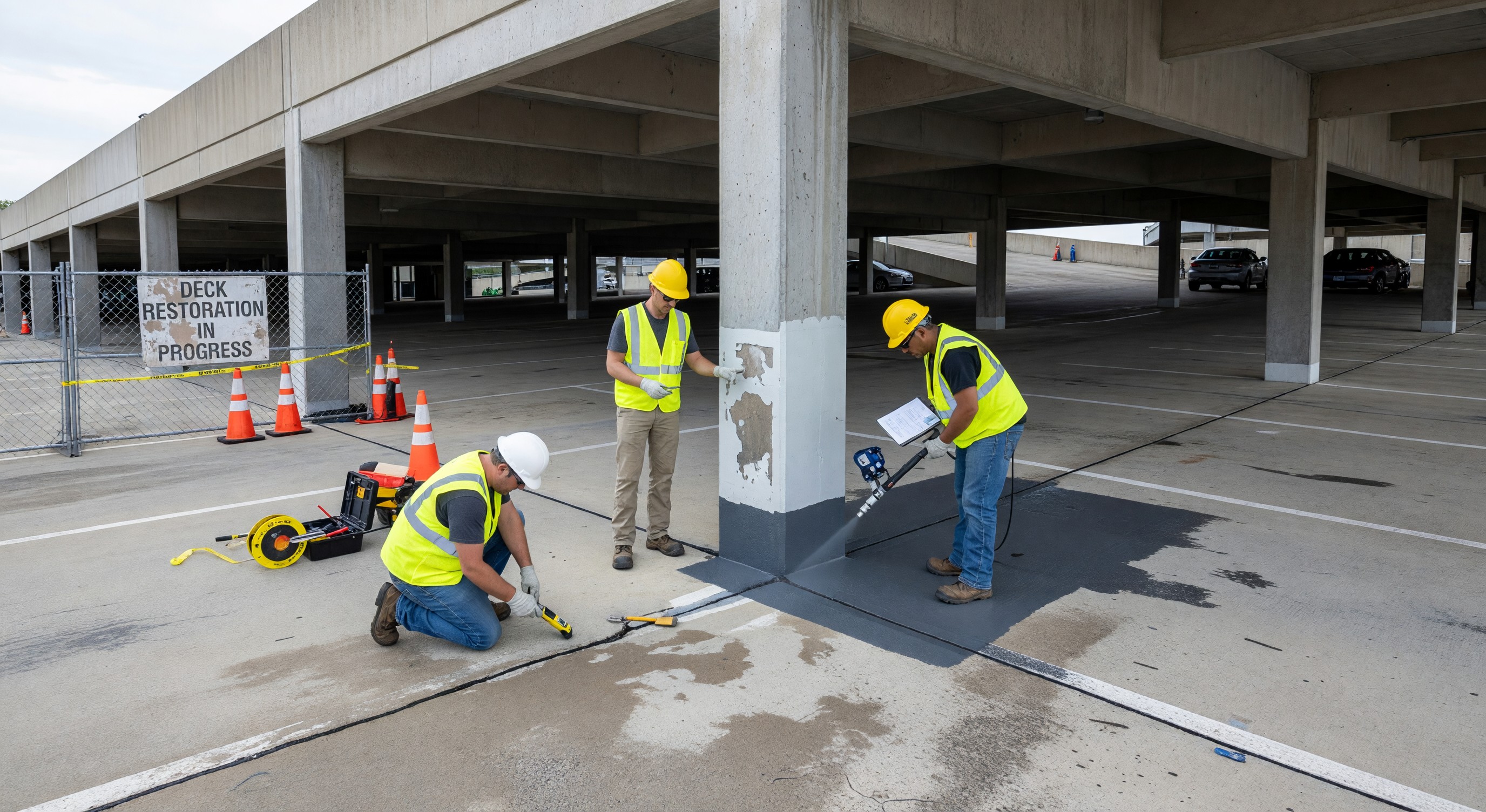
Parking deck waterproofing is the first line of defense for the most valuable structural asset in a parking facility — the concrete deck and the reinforcing steel it protects. When waterproofing fails, water and chlorides from deicing salts infiltrate the concrete, initiate reinforcement corrosion, and begin the deterioration cycle that ultimately requires expensive concrete repair or reconstruction.
The lifecycle cost of waterproofing maintenance is far lower than the lifecycle cost of concrete repair. A deck restoration that might be needed after 20 years of active waterproofing management might be needed in 10 to 12 years if waterproofing is neglected. The cost difference — potentially millions of dollars for a large structure — dwarfs the cost of a consistent waterproofing maintenance program.
Types of Deck Waterproofing Systems
Parking decks use several waterproofing approaches, each with different performance characteristics, maintenance requirements, and service lives.
Traffic-bearing deck coatings (also called traffic deck coatings or vehicular traffic coatings): Polymer-modified coatings applied directly to the concrete deck surface that provide waterproofing while accommodating vehicle traffic and the thermal and structural movement of the deck. These are the most common waterproofing system for exposed parking decks.
Traffic coatings come in two primary configurations:
- Wearing-course only systems: A wear-resistant topcoat applied over a primer system. Lower cost, shorter service life (5 to 10 years).
- Full membrane systems: A reinforced elastomeric membrane topped with an aggregate-filled wear course. Higher initial cost, but longer service life (10 to 15 years) and better performance under heavy use.
Penetrating sealers: Silane, siloxane, and silane-siloxane blend penetrating sealers treat the concrete surface to reduce water and chloride absorption without forming a surface film. Penetrating sealers are appropriate as a maintenance treatment for decks in early deterioration stages or as a supplement to other systems, but do not provide the waterproofing performance of a membrane system.
Sheet-applied membranes: Hot-applied rubberized asphalt or cold-applied sheet membranes are used under topping slabs on some lower-deck configurations. Maintenance access requires removal of the topping slab, making maintenance more complex and expensive.
Inspection: What to Look For
Annual inspection of deck waterproofing should cover:
Surface condition of coating: Active wear patterns, areas of delamination (coating lifting from substrate), cracking in the coating surface, and areas where the wear course aggregate has been worn smooth. These conditions indicate areas where waterproofing protection is compromised.
Cracks in coating: Traffic deck coatings bridge structural cracks in the concrete by remaining flexible over the crack. When a coating cracks through (bridging capacity exceeded), water can enter the crack. Note crack locations and widths.
Drain collars and transitions: The interface between deck coating and drain bodies, expansion joints, and parapet walls are high-failure areas. Inspect these interfaces carefully for separation, cracks, or lifted edges.
Water staining on underside: Inspect the underside of all deck elements for water staining or wet spots that indicate active water infiltration through the deck.
Standing water: Areas where water ponds rather than draining indicate either blocked drains or areas where deck settlement has changed drainage grades. Standing water accelerates coating deterioration.
Maintenance Interventions
Crack Repair
Cracks in traffic deck coatings should be repaired promptly to prevent water intrusion into the structural slab. Crack repair materials must be compatible with the existing coating system — consult the coating manufacturer for recommended crack repair products.
For hairline cracks (less than 1/16 inch), flood coat with compatible coating material. For wider cracks, route and fill with appropriate sealant before applying a bridging membrane strip over the crack.
Topcoat Renewal
Traffic deck coatings are wearing surfaces. The top wear course erodes under traffic and loses both its aesthetic appearance and its protective performance. Before the wear course is completely worn through to the waterproofing membrane below, apply a new wear course over the existing system.
Topcoat renewal intervals depend on traffic volume and the specific coating system. Many manufacturers recommend topcoat renewal every 3 to 7 years. This significantly extends the life of the underlying membrane, delaying full system replacement.
Spot Repairs and Edge Sealing
Delaminated areas, drain collar separations, and failed joint transitions should be repaired promptly. Delay allows water infiltration to expand the area of concrete damage beyond the failed waterproofing area.
Full System Replacement
When a traffic deck coating has reached the end of its service life — defined by through-cracking of the membrane, widespread delamination, or loss of waterproofing performance — full system removal and replacement is required.
Full system replacement involves: removal of the existing coating by scarifying, shot blasting, or grinding; concrete surface preparation and repair of any concrete deficiencies revealed by coating removal; application of new primer, membrane, and wear course per the new system specification.
Capital Planning for Deck Restoration
Deck waterproofing replacement is a major capital event. Planning for it in your reserve fund ensures you have the resources available when needed.
Establish the original installation date and specification for your deck waterproofing system. If this documentation is not available, a representative core sample for laboratory analysis can help characterize the existing system.
Estimate remaining service life based on current condition observations. Systems in good condition with active maintenance may have 8 to 12 years of remaining life. Systems showing widespread wear, cracking, or delamination may need replacement within 2 to 5 years.
Plan the replacement project budget based on current cost estimates (typically $15 to $40 per square foot for a full system removal and replacement) escalated at 3 to 5 percent per year to the anticipated replacement date.
Working with Coating Contractors
Deck coating work is a specialty discipline. Contractors who perform standard commercial painting are not necessarily qualified for traffic deck waterproofing applications.
Qualified contractors should have: specific experience with the proposed coating system from the same manufacturer, trained and certified applicators for the specified system (most coating manufacturers offer applicator certification), quality control procedures including daily written documentation of surface preparation conditions, ambient conditions, and applied film thicknesses.
Request references from projects using the same coating system in comparable applications. Verify the references before awarding work.
FAQ
How do I know if my deck waterproofing is failing before there is visible concrete damage? Water staining on deck soffits is the most important early indicator. Other indicators include coating delamination observed during walking inspection, reduced slip resistance in areas where aggregate has worn smooth, and unusually rapid coating wear in high-traffic paths. An annual inspection with these indicators in mind catches developing failure before concrete damage occurs.
Can penetrating sealers substitute for a traffic deck coating? Penetrating sealers reduce water and chloride absorption but do not provide the waterproofing performance of a traffic deck coating. For decks that are not regularly deiced and are in low-chloride environments, penetrating sealers may be adequate. For northern climate decks that receive deicing salts, a full traffic deck coating system is the appropriate specification.
What causes traffic deck coatings to delaminate? Delamination occurs when the bond between the coating and the substrate is broken. Common causes: moisture in the concrete at the time of application (the most common cause), contamination of the substrate surface before application, incompatible primer and topcoat materials, and thermal shock to a freshly applied coating.
How long should a traffic deck coating last? Full membrane systems with an aggregate wear course should last 10 to 15 years with active maintenance (including topcoat renewals). Wearing-course-only systems on lower-use areas may last 7 to 10 years. Service life is significantly affected by traffic volume, climatic conditions (freeze-thaw cycles), and the diligence of the maintenance program.
Further Reading from Authoritative Sources
- International Parking and Mobility Institute deck waterproofing maintenance resources — parking-mobility.org (IPMI) is on the whitelist as the primary parking industry authority with directly relevant waterproofing maintenance content for parking structure operators.
- Transportation Research Board parking structure waterproofing research — trb.org is on the whitelist and TRB’s waterproofing research provides technical support for the service life claims and maintenance interval recommendations in this article.