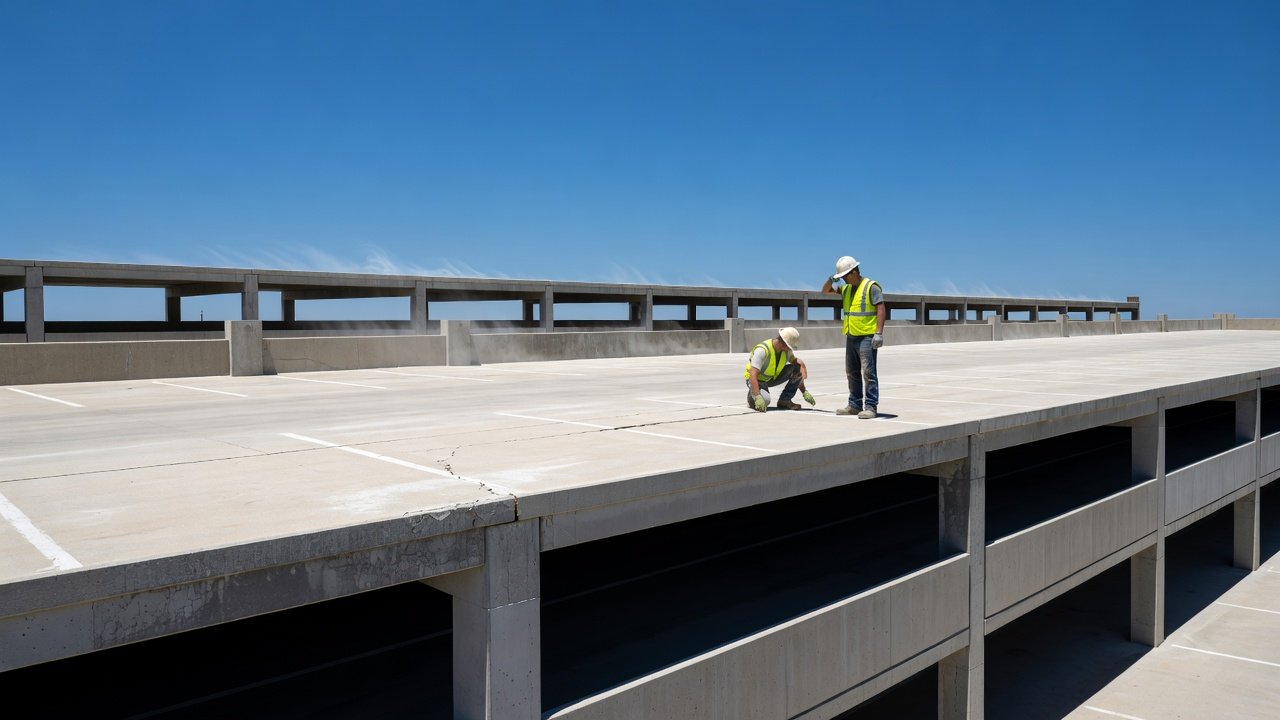
A parking structure absorbs heat all day and releases almost none of it. The open decks that make a garage cheap to ventilate also make it a solar collector: top-level slabs routinely run 40 to 60 degrees hotter than the shaded air temperature, and during a heat dome that surface can stay above 130°F from late morning to sundown. When the U.S. records its fourth-hottest summer, as it did in 2024 with an average temperature 3.0°F above the 20th-century norm through the end of August, the strain shows up in three places at once — the concrete, the powered equipment, and the people you send out to work on them. Each needs its own plan, and the budget line for all three lands in the same summer.
Concrete Moves More Than You Think
Concrete expands and contracts with temperature, and a parking deck is one of the few building assets that lives fully exposed to that cycle. The material grows roughly 5.5 millionths of its length for every degree Fahrenheit — small until you multiply it across a full structure. A 200-foot deck swinging from a 40°F winter night to a 130°F summer surface moves close to an inch. That movement is exactly what expansion joints exist to absorb, and it is exactly where heat-season failures concentrate.
Expansion and control joints take a double hit in summer: the thermal load pushes the slabs together while vehicle traffic abrasion and standing surface water break down the sealant. When a joint seal fails, water reaches the reinforcing steel below, and the freeze-thaw and corrosion damage that follows is far more expensive than the seal. The American Concrete Institute’s guidance on joint spacing (ACI 224) and post-tensioning industry design references treat joint width as a direct function of span length, the coefficient of thermal expansion, and the temperature differential — meaning the hotter your peak surface temperature runs, the more joint travel your structure demands.
For a facility manager, the practical move is a mid-summer joint and surface inspection rather than the traditional spring-only walk. Budget for it:
- Joint reseal: commonly $8 to $20 per linear foot depending on system and access.
- Crack routing and sealing: a lower-cost preventive step that keeps water out before it reaches rebar.
- Traffic-coating touch-up on top decks, where UV and heat degrade membranes fastest.
Catching a failed joint in July costs a reseal. Finding the same joint after a winter of water intrusion can turn into slab repair at many times the price.
Powered Equipment Throttles and Fails in the Heat
Every electronic system in the garage has a temperature ceiling, and heat domes push equipment past it. The clearest example is EV charging. When a vehicle’s battery management system detects excess battery temperature, it deliberately reduces charging power — and in extreme cases pauses charging entirely — until the pack cools. Drivers read that as a broken station. Meanwhile the charger’s own power electronics can overheat and fault, so the hardware you installed to attract tenants becomes the equipment generating the most heat-season complaints.
The same physics applies across the garage: gate operators, payment terminals, LED drivers, and access-control cabinets all derate or fail faster in sustained heat. Two responses matter. First, siting — charging and sensitive electronics belong on lower, shaded, or covered levels rather than the fully exposed top deck; industry guidance consistently favors canopies, covered bays, and passive cooling for chargers. Second, maintenance timing — confirm cabinet ventilation is clear, filters are clean, and firmware is current before the first heat wave, not during it. A charger that faults at 2 p.m. on a 105°F afternoon is the one your tenants remember.
Staff Safety Is Now a Compliance Question
The people doing heat-season inspections and repairs are the most exposed asset of all, and the regulatory ground under them is shifting. In 2024, 48 U.S. workers died from environmental heat exposure, and fatalities concentrate in construction, repair, cleaning, and materials-handling work — the exact tasks a garage crew performs in summer. On August 30, 2024, OSHA published a proposed Heat Injury and Illness Prevention standard in the Federal Register, its first comprehensive federal heat rule, projected to cover as many as 36 million workers. It drew more than 43,000 public comments and an informal hearing in June 2025.
The proposed rule is worth reading now even though it is not yet final, because it signals the enforcement baseline. As drafted, obligations trigger at a heat index of 80°F sustained over a 15-minute window, with additional high-heat requirements at 90°F. Until a federal standard lands, OSHA still cites heat hazards under the General Duty Clause, and several states already run their own heat rules — so “no standard yet” is not the same as “no exposure.”
Build the Program Around Water, Rest, Shade
OSHA and NIOSH converge on the same core, and none of it requires new capital:
- Water: NIOSH recommends 24 to 32 ounces of cool water per hour of heat exposure, kept below 59°F and within reach of the work area, with electrolytes added when work runs past two hours.
- Rest: scheduled breaks in a genuinely cooler location, lengthened as the wet-bulb globe temperature climbs.
- Shade: a designated cool or shaded recovery area on site, not a hypothetical one across the property.
- Acclimatization: ramp new and returning workers up over 7 to 14 days with lighter loads and more frequent breaks — the single most-cited factor in heat fatalities is a worker in their first days on the job.
Write these into the summer work plan, train supervisors to recognize heat-illness signs, and document it. If the OSHA standard finalizes, a facility that already runs a written heat program adjusts paperwork; one that does not starts from zero under enforcement pressure.
Treat the heat dome the way you already treat a winter storm — as a recurring, plannable event with a pre-staged response, not a surprise. Move the structural inspection into mid-summer, pull EV and electronics maintenance forward of the first heat wave, and stand up the water-rest-shade program before the crew is already out on a 105°F deck. The facilities that budget for heat as a season, rather than reacting to it as an emergency, spend less on both concrete repair and workers’ comp — and they are the ones ready when the standard becomes law.