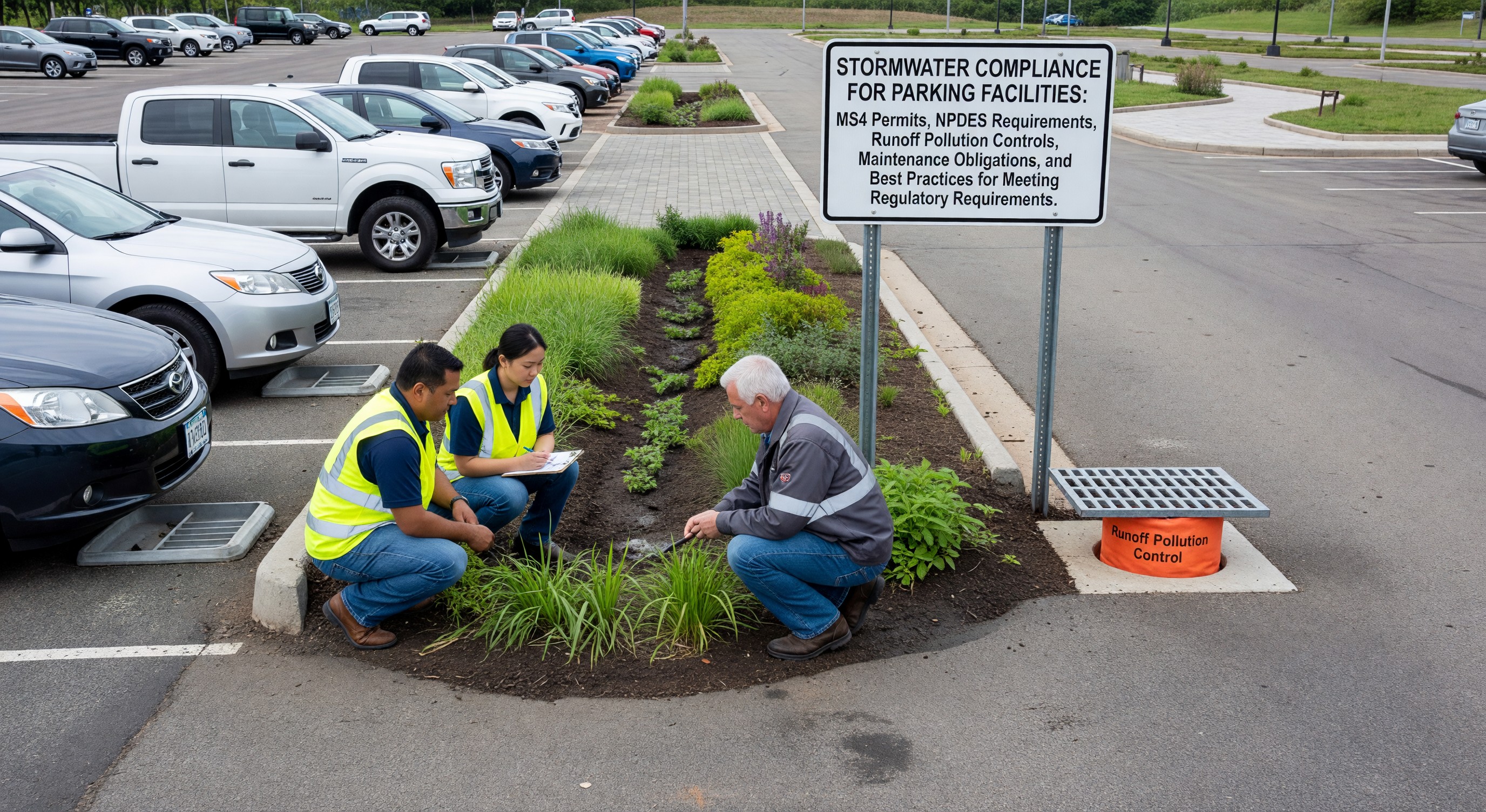
Parking facilities are significant contributors to urban stormwater runoff. Impervious pavement surfaces collect pollutants — motor oil, heavy metals, sediment, fertilizers — that rainfall washes directly into storm drains and eventually into waterways. Federal and state regulations impose specific requirements on parking facility operators to manage this runoff and reduce pollutant loads.
Facility managers who are not familiar with their stormwater obligations frequently discover non-compliance during regulatory inspections or property transactions. Understanding the applicable requirements and maintaining a documented compliance program protects both the environment and the facility from regulatory exposure.
The Federal Regulatory Framework
Clean Water Act Section 402 establishes the National Pollutant Discharge Elimination System (NPDES), which regulates discharges to waters of the United States. Stormwater discharges from certain facilities are regulated under NPDES permits.
Phase II NPDES regulations require most municipalities with populations above 10,000 to operate Municipal Separate Storm Sewer System (MS4) programs that address stormwater quality from commercial and industrial sites, including parking facilities. If your facility discharges to a municipal storm sewer system in an MS4 jurisdiction, the MS4 program requirements apply to you.
Industrial stormwater permits under NPDES may apply to parking facilities associated with certain industrial activities. Facility managers should verify whether their parking operations fall under industrial permit requirements based on the North American Industry Classification System (NAICS) code of the overall facility.
State-level stormwater programs implement and frequently exceed federal NPDES requirements. Many states have adopted numeric effluent limits, post-construction runoff reduction requirements, and maintenance obligations that go beyond federal minimums.
What MS4 Programs Require of Parking Operators
MS4 programs typically require commercial facility operators (including parking facilities) to implement best management practices (BMPs) that reduce pollutants in stormwater discharges. Common requirements include:
Spill prevention and response. Facilities must have procedures for responding to spills of motor oil, fuel, hydraulic fluid, and other potential pollutants. Spill response kits and documented procedures are typically required.
Housekeeping practices. Regular sweeping to remove sediment, debris, and contaminants before they wash into storm drains. Frequency requirements vary by jurisdiction; quarterly sweeping is a common minimum.
Illicit discharge elimination. Facilities may not discharge non-stormwater to storm drains. Washing vehicles, hosing down drive surfaces, or allowing sanitary sewage to enter storm drains are common illicit discharge violations.
BMP maintenance documentation. Records of BMP implementation, maintenance activities, and inspections may be required by local MS4 permits. Maintain a stormwater pollution prevention plan (SWPPP) or stormwater management plan appropriate for your facility.
Post-Construction Stormwater Requirements
Many states and municipalities have adopted post-construction stormwater regulations that require new development and redevelopment projects above a certain size to manage stormwater runoff volume and quality through engineered controls.
For parking facility construction and renovation projects, post-construction requirements typically include:
Runoff volume reduction. Projects must retain or infiltrate a specified volume of stormwater (often the first inch of runoff from a storm event) on-site through infiltration, evapotranspiration, or reuse.
Pollutant removal. Treatment controls such as bioretention cells, filter strips, or manufactured treatment devices must achieve defined pollutant removal efficiencies.
Inspection and maintenance obligations. Post-construction stormwater controls require ongoing maintenance to function properly. Inspection and maintenance requirements are typically written into permits or easements that run with the property and bind future owners.
Oil-Water Separators: Maintenance Obligations
Oil-water separators are the most common engineered stormwater control at commercial parking facilities. These below-grade devices remove oil, grease, and sediment from parking lot runoff before it enters the storm drain system.
Oil-water separators require regular maintenance to function properly. A separator that has not been cleaned within the last one to two years (or that serves a high-use facility) may have lost most of its effective capacity. Key maintenance requirements:
Regular inspection. Inspect oil-water separators annually at minimum. Check oil accumulation in the separator chamber and sediment depth in the inlet and outlet chambers. Document inspection findings.
Cleanout frequency. Cleanout frequency depends on facility traffic and contaminant loads. High-traffic lots or facilities near food service operations typically require cleanout every six to twelve months. Lower-traffic facilities may require annual or biannual service.
Documentation. Maintain records of all inspections and cleanouts, including the date, technician name, and volume of material removed. These records support compliance documentation and are required by many MS4 permit programs.
Disposal. Material removed from oil-water separators — oil, grease, and sediment — must be disposed of in accordance with applicable regulations. The cleaning contractor should provide documentation of proper disposal. Hazardous waste characterization may be required depending on contaminant levels.
Parking Lot Sweeping as a BMP
Parking lot sweeping removes pollutants from pavement before rainfall mobilizes them into runoff. Effective sweeping programs use regenerative air or high-efficiency vacuum sweepers that capture fine particles; older mechanical sweepers with poor fine-particle capture are less effective as stormwater BMPs.
For stormwater management purposes, sweeping frequency should be based on pollutant loading, not just appearance. High-traffic lots adjacent to vehicle repair operations or food establishments typically require more frequent sweeping than low-traffic employee parking lots.
Sweeping contractors should provide weight tickets documenting material removed. This data demonstrates program effectiveness and supports MS4 reporting requirements.
Deicing and Nutrient Runoff
Winter parking lot operations in cold climates present additional stormwater concerns. Chloride-based deicing chemicals (rock salt, calcium chloride, magnesium chloride) are water-soluble pollutants that move readily through stormwater into streams and groundwater. Many states are developing or have adopted chloride reduction requirements.
Best practices for winter deicing:
Pre-treatment with liquid anti-icers before snow events reduces solid deicer use by 30 to 50 percent with equivalent ice management performance.
Calibrated spreaders applying deicers at manufacturer-recommended rates, rather than the over-application common with uncalibrated equipment.
Pavement temperature-based application rather than air temperature — deicers are effective only above approximately -15°F pavement temperature, and application below this threshold wastes material.
Collection and reuse of snowmelt. For facilities with significant snow storage, capture and controlled discharge or reuse of snowmelt reduces peak pollutant loading in storm drain systems.
FAQ
How do I determine if my facility needs an NPDES stormwater permit? Contact your state environmental agency. Depending on your facility’s industry classification, discharge location, and size, you may need coverage under a general permit or may be regulated through the local MS4 program rather than a direct NPDES permit. Environmental regulatory consultants can also help determine permit applicability.
What is a SWPPP and does my facility need one? A Stormwater Pollution Prevention Plan (SWPPP) documents the BMPs, procedures, and responsibilities for stormwater management at a facility. Many NPDES permits require SWPPPs for covered facilities. Even where not specifically required by permit, a documented SWPPP demonstrates due diligence and provides a framework for consistent compliance.
Are there penalties for stormwater non-compliance? Yes. Clean Water Act violations can result in significant civil penalties. Administrative penalties under Section 309(g) can reach $25,000 per day per violation for Class I violations, with higher penalties for more serious or repeated violations. State programs may add additional penalties.
What documentation should I maintain for stormwater compliance? Maintain records of inspections, BMP maintenance activities, sweeping contractor receipts, oil-water separator cleanout records, spill response records, and any permit applications or correspondence with regulatory agencies. Retain these records for at least five years.
Further Reading from Authoritative Sources
- EPA NPDES stormwater discharge requirements for parking facilities — epa.gov is on the whitelist as the primary federal environmental authority and is the direct regulatory source for the NPDES stormwater compliance requirements discussed throughout this article.
- Federal Highway Administration stormwater best management practices for parking and transportation facilities — fhwa.dot.gov is on the whitelist and FHWA’s stormwater BMP guidance for transportation facilities directly applies to the parking facility stormwater management practices described in this article.