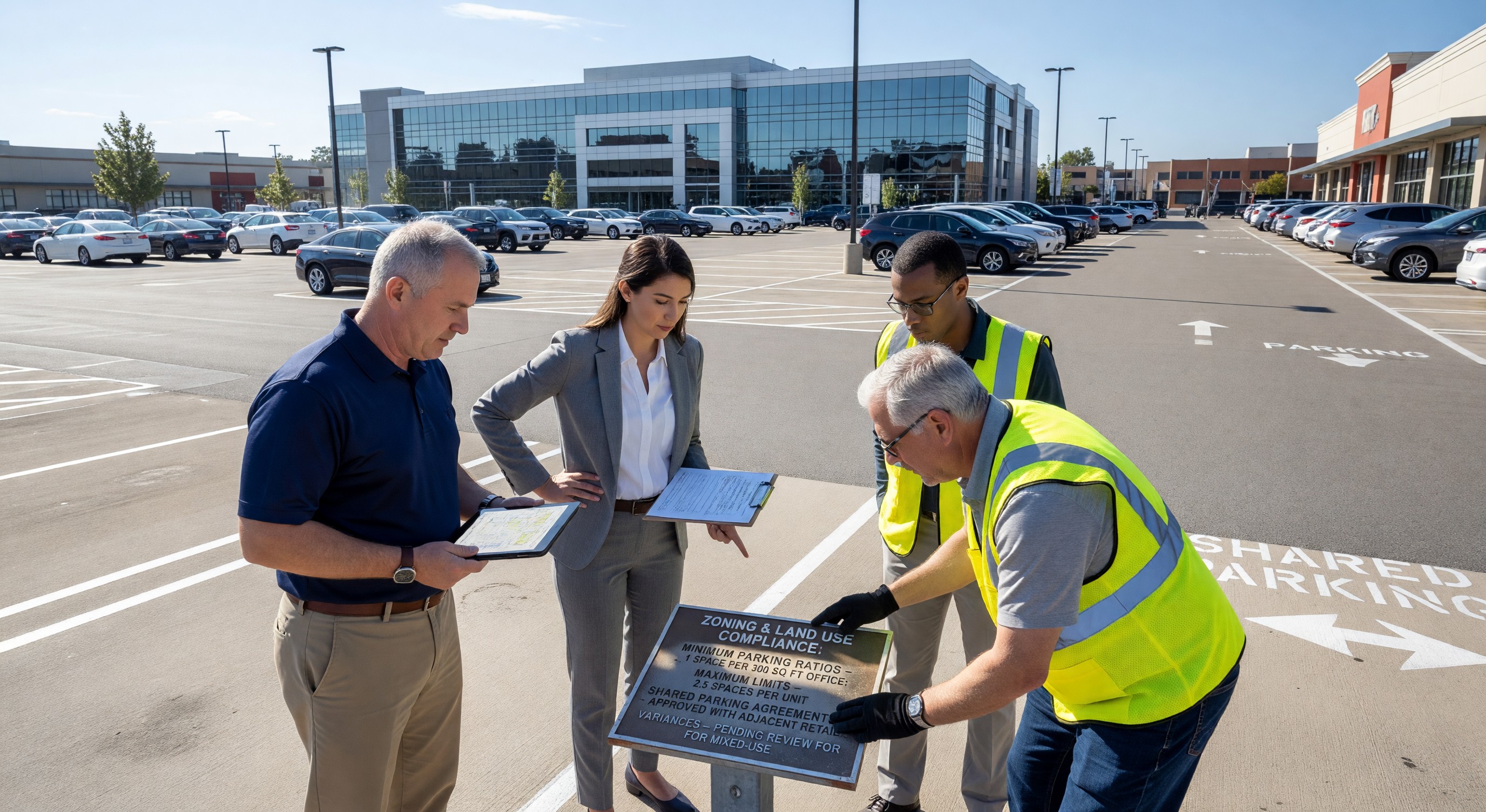
Zoning ordinances govern parking as a land use, establishing requirements for how much parking properties must provide and, in an increasing number of jurisdictions, how much parking they are allowed to provide. Facility managers who operate parking in leased buildings, manage parking as part of mixed-use developments, or deal with shared parking arrangements need to understand the zoning framework governing their operations.
This guide covers the key land use and zoning concepts that affect parking facility operations, the compliance obligations they create, and the approaches to navigating zoning requirements.
Parking Minimums: The Traditional Framework
Traditional zoning codes establish minimum parking requirements based on land use type and intensity. A typical code might require one parking space per 250 square feet of office space, four spaces per 1,000 square feet of retail, or one and a half spaces per residential unit.
These minimum requirements were established in an era when zoning prioritized automobile accommodation. They remain in effect in the majority of U.S. municipalities, though an increasing number of cities are reducing or eliminating minimums in urban areas.
Minimum parking requirements affect facility managers primarily in two contexts:
Building change of use: When a building’s use changes, parking requirements may change with it. Converting an office building to residential, or a retail space to a restaurant, may trigger a requirement for additional parking that does not exist on the site.
Building expansion: Adding square footage or new uses often requires proportionally more parking. If the site cannot accommodate additional parking, a variance, shared parking agreement, or alternative compliance approach may be needed.
Lease review: Before a tenant change that involves a significant use change, review parking requirements for the new use against the site’s available parking. Discover compliance gaps before the lease is signed, not after.
Parking Maximums: A Growing Trend
An increasing number of cities — particularly in transit-rich urban areas — have adopted parking maximum requirements that limit how much parking can be built or maintained. These policies are designed to reduce traffic congestion, support transit ridership, and encourage development density.
Parking maximums are most common in central business districts and areas well-served by public transit. They typically apply to new construction and major renovations. Existing parking facilities that predate maximum requirements may be grandfathered, but changes to the use, operations, or physical extent of the parking may trigger re-review.
Facility managers in markets with parking maximums should be aware of the limits applicable to their properties and consider the compliance implications of any expansion plans.
Shared Parking Agreements
Shared parking arrangements allow two or more uses to share parking spaces that would otherwise be required to be provided separately on each site. The economic and land-use efficiency of shared parking — recognizing that different uses have complementary peak demand periods — is well-established in planning literature and practice.
ITE Shared Parking methodology (published by the Institute of Transportation Engineers) provides the industry-standard framework for calculating shared parking adequacy. The methodology adjusts individual land use parking demands by time of day and day of week, then sums the adjusted demands to determine the maximum concurrent requirement.
For facility managers, shared parking agreements typically create several ongoing obligations:
Maintenance of parking supply: The agreement may require that the facility maintain a specified number of spaces in usable condition. Temporary closures for construction or maintenance may require advance notice or make-up provisions.
Access assurance: Agreement users must be able to access the shared parking during specified hours. Gate system configurations, access credentials, and enforcement practices must support the sharing arrangement.
Documentation and reporting: Some shared parking agreements require periodic reporting on space counts and availability. Major changes to the facility that affect the shared supply trigger disclosure obligations.
Parking supply certification: Lenders and property transactions often require certification that shared parking obligations are being met. Maintain current documentation of shared parking agreements and the parking supply they rely upon.
Variance and Special Use Permit Processes
When a property cannot meet standard zoning requirements for parking, variances or special use permits provide a relief mechanism.
Area variances modify dimensional requirements — allowing a facility to be built closer to a property line, or allowing fewer parking spaces than the minimum — when strict application of the standard would create an unnecessary hardship.
Use variances authorize uses that are not otherwise permitted in a zoning district. In parking contexts, a use variance might allow a commercial parking facility in a zone where it is otherwise prohibited.
Special use permits (also called conditional use permits) authorize specific uses that are allowed only with additional review and conditions. New commercial parking facilities or significant expansions often require special use permits with conditions addressing traffic, lighting, screening, and operating hours.
The variance and special use permit processes require application, notice to neighbors, and public hearings. Outcomes are not guaranteed, and conditions attached to approvals create ongoing compliance obligations.
Parking in Historic Districts and Design Review Zones
Parking facilities in historic districts or areas subject to design review face requirements beyond standard zoning. Facade treatment, lighting design, signage, and the visual impact of parking structures may be subject to review by a historic preservation commission or design review board.
These requirements are procedural — they require approval before work proceeds — and substantive — they may impose specific design standards that affect cost and design approach. Engage with the applicable review body early in any project involving changes to a parking facility in a regulated district.
Parking Agreements in Multi-Parcel Developments
Mixed-use developments and multi-building campuses frequently implement parking through cross-access and cross-parking agreements recorded against the involved properties. These agreements run with the land and create enforceable obligations on property owners and their successors.
Key elements of cross-parking agreements that facility managers must track:
Space counts and designations. How many spaces are dedicated to each parcel or use? Are any spaces designated as reserved?
Operating hours. When is cross-parking access available to each parcel’s users?
Maintenance cost allocation. How are parking facility maintenance costs allocated among the parcels?
Modification and termination provisions. What triggers allow a party to modify or terminate the agreement?
Cross-parking agreements are often recorded with minimal publicity. When taking over management of a facility or a property, conduct a thorough review of recorded documents to identify any cross-parking or shared access obligations.
FAQ
How do I find out what parking requirements apply to my property? Start with your local zoning department. Most municipalities have zoning codes available online. Look up your property’s zoning district and the applicable use categories. If the requirements are ambiguous for your specific use, a pre-application meeting with the zoning department can provide clarity without the formality of a variance application.
What happens if my facility falls out of compliance with a parking minimum? Non-compliance with parking minimums can create legal exposure in several ways: tenant claims for breach of lease if parking availability is a lease term, regulatory exposure if a code enforcement complaint is filed, and complications in property transactions where parking compliance is part of due diligence. Address known compliance gaps proactively.
Can a municipality require more parking than I currently provide? Existing uses are typically protected by grandfathering provisions that allow continued operation under prior standards. Major changes to use, intensity, or physical structure may trigger application of current standards. Review any proposed changes with your zoning attorney before proceeding.
Are shared parking arrangements publicly recorded? Typically yes, when they are part of a formal land use approval or when recorded cross-parking easements are involved. Informal shared parking arrangements without recorded documentation provide weaker legal protection and may not survive property ownership changes.
Further Reading from Authoritative Sources
- Institute of Transportation Engineers Shared Parking methodology and publications — ite.org is on the whitelist and ITE’s Shared Parking publication is directly referenced in this article as the industry-standard methodology for parking demand calculation.
- NACTO urban parking policy and demand management resources — nacto.org is on the whitelist and NACTO’s urban parking policy work provides context for the trend toward parking maximums in transit-rich areas discussed in this article.