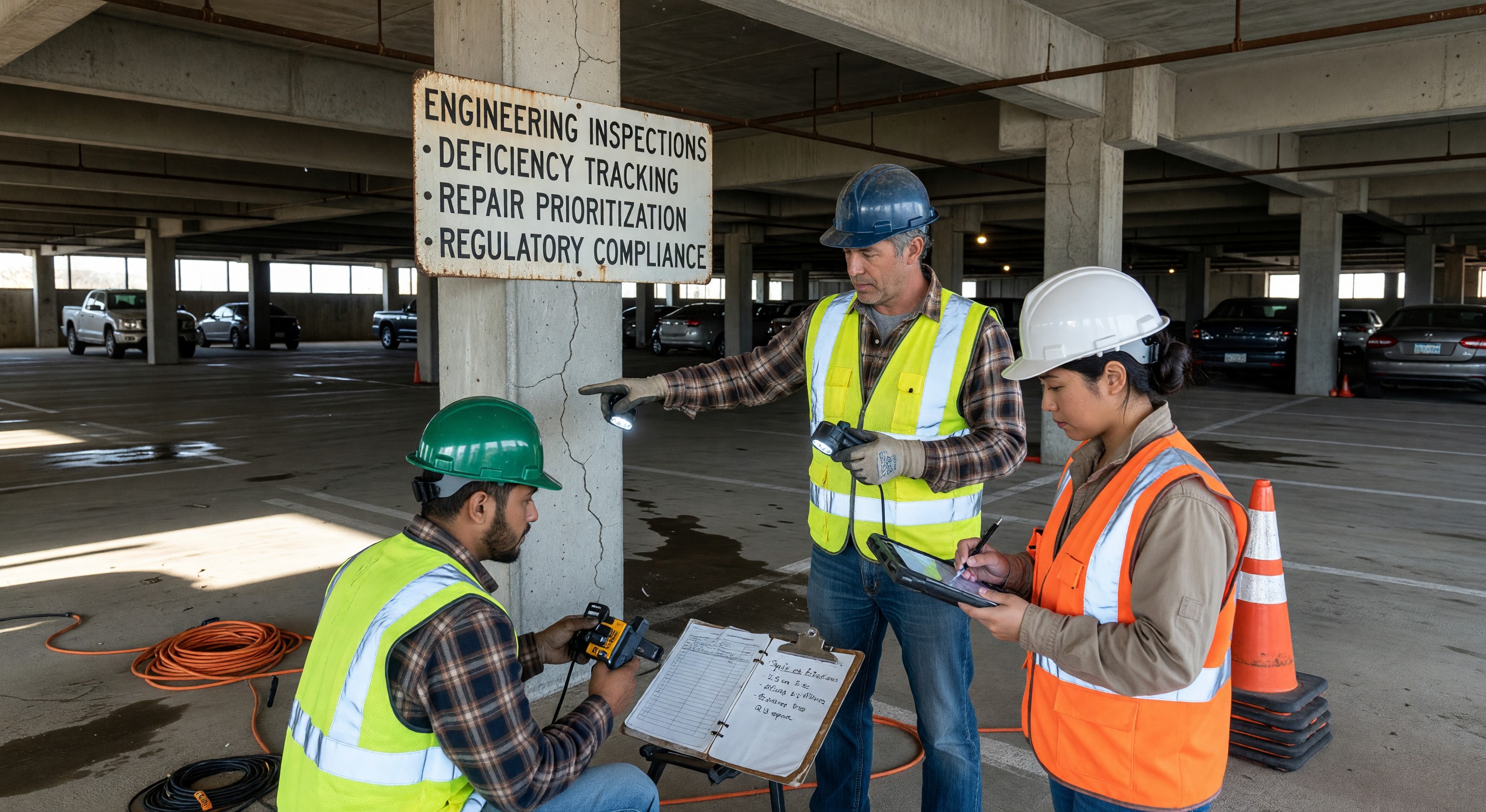
Parking structures are durable assets with lives measured in decades, but they require systematic inspection and maintenance to reach those service lives safely. The structural failures that occasionally make headlines — deck collapses, spalling concrete injuring pedestrians, post-tensioning failures — almost always have a history of inspection findings that were not addressed adequately.
Facility managers responsible for parking structures need a comprehensive inspection and compliance program that catches deterioration early, prioritizes repairs appropriately, and documents the condition management decisions that affect long-term asset health.
The Regulatory Landscape for Parking Structure Inspections
Building code inspection requirements for existing parking structures are less prescriptive than for new construction. Most jurisdictions do not mandate periodic structural condition inspections for existing private parking structures, though this is changing.
New York City has the most aggressive existing structure inspection requirement in the United States. NYC Local Law 126 (2021) requires periodic facade and structural inspections for parking structures, with reports submitted to the Department of Buildings. Category 1 conditions (safe) through Category 3 conditions (unsafe) drive different response obligations.
New Jersey enacted parking structure inspection requirements following structural failures, requiring periodic inspections by licensed structural engineers.
Other jurisdictions are actively considering similar requirements following high-profile structural failures. Facility managers in jurisdictions without current requirements should assume that requirements are coming and build proactive programs rather than waiting for mandates.
Insurance requirements: Property insurers for parking structures increasingly require periodic engineering condition assessments as a condition of coverage. Carriers that have experienced structural-related claims are particularly likely to impose this requirement.
Types of Parking Structure Inspections
A comprehensive parking structure inspection program includes multiple levels of inspection at different intervals.
Routine visual inspections by facility management personnel should occur monthly. Non-specialist personnel can identify obvious deterioration — concrete spalling, exposed reinforcing steel, water stains indicating leakage, cracked or deteriorated joint sealants, damaged equipment, and tripping hazards. Document findings with photographs and date stamps.
Annual maintenance inspections by a qualified inspector (engineer or experienced maintenance professional) should cover the complete facility systematically. These inspections follow a structured protocol that assesses deck surfaces, underside of deck elements, columns and walls, expansion joints, drainage, electrical and lighting, and life safety systems.
Comprehensive engineering condition assessments every three to five years (or after major loading events or storm damage) by a licensed structural engineer provide the most complete picture of structural condition. These assessments may include:
- Delamination survey using chain drag or infrared imaging
- Carbonation depth testing on concrete cover
- Chloride content testing in concrete
- Post-tensioning strand condition assessment in PT structures
- Expansion joint and bearing condition assessment
- Overall structural capacity review
Engineering condition assessments produce reports that classify deficiencies by severity and urgency, forming the basis for capital repair planning.
Deficiency Classification Systems
A consistent deficiency classification system allows you to prioritize repairs and track remediation progress. The most widely used classification system in parking structures has three main categories:
Immediate hazard: Conditions that pose an immediate risk of injury — loose or falling concrete, structural elements that have failed or are at imminent risk of failure, drainage blocked to the point of flooding hazard. Immediate hazards require same-day or next-day response, which may include closing affected areas, emergency repairs, or temporary shoring.
Near-term: Conditions that are deteriorating and will become immediate hazards within one to two years if not addressed. Include in the current or next fiscal year capital budget.
Routine maintenance: Conditions that represent normal deterioration and can be addressed within a planned maintenance cycle. Include in multi-year capital plans and reserve fund projections.
Consistent application of this classification system — rather than subjective description — allows comparison between inspection cycles and demonstrates active management of the condition lifecycle.
Building the Inspection Record System
Inspection records are the documentation that demonstrates active condition management and supports legal defense if incidents occur. A minimum inspection record system includes:
Facility condition file: A permanent record for the facility with as-built drawings (if available), historical inspection reports, material test data, and major repair records. This record should be retained for the life of the structure.
Inspection report archive: All inspection reports, with photographs and deficiency documentation, retained in chronological order. Retain all reports permanently — periodic attempts to “clean out” old inspection files create gaps that are damaging in litigation.
Deficiency tracking log: An active log of all open deficiencies from current and prior inspections, with assigned priority, targeted remediation date, and actual completion date. This log demonstrates that deficiencies identified in inspections are tracked to resolution.
Work order history: Documentation of all maintenance and repair work performed, linked to specific deficiencies or planned maintenance items.
Structural Load Considerations
Parking structures have defined load limits based on structural design. Overloading — from construction staging, large vehicles exceeding design loads, or material storage — can cause structural damage without visible external signs.
Vehicle load limits: Most parking structures are designed for passenger vehicle loads, typically 40 to 50 pounds per square foot live load. Heavy trucks, buses, or construction equipment should not be allowed on deck surfaces unless load studies confirm adequacy.
Construction staging: Using parking structure decks for storage of construction materials or equipment during renovation projects is a frequent cause of overload. Require engineering review before any construction staging on deck surfaces.
Signage: Post maximum vehicle weight limits at facility entrances, consistent with the structural design basis.
Post-Event Inspections
Certain events should trigger immediate inspections beyond the scheduled program:
- Seismic events above Magnitude 4.5 in the local area
- Major vehicle collisions with structural elements
- Significant flooding or drainage system failure
- Reported concrete falling or structural distress
- Winter events with unusually heavy ice or snow loads
Post-event inspections should be conducted within 24 to 48 hours of the triggering event. If the inspection reveals potentially unsafe conditions, close the affected area until professional engineering assessment confirms safety.
FAQ
How do I determine whether my parking structure needs a structural engineer or can be assessed by a maintenance professional? Routine visual inspections and annual maintenance inspections can be conducted by qualified maintenance professionals with training in parking structure deterioration recognition. Comprehensive condition assessments, evaluation of structural deficiencies, and investigations following incidents or structural concerns require a licensed structural engineer. When in doubt, the conservative choice is to engage an engineer.
What should I do if an engineering inspection recommends a major repair I cannot immediately fund? Do not ignore the recommendation. Engage the engineer to characterize the risk of deferral and identify any interim measures (temporary barriers, enhanced monitoring, load restrictions) that can be implemented while funding is secured. Document the engineer’s recommendation, your response, and the interim measures taken. This documentation demonstrates responsible management and is important if deterioration accelerates.
Are parking structure inspection records discoverable in litigation? Yes. Inspection records, including unflattering findings, are discoverable in premises liability litigation. However, having inspection records that show active, documented management of facility condition is far better than having no records or records that show inspections were not conducted. Gaps in inspection records create an inference that conditions were not managed.
How do I find a structural engineer with parking structure expertise? Professional engineering firms with structural engineering departments typically have experience with parking structures. Ask specifically about parking structure experience and request references from similar projects. Industry organizations like IPMI and the Structural Engineering Institute can provide referrals.
Further Reading from Authoritative Sources
- International Parking and Mobility Institute parking structure inspection resources — parking-mobility.org (IPMI) is on the whitelist as the primary parking industry authority and its structural inspection resources are directly relevant to the compliance framework in this article.
- Transportation Research Board parking structure condition and inspection research — trb.org is on the whitelist and TRB’s structural research provides the technical foundation for the inspection frequency and deficiency categorization guidance in this article.