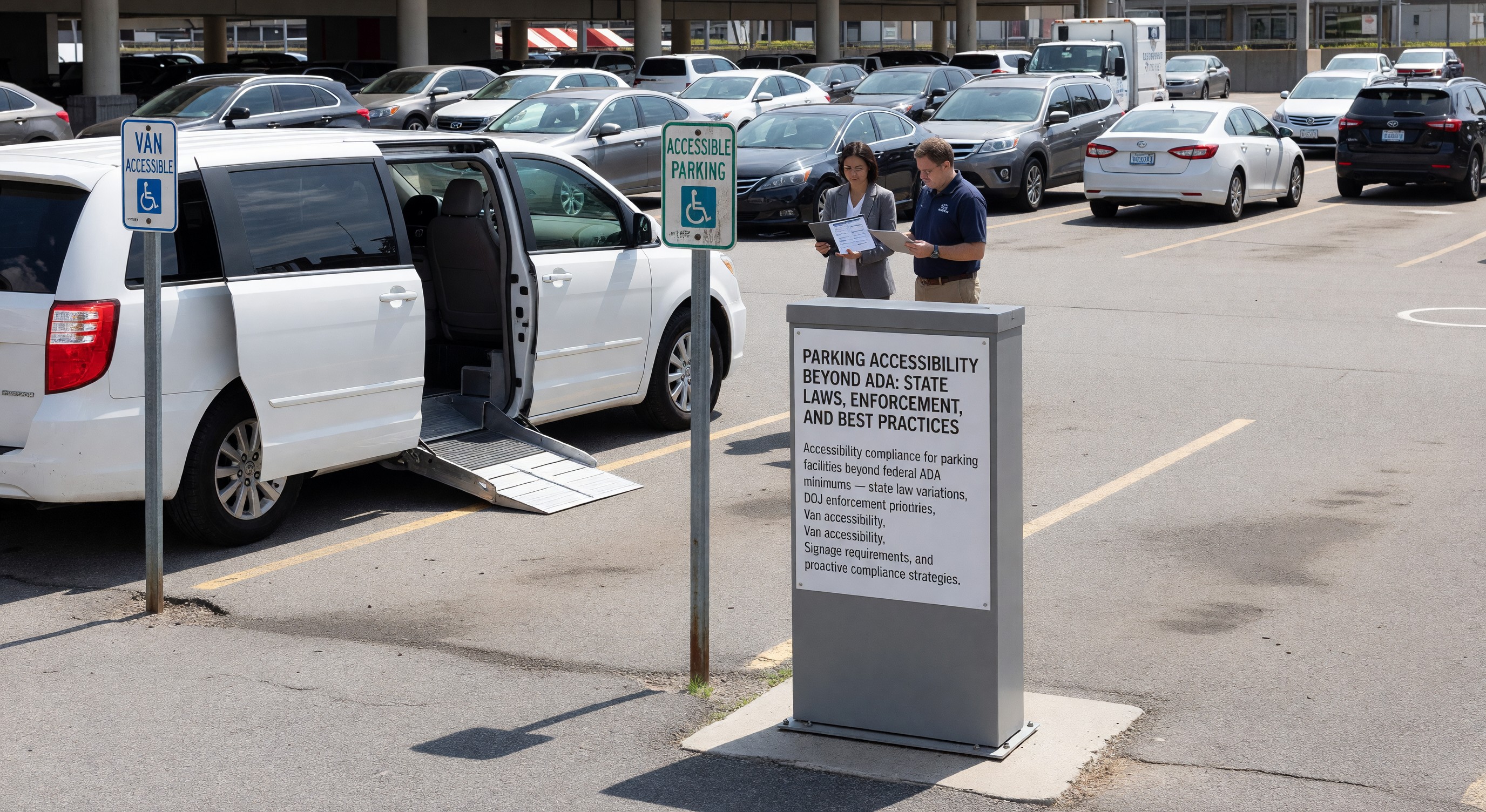
Federal ADA requirements for accessible parking are the minimum legal baseline, not the gold standard. Many states have adopted accessibility requirements that exceed federal minimums. DOJ enforcement and private litigation have highlighted compliance gaps that many facility managers did not know existed. And the disability community’s expectations for accessible parking facilities continue to rise beyond the letter of the law.
Facility managers who understand the full landscape of accessibility requirements — federal, state, and emerging best practice — are better positioned to manage compliance risk and serve all users effectively.
Federal ADA Requirements: A Brief Recap
The ADA Standards for Accessible Design (2010) establish the baseline. Key requirements for parking facilities:
Space counts: ADA Section 208 establishes minimum accessible space counts based on total lot size. For 1 to 25 total spaces, one accessible space is required; the ratio decreases as total lot size increases. One in every six accessible spaces must be van-accessible.
Dimensions: Standard accessible spaces must be at least 8 feet wide with a 5-foot access aisle. Van-accessible spaces require either an 8-foot space with an 8-foot access aisle, or an 11-foot space with a 5-foot access aisle.
Location: Accessible spaces must be on the shortest accessible route to the building entrance or entrance being served. When multiple entrances serve a facility, accessible spaces should be distributed across those entrances.
Signage: Accessible spaces must be marked with the International Symbol of Accessibility on a post-mounted sign at the head of the space, at a height between 60 inches and 66 inches.
Surface: Accessible spaces and access aisles must have slopes not exceeding 1:48 (approximately 2 percent) in any direction.
Van Accessibility: The Most Common Compliance Gap
Van accessibility is the most frequently cited ADA parking deficiency in DOJ enforcement actions and private litigation. Many facilities have the correct number of van-accessible spaces on paper but fail to meet technical requirements in practice.
The access aisle for a van-accessible space must be on the passenger side of the space (the right side when approaching head-in). A van-accessible space with a driver-side access aisle does not meet the standard unless a second van-accessible space with a passenger-side aisle is provided.
Many parking facilities that were built to pre-2010 standards have van-accessible spaces that meet the older 96-inch (8-foot) width requirement but have driver-side aisles that were acceptable under the earlier standard. These spaces do not conform to the 2010 ADA Standards and should be corrected.
Overhead clearance is another common van accessibility gap. Most adaptive vans require 8 feet, 2 inches of vertical clearance for roof equipment. Enclosed garages with lower ceiling heights often fail this requirement. Parking structures that cannot provide 8-foot, 2-inch clearance throughout must have at least one van-accessible entrance route that provides that clearance, with signage directing vans to the compliant entrance.
State Law Variations
Several states have adopted accessible parking requirements that exceed federal ADA minimums. Facility managers operating in these states must comply with the higher standard.
California imposes additional requirements for accessible space design, signage, and enforcement under the California Building Code and California Vehicle Code. Van-accessible space signage in California must include the minimum fine for unauthorized parking ($250 minimum), and the space must be marked with “No Parking” at the access aisle.
New York has adopted accessible parking requirements that track the 2010 ADA Standards but includes additional enforcement provisions under the New York State Human Rights Law.
Florida requires accessible parking enforcement through the Florida Department of Agriculture and Consumer Services, and imposes specific fine amounts for violations that must appear on signage.
Confirm applicable state and local requirements for each facility location. State building codes, motor vehicle codes, and human rights laws all potentially apply.
Accessible Route Continuity
Accessible parking spaces are only usable if they connect to an accessible route leading to the building entrance. The accessible route must:
- Be at least 44 inches wide (36 inches minimum in limited circumstances)
- Have a running slope not exceeding 5 percent (1:20) and a cross slope not exceeding 2 percent (1:48)
- Be free of obstructions
- Have curb cuts where routes cross curbs
- Connect continuously from accessible spaces to all accessible building entrances
Many parking facilities have technically compliant accessible spaces but fail on accessible route continuity. Curb cuts that are too steep, routes that cross uncontrolled drive lanes without pedestrian markings, or routes that lead to non-accessible building entrances all compromise accessibility despite individually compliant components.
Accessible Space Maintenance: An Ongoing Obligation
ADA compliance is not a one-time installation task — it is an ongoing obligation. Accessible spaces and routes that are compliant when built can become non-compliant through:
Pavement deterioration: Settlement, heaving, or cracking that changes slopes of accessible spaces or access aisles beyond the 1:48 limit.
Faded markings: Striping and pavement markings that have faded below legibility. Access aisle markings must include the “NO PARKING” text as required.
Signage damage: Post-mounted accessible parking signs that have been damaged, tilted, or moved below the required height.
Snow and ice obstruction: Access aisles that are used for snow storage, or accessible routes not cleared within a reasonable time after snow events.
Conduct accessible parking compliance inspections at least annually, and after any significant pavement work, striping project, or winter season. Document inspections and any corrective actions.
DOJ Enforcement Priorities
The Department of Justice has enforcement priorities in accessible parking that reflect the most common and impactful accessibility failures:
Insufficient van-accessible spaces: Facilities with inadequate van-accessible space counts are priority enforcement targets.
Accessible route failures: DOJ frequently cites facilities where accessible spaces do not connect to accessible building entrances via a safe, compliant accessible route.
Signage deficiencies: Missing, incorrect, or damaged signage is commonly cited because it is easily observable during investigations.
Proactive compliance audits that address these priority areas reduce enforcement risk significantly.
FAQ
Can I use parking enforcement to protect accessible spaces? Yes, and you should. Unauthorized parking in accessible spaces is enforceable under state motor vehicle codes and, in some jurisdictions, local ordinances. Establish a clear process for reporting unauthorized occupancy and coordinate with local enforcement when self-enforcement is inadequate.
What happens if I receive a DOJ complaint about accessible parking? DOJ typically first pursues voluntary compliance through complaint resolution. Facilities that respond cooperatively and demonstrate a plan for remediation are more likely to reach a negotiated settlement. Facilities that fail to respond or that dispute valid complaints may face formal enforcement action and litigation.
Do temporary accessible space arrangements (during construction) satisfy ADA requirements? Temporary arrangements must still provide the minimum required accessible spaces, accessible routes, and technical compliance. The ADA does not create an exception for construction-phase temporary arrangements. Plan accessible space provisions into your construction phasing.
How often should I update my accessible parking compliance assessment? Formally, whenever there is a change to the facility (construction, repaving, restriping, new building entrances). As a routine matter, an annual inspection of accessible spaces, routes, and signage is appropriate.
Further Reading from Authoritative Sources
- U.S. Access Board ADA parking accessibility technical standards — access-board.gov is on the whitelist as the authoritative source for federal ADA parking standards — essential reference for the ‘beyond ADA’ comparison this article makes.
- ADA.gov Department of Justice accessible parking enforcement guidance — ada.gov is on the whitelist as the DOJ’s ADA portal and is the source for DOJ enforcement priority information referenced in this article.