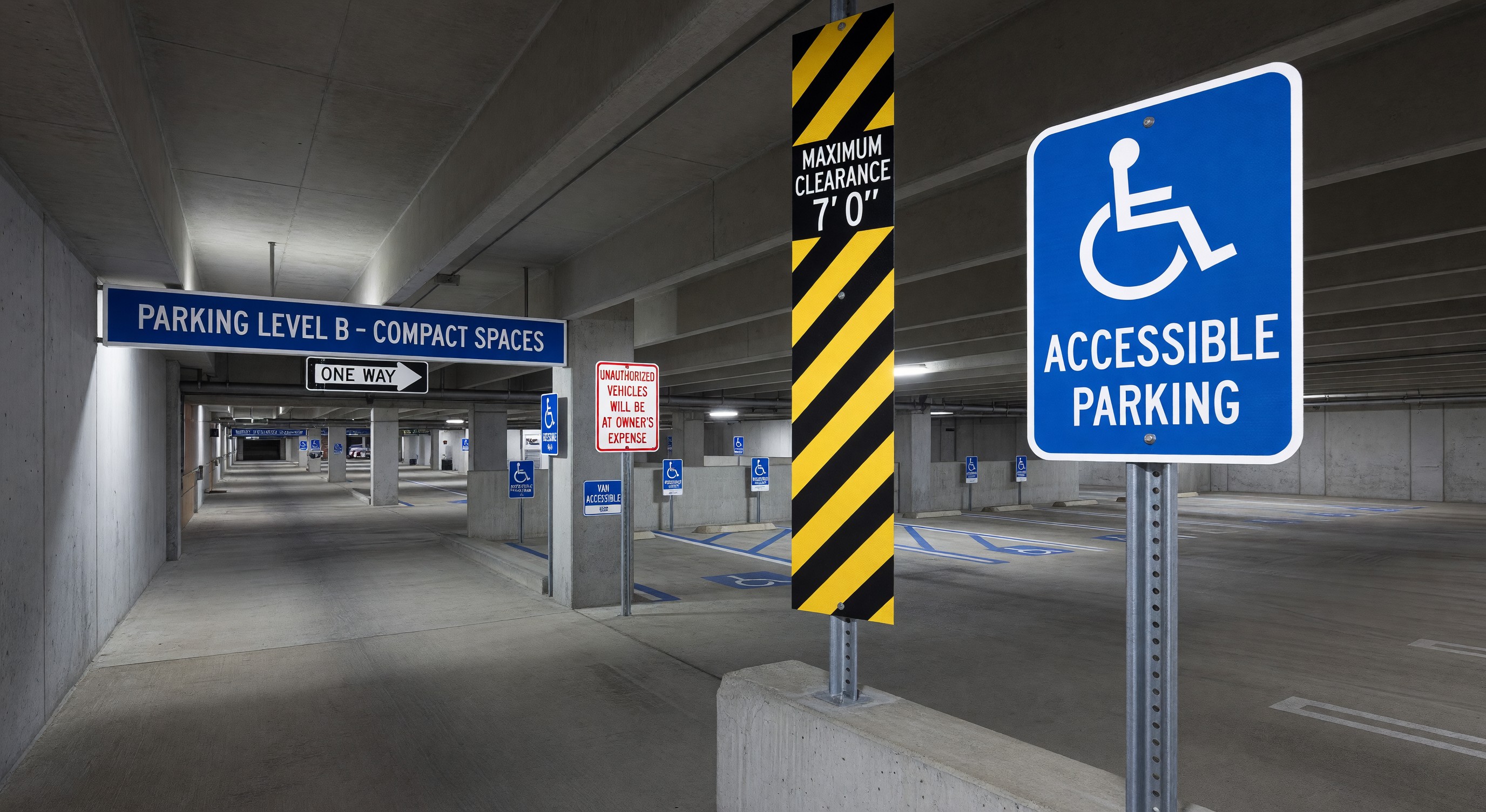
Parking facility signage serves multiple compliance functions simultaneously: directing traffic safely, communicating parking rules and rates, identifying accessible spaces, and meeting regulatory requirements from multiple codes and laws. Inadequate or non-compliant signage creates liability exposure, ADA compliance gaps, and enforcement difficulties.
This guide covers the signage categories that carry compliance requirements, the applicable standards, and the operational practices that keep signage current and compliant.
ADA-Required Accessible Parking Signage
ADA Standards for Accessible Design (2010) establish specific requirements for accessible parking space signage. Non-compliance is common and frequently cited in DOJ enforcement actions and private litigation.
Required signs:
- International Symbol of Accessibility (ISA) mounted on a post at the head of each accessible parking space
- Mounted height: bottom of sign between 60 inches and 66 inches above the ground surface
- Sign must include the ISA (the blue wheelchair symbol) per ADA requirements
- Van-accessible spaces must include “Van-Accessible” text or an appropriate symbol
Common deficiencies:
- Signs mounted too low (common when signs have been replaced with different mounting hardware)
- Signs damaged or faded to the point where the ISA is not clearly visible
- Missing “Van-Accessible” designation on spaces that are van-accessible
- Signs mounted on walls rather than posts when wall mounting does not meet height requirements
State-specific additions: Many states add requirements to accessible parking signage beyond federal minimums. California requires the minimum fine for unauthorized parking ($250+). Other states require specific language about permit requirements or enforcement authority.
Conduct an annual inspection of all accessible parking signage for visibility, correct mounting height, and compliance with applicable state requirements.
Parking Rates and Time Limit Signage
Parking facilities that charge fees or enforce time limits must post this information in a manner that complies with applicable consumer protection and motor vehicle laws.
Rate posting requirements: Most states require that parking rates be conspicuously posted at the facility entrance, at the point of payment, and at any point where a contract for parking is entered into. Rate signage must be legible and placed so that drivers can read it before committing to park.
Rate signs should include: all applicable rates (daily maximum, hourly rates, flat event rates), the hours the rates apply, and any conditions or exceptions. A rate sign that shows only the maximum daily rate without showing the hourly rates for shorter stays may not satisfy disclosure requirements in all jurisdictions.
Time limit signage: If parking time is limited in all or part of the facility, signage must communicate the limit clearly. Time limit signs should specify the hours during which limits apply, the maximum time limit, and any exemptions (monthly permit holders, accessible space users).
Traffic Control Signage
Traffic flow through parking facilities is regulated by a mix of private signage (speed limit, stop signs, yield signs, directional signs) and, in some jurisdictions, motor vehicle code requirements for signage that carries legal enforcement authority.
Speed limit signs: Post speed limits at facility entrances and at appropriate intervals within the facility. Most jurisdictions recognize private speed limit signs posted in off-street parking areas. Maximum posted speeds of 5 to 10 mph are standard for structured parking; 10 to 15 mph is typical for surface lots.
Stop and yield signs: Stop signs at pedestrian crossing points, exits, and intersections with significant sight-line limitations improve safety and create a documented standard against which driver behavior is evaluated in incident litigation.
Directional signage: Clear wayfinding reduces wrong-way driving, speeds circulation, and reduces conflicts. Post entry and exit arrows at the facility perimeter, directional signs at internal decision points, and elevator/stair identification signs.
Height clearance signs: All enclosed garages must post height clearance signs at the entrance. Height clearance signs must be accurate — they should reflect the minimum vertical clearance throughout the facility, not just at the entrance. The most common required format includes the clearance in feet and inches (e.g., “6'2” Low Clearance") with high-visibility background (typically red or yellow) and reflective treatment for night visibility.
ITE Signage Standards: The Institute of Transportation Engineers (ITE) publishes guidelines for traffic control signage in parking facilities that are widely used as the professional standard.
No Parking and Tow-Away Signage
Effective enforcement of parking rules requires compliant tow-away and no-parking signage. Many towing disputes arise from signage that fails to meet state requirements.
Most states that regulate private property towing have specific signage requirements as a condition of towing authority. Common requirements include:
- Sign dimensions (typically minimum 17 x 22 inches or similar)
- Required text (usually including the towing company name and phone number, and the fact that unauthorized vehicles will be towed)
- Sign placement (at each entrance, at intervals within the facility, and specifically at no-parking zones)
- Lighting or reflectivity requirements for 24/7 enforcement authority
If signs do not meet state towing law requirements, towing may be legally defective even if the vehicle was unauthorized. Review your towing signage against current state requirements and document compliance.
Signage Maintenance Program
Compliant signage at installation is only part of the obligation. Signs deteriorate through UV exposure, physical damage, and vandalism. A systematic signage maintenance program ensures ongoing compliance.
Annual signage audit: Walk the entire facility and document the condition, visibility, and compliance status of all required signage. Flag any signs that are damaged, faded, incorrectly mounted, or out of compliance with current requirements.
Sign replacement standards: Establish a policy for replacing signs based on condition. Signs with faded reflective sheeting, damaged panels, or illegible text should be replaced promptly. Reflective sign materials have defined service lives (typically 7 to 12 years depending on material grade).
Regulatory change monitoring: Sign compliance requirements change as states amend towing laws, accessibility standards are updated, and local codes evolve. Designate a responsible party to monitor regulatory changes that affect signage requirements.
FAQ
Can I use wall-mounted accessible parking signs instead of post-mounted signs? The 2010 ADA Standards specify post-mounted signs with the bottom of the sign between 60 and 66 inches above ground. Wall-mounted signs can be compliant if they meet the height requirement and are located at the head of the accessible space. In practice, wall mounting at accessible spaces is often non-compliant because the mounting height or location relative to the space does not meet requirements.
Do parking rate signs need to meet any specific standard for typeface size? State consumer protection regulations vary on rate sign legibility requirements. Some states specify minimum letter heights for rate signage; others require legibility at a specified distance without prescribing exact dimensions. Review applicable state law, and as a practical matter, design rate signs so that drivers can read them from their vehicle before entering the facility.
How should I handle height clearance when some areas of my garage have lower clearance than the entrance? Post the minimum clearance for the entire facility at the entrance. If certain areas have lower clearance than others, post additional clearance warning signs at the transitions to lower-clearance areas. Routing tall vehicles through only the compliant sections with appropriate directional signage is an acceptable approach when consistent clearance throughout the facility is not achievable.
What happens if a vehicle is damaged because of inadequate height clearance signage? Facility liability for vehicle damage from inadequate clearance signage is well-established in case law. If a driver can show that posted clearance was inaccurate or signs were inadequate to warn of a low-clearance hazard, the facility faces significant liability exposure. Accurate clearance measurement and posting, combined with adequate warning signs at low-clearance points, is both a compliance requirement and a liability management essential.
Further Reading from Authoritative Sources
- Institute of Transportation Engineers parking facility signage and traffic control resources — ite.org is on the whitelist and ITE’s parking design and traffic engineering publications are the industry standard technical references for parking facility signage design.
- U.S. Access Board accessible parking signage requirements — access-board.gov is on the whitelist as the authoritative source for the ADA signage technical requirements that are a central compliance dimension of this parking signage article.