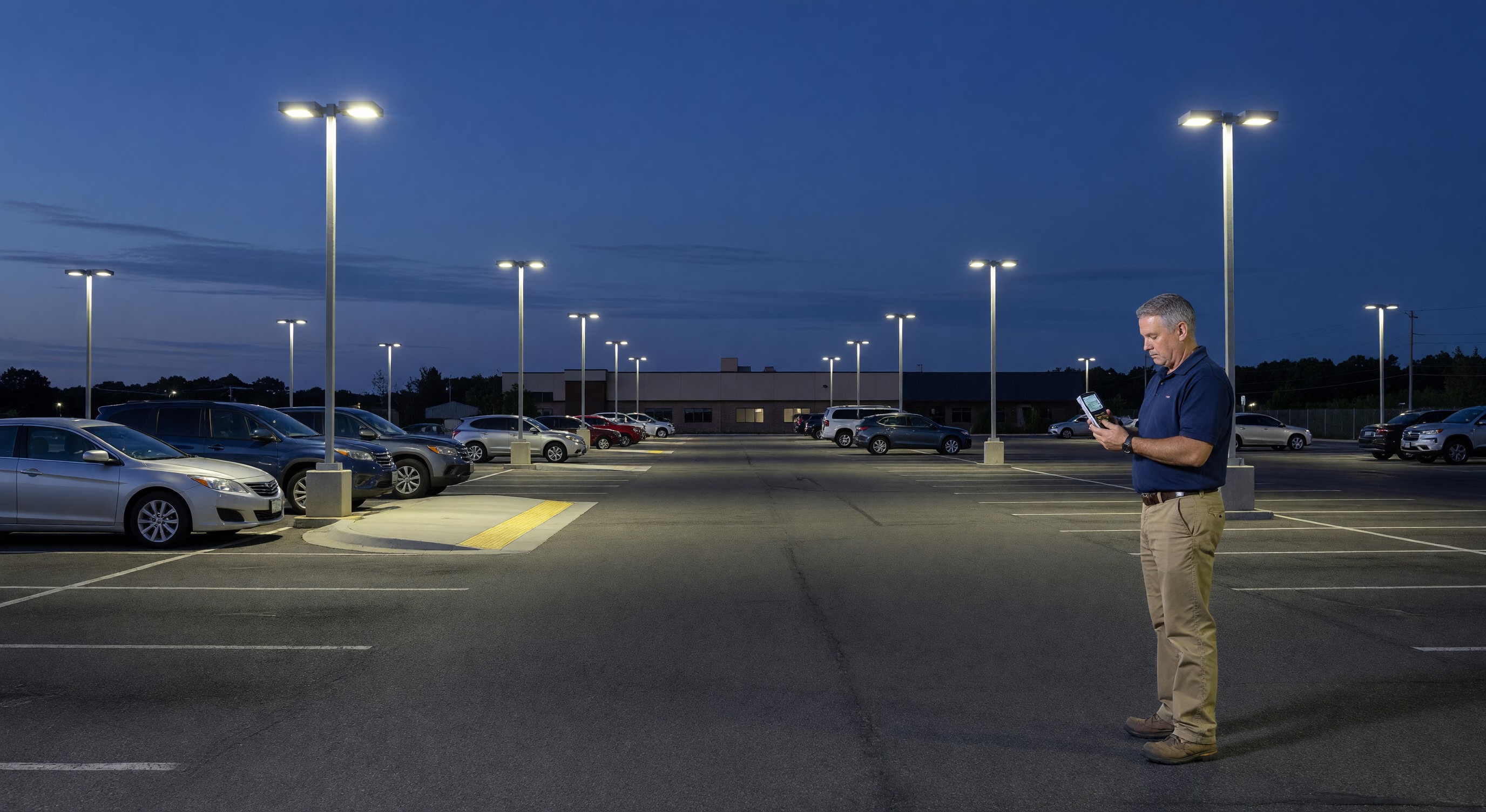
Parking facility lighting is a compliance requirement, a safety imperative, and a customer experience factor simultaneously. Facilities with inadequate lighting face liability exposure from slip-and-fall incidents, security incidents, and ADA non-compliance. Facilities with excessive or poorly designed lighting waste energy and annoy neighbors with light pollution.
Understanding the applicable standards and how to measure compliance against them is essential for facility managers responsible for parking operations.
Applicable Standards and Their Authority
Parking lighting standards come from multiple sources, and understanding which ones apply — and with what force — is the starting point.
IES RP-20 (Illuminating Engineering Society, Recommended Practice for Parking Facilities) is the primary professional standard for parking lighting. IES standards are not building codes but are widely adopted by reference in state and local building codes, and are considered the authoritative technical benchmark by courts evaluating premises liability claims.
IES RP-20 establishes recommended illuminance levels (footcandles) and uniformity ratios for different areas within parking facilities. These recommendations are the foundation for lighting design, specification, and adequacy assessments.
IBC (International Building Code) and local building codes may reference minimum lighting levels. These requirements are minimums — compliance with code does not necessarily mean compliance with professional standards for safety and security.
OSHA General Duty Clause can apply to parking facilities accessible to employees. OSHA has no specific parking lighting standard, but the general duty clause requires employers to maintain workplaces free of recognized hazards. Inadequate parking lot lighting for employee access can be cited as a general duty violation following incidents.
ADA Standards for Accessible Design do not specify footcandle levels directly, but adequate lighting for accessible routes is implied and supported by DOJ guidance. Accessible paths of travel — including those through parking areas — must be safely usable, which requires adequate lighting.
IES RP-20 Recommended Illuminance Levels
IES RP-20 establishes recommended maintained illuminance levels (in footcandles, measured at the floor or pavement surface) for different facility types and zones.
Parking lots (open surface lots):
- Basic (low activity, suburban): 0.5 to 1.0 footcandle average
- Enhanced (moderate activity, commercial): 1.0 to 2.0 footcandles average
- High activity (urban, retail, events): 2.0 to 5.0 footcandles average
Parking garages (enclosed structures):
- Entrance areas (day transition zones): 50 footcandles or more (for day/night adaptation)
- General parking areas: 5 to 10 footcandles
- Ramps and transitions: 5 to 10 footcandles
- Stairwells: 5 to 15 footcandles
These are maintained illuminance targets — the levels after accounting for lamp lumen depreciation over time. Initial (as-installed) levels should be 15 to 20 percent higher than maintained targets.
Uniformity Ratios: Often Overlooked
Average illuminance levels alone do not ensure adequate lighting. Uniformity ratios measure how evenly light is distributed — specifically the ratio of average footcandles to minimum footcandles across a measurement grid.
IES recommends uniformity ratios (average/minimum) of 4:1 or better for general parking areas and 3:1 or better for higher-security or higher-activity areas. A uniformity ratio of 10:1 or worse produces bright spots under fixtures and deep shadows between them — a condition that creates both safety hazards and a psychological sense of insecurity.
Facilities that replaced individual fixtures without redesigning the layout often have poor uniformity ratios even if average light levels are adequate. Evaluate uniformity whenever you assess lighting adequacy.
How to Measure Lighting Compliance
Lighting adequacy assessments require measurement, not just visual inspection. A lux meter (illuminance meter) measures footcandles at a specific point. Systematic measurements across a measurement grid allow calculation of average illuminance and uniformity ratios.
IES recommends measurement grids with points spaced at maximum five-foot intervals for detailed assessments. For a preliminary self-assessment, measurements at representative points — under a fixture, midway between fixtures, and at the farthest point from any fixture — provide directional information.
Document measurements with the date, time, and measurement locations. This documentation establishes a baseline and supports compliance demonstration if an incident leads to a premises liability claim.
For comprehensive lighting assessments, particularly before major retrofits or after incidents, engage a certified lighting designer (NCQLP credential) or a qualified electrical engineer.
ADA Lighting Requirements for Parking Areas
ADA accessibility standards require that accessible routes — including those connecting accessible parking spaces to building entrances — be safely passable for people with disabilities. While specific footcandle levels are not stated in ADA standards, the accessible route must be usable in practice.
Accessible parking spaces, access aisles, and accessible routes from parking to building entrances should meet or exceed the illuminance levels recommended for general parking areas. Where accessible routes cross drive lanes, lighting should ensure that pedestrians with visual impairments are visible to drivers.
Pay particular attention to transition areas — the grade-level connections between parking and buildings, ramp connections, and any areas where vertical surfaces create shadows on the accessible path.
Night-Time Security Considerations
Adequate lighting is one of the most effective crime deterrents in parking facilities. CPTED (Crime Prevention Through Environmental Design) principles identify lighting as a primary environmental factor in crime reduction.
Beyond meeting IES minimums, security-focused lighting design considers:
Coverage consistency. Uniform lighting without deep shadows eliminates hiding places and equalizes the visibility throughout a facility.
Stairwell and elevator lobby lighting. These spaces, where users are most vulnerable to assault, should be among the best-lit areas in a parking structure.
Color rendering. Light sources with higher color rendering index (CRI) values allow security cameras and human vision to better distinguish colors and details. LED sources with CRI of 70 or higher are recommended for areas with security camera coverage.
FAQ
How do I know if my parking lot meets IES standards without hiring a consultant? A basic self-assessment is possible with an inexpensive lux meter. Take spot measurements at multiple locations across the parking area, including under fixtures and at midpoints between fixtures. Compare your measurements to IES RP-20 recommended levels for your facility type and use. A pattern of measurements below recommended levels, or a high variance between bright and dark spots, indicates a potential deficiency.
Does passing a building inspection mean my lighting is adequate? Not necessarily. Building code minimum lighting requirements are lower than IES recommended practice levels. A facility can be code-compliant but still fall below the standards used to evaluate premises liability in negligence claims.
How often should parking lighting be evaluated? Formally evaluate lighting every three to five years, and after any lighting retrofit or change in use. Lamp lumen depreciation causes illuminance levels to fall over time; systems that met standards when installed may fall below standards after several years of operation.
Do LED fixtures change the measurement approach? No. LED fixtures are measured the same way as other sources — illuminance in footcandles at the measurement point. The measurement methodology is independent of source technology.
Further Reading from Authoritative Sources
- International Parking and Mobility Institute lighting standards and guidance — parking-mobility.org (IPMI) is on the whitelist as the primary parking industry authority with directly relevant lighting standards guidance for parking facility managers.
- U.S. Department of Energy commercial lighting efficiency resources — energy.gov is on the whitelist and the DOE’s lighting efficiency resources directly support the LED conversion and energy performance discussion in this article.