Parking provisions in commercial leases are a frequent source of disputes between landlords and tenants. Ambiguous space counts, disagreements about access rights, unauthorized use of reserved spaces, and conflicting interpretations of parking ratio commitments create legal and operational friction that property managers deal with regularly.
Proactive parking lease compliance management — establishing clear policies, maintaining accurate records, and addressing issues before they escalate — prevents most parking-related disputes from becoming costly disagreements.
Understanding What Lease Parking Provisions Typically Cover
Commercial leases address parking in varying levels of detail. Well-drafted leases specify:
Space count and type: The number of parking spaces allocated to the tenant, whether they are reserved or unreserved, covered or surface, and where they are located within the facility.
Parking ratio: The ratio of parking spaces to rentable square footage committed to the tenant (e.g., 4 spaces per 1,000 rentable square feet). When tenants expand into additional space, the parking ratio determines their entitlement to additional parking.
Rate and escalation: Whether parking is included in rent, separately charged, and how rates escalate over time. Parking rate escalations are often indexed to CPI or tied to market rates.
Operating hours and access: The hours during which tenants may access parking, whether 24/7 access is provided, and any limitations.
Tenant’s obligations: Permit registration requirements, access credential management, enforcement cooperation, and maintenance of employee parking compliance.
Landlord’s obligations: Maintenance obligations, lighting standards, ADA compliance, and the process for addressing service failures.
Building a Parking Entitlement Tracking System
For properties with multiple tenants and complex parking allocations, informal tracking creates gaps that lead to disputes. Build a systematic parking entitlement tracking system:
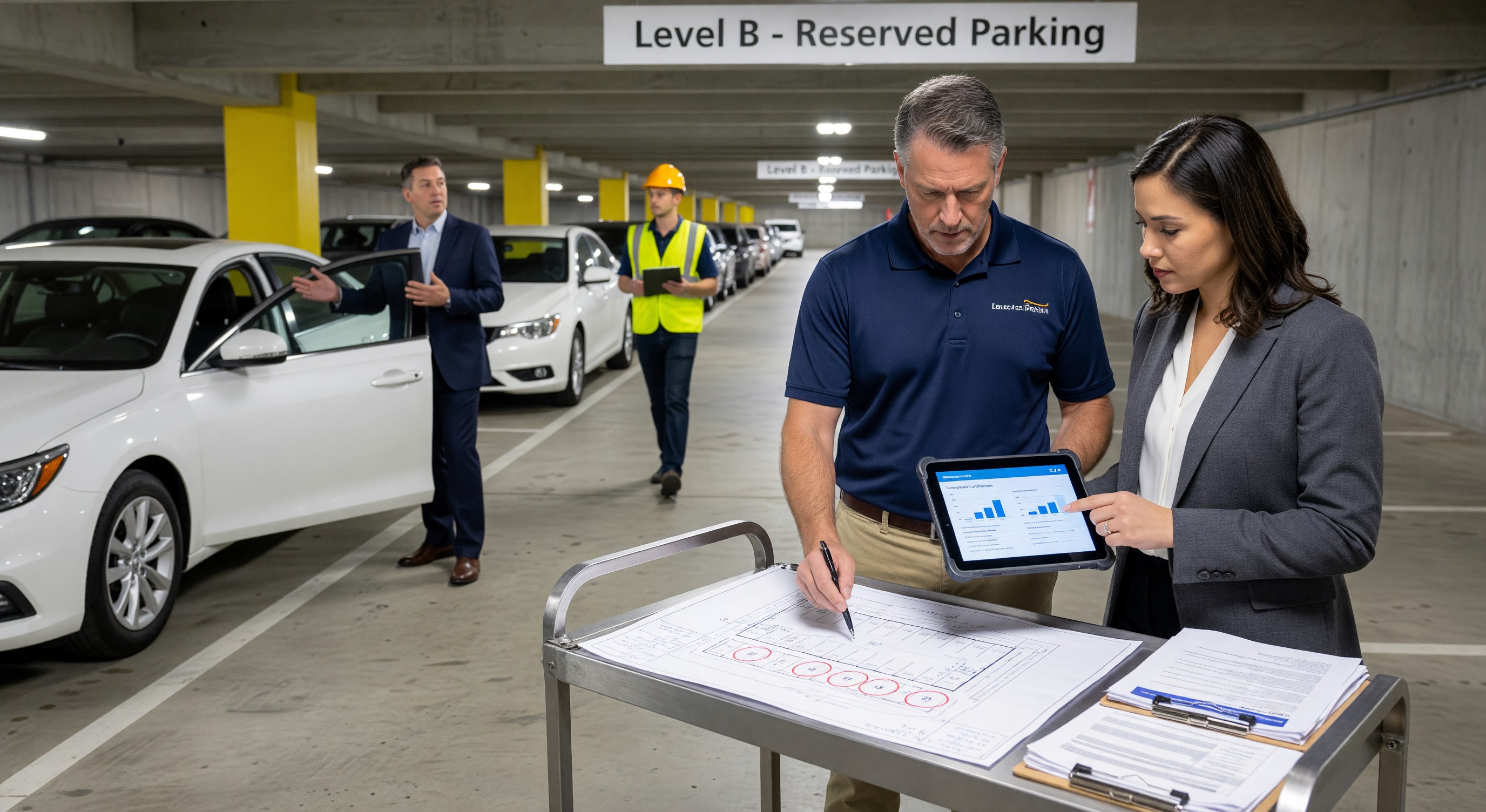
Tenant register: For each tenant, maintain a record of their lease term, space count commitment, space types (reserved/unreserved), specific space assignments if applicable, current rate, and rate escalation schedule.
Space inventory: Maintain a current map of all spaces in the facility with status (committed to which tenant, available, reserved, accessible, EV-designated).
Reconciliation process: Quarterly reconciliation between the tenant register and actual space assignments catches discrepancies before they become disputes. When tenants expand, contract, or sublet, update the register promptly.
Permit register: For facilities using hang tags, stickers, or license plate-registered permits, maintain a register of all active permits linked to the tenant register. This allows you to verify that the number of active permits does not exceed entitlement.
Handling Tenant Parking Rule Violations
Tenant employees who park in spaces they are not entitled to use — reserved spaces belonging to other tenants, accessible spaces without valid placards, or loading zones — create conflict and liability.
Establish clear parking rules that are communicated to all tenants in writing, ideally as an exhibit to the lease or in a parking rules document acknowledged at lease execution. Rules should cover:
- Prohibited areas and consequences
- Visitor parking allocation and procedures
- After-hours access procedures
- Consequences for permit violations
- Tenant’s responsibility for communicating rules to employees
When violations occur, address them consistently. A violation by a senior employee of a major tenant should be handled the same way as a violation by a small tenant. Selective enforcement creates discrimination claims and undermines the credibility of your rules.
Escalation process for repeated violations: written notice to the tenant, meeting with tenant management, formal violation notice citing lease provision, and ultimately loss of parking privileges for repeat offenders.
Managing Reserved Space Assignments
Reserved space programs require more active management than unreserved programs. When a tenant holds a named space, they expect it to be available exclusively whenever they need it. Violations of reserved space exclusivity damage tenant relationships quickly.
Physical marking: Reserved spaces should be physically marked with the tenant or individual name, space number, or other clear identifier. Physical marking makes violations obvious to both the violator and enforcement personnel.
Enforcement frequency: Reserved space enforcement requires more active monitoring than unreserved enforcement. A tenant whose reserved space is regularly occupied by others will not renew their reserved permit — and may raise a lease compliance claim.
Substitute space procedures: When a reserved space must be temporarily taken out of service (for maintenance, cleaning, or operational reasons), establish a procedure for providing a comparable substitute space and notifying the tenant in advance.
Tenant Parking at Lease Renewal and Expansion
Lease renewal and tenant expansion create parking compliance decision points.
Renewal: At renewal, parking rates and space counts should be formally renegotiated as part of the lease negotiation. Avoid allowing parking to automatically continue on prior terms without a formal renewal, which can create ambiguity about current rights and rates.
Expansion: When a tenant takes additional space, their parking entitlement increases proportionally per the lease parking ratio. Identify the additional spaces to be allocated, update the tenant register, issue new permits, and amend the lease or execute a parking amendment.
Contraction: When a tenant reduces their space, their parking entitlement decreases. Collect excess permits and update space assignments. Handle this sensitively — tenants who have given up valuable space do not need parking friction added to the experience.
Disputes and Dispute Resolution
Despite good management practices, parking lease disputes will occur. Common dispute types:
Entitlement disputes: Tenant claims they are entitled to more spaces than the landlord acknowledges. Resolution requires careful review of lease language, parking ratio definitions, and square footage measurements.
Quality of service disputes: Tenant claims parking quality has deteriorated below the standard implied or stated in the lease. Maintenance records, lighting assessments, and documented complaints are the evidentiary foundation for evaluating these claims.
Rate disputes: Tenant disputes the current parking rate or escalation methodology. Rate escalation provisions must be precisely calculated per lease terms.
For most parking disputes, a direct conversation with the tenant’s property manager or occupancy manager resolves the issue without escalation. Document the conversation and the resolution in writing.
For disputes that do not resolve informally, the lease typically provides a dispute resolution mechanism — notice and cure periods, mediation, or arbitration. Follow the lease dispute resolution process, which will typically be a condition precedent to litigation.
FAQ
What should I do when a tenant’s lease expires but they have not vacated their reserved parking spaces? Treat holdover parking the same as holdover tenancy. The lease’s holdover provisions typically address this. Issue a formal notice identifying the unauthorized parking and providing a deadline for resolution. If the tenant has fully vacated the space but left vehicles, follow your jurisdiction’s abandoned vehicle process.
Can I change parking rates mid-lease? Only if the lease expressly permits it. Most commercial leases either fix parking rates for the lease term or provide a specific escalation mechanism. Unilateral mid-lease rate changes not authorized by the lease are a landlord default.
How do I handle tenant requests for accessible parking spaces beyond their lease entitlement? ADA and FHA (for residential properties) impose obligations to provide reasonable accommodation for disability-related parking needs. Requests for accessible spaces beyond lease entitlement should be evaluated as reasonable accommodation requests, not standard lease negotiation. Consult your legal counsel before denying accommodation requests.
Should parking provisions be in the main lease or in a separate parking agreement? Both approaches are used. Separate parking agreements allow parking terms to be modified without amending the main lease, which can be advantageous when parking operations change frequently. Integrated lease provisions provide a single document for all tenant rights and obligations. The choice depends on your management model and the complexity of the parking arrangement.
Further Reading from Authoritative Sources
- BOMI International lease administration and compliance resources — bomi.org is on the whitelist as a facility management authority whose lease administration training directly applies to the parking lease compliance framework in this article.
- IFMA facility management lease compliance resources — ifma.org is on the whitelist as a facility management authority with relevant lease compliance and space management resources for the audience this article serves.