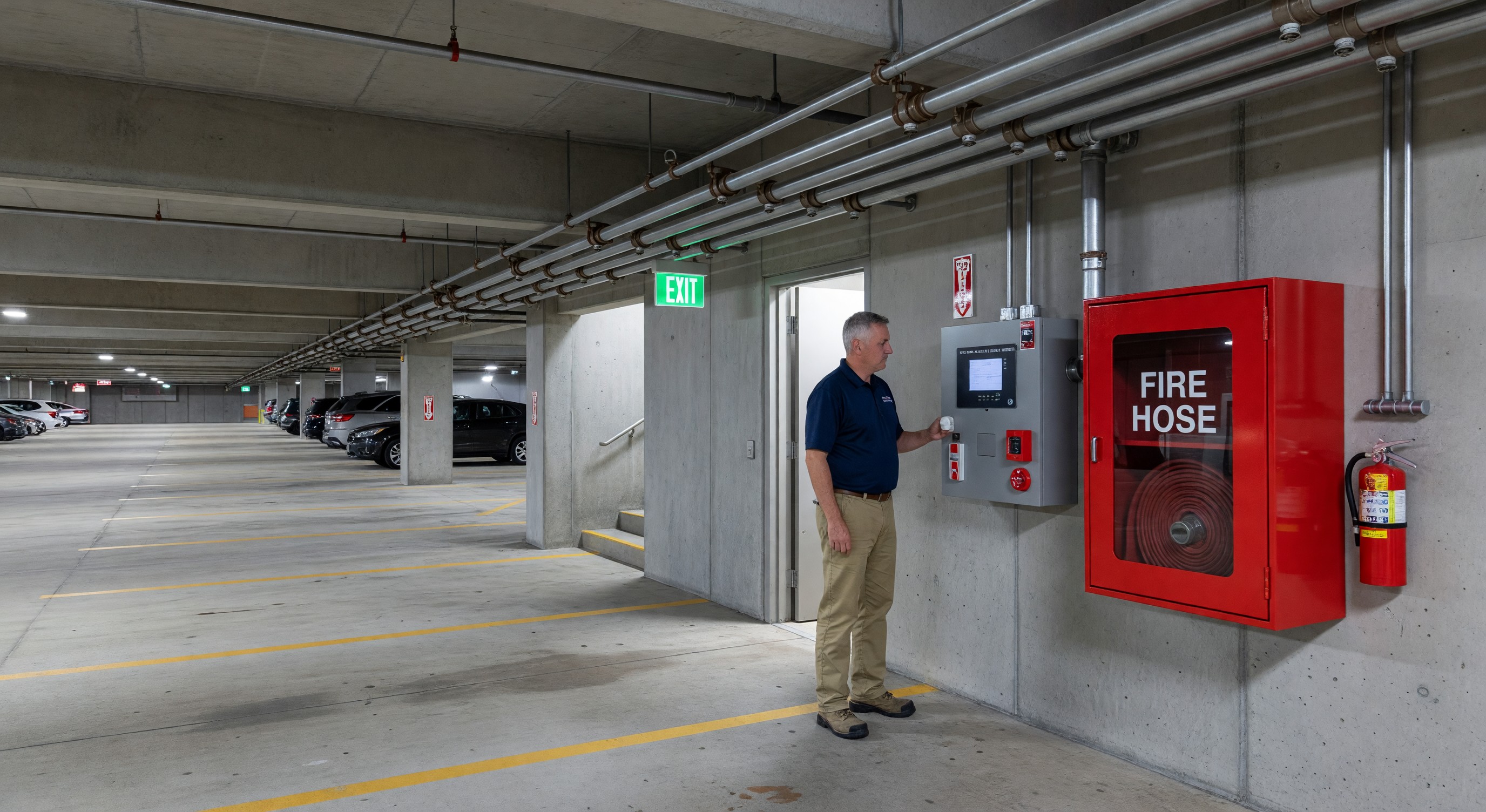
Life safety systems in parking garages are governed by a complex intersection of model codes, NFPA standards, local amendments, and enforcement practices that vary significantly by jurisdiction. Facility managers who oversee parking structures need to understand both the applicable requirements and the ongoing maintenance and inspection obligations that keep life safety systems compliant and functional.
This guide covers the major life safety system categories for parking structures, the applicable code requirements, and the compliance obligations facility managers must fulfill.
Building Code Framework
Life safety requirements for parking structures derive primarily from two model code families:
International Building Code (IBC) classifies parking structures as Group S-2 occupancy (low-hazard storage) for open parking structures, and as Group S-2 (enclosed) for structures with limited openings. Classification affects sprinkler, alarm, and egress requirements.
NFPA 101 Life Safety Code provides an alternative compliance path adopted by some jurisdictions in place of or in addition to IBC. NFPA 101 requirements for parking structures are generally consistent with IBC for most life safety systems.
IFC (International Fire Code) addresses operational fire safety requirements — the ongoing requirements after construction that facility managers must maintain.
Local jurisdictions adopt model codes with amendments. The applicable requirements in your jurisdiction may differ from the unamended model code. Confirm applicable requirements with your local building and fire departments.
Fire Suppression: Sprinkler Requirements
Whether parking structures require automatic fire suppression depends on construction type, occupancy type, and local code adoption.
Open parking structures — defined by IBC as having openings in exterior walls not less than 20 percent of the perimeter wall area on two or more sides with natural ventilation — are generally not required to have sprinkler systems under federal model codes. However, local amendments frequently require sprinklers in open parking structures, particularly in urban jurisdictions or for structures above a certain height.
Enclosed parking structures (those not meeting the open structure definition) are generally required to have automatic sprinkler systems under IBC. The sprinkler system must be designed and installed per NFPA 13 (Standard for the Installation of Sprinkler Systems).
For existing structures, sprinkler requirements may have changed since original construction. Significant renovation or change of use can trigger requirements to upgrade to current standards. Consult with your fire protection engineer before major renovation projects.
Sprinkler maintenance: NFPA 25 (Standard for the Inspection, Testing, and Maintenance of Water-Based Fire Protection Systems) governs sprinkler system maintenance. Key requirements include quarterly visual inspections of sprinkler heads and control valves, annual inspector test of flow alarms, five-year internal inspection of sprinkler piping, and pressure testing per schedules based on system type. Maintain inspection records and retain for three years minimum.
Mechanical Ventilation and Carbon Monoxide Systems
Enclosed parking garages require mechanical ventilation to manage CO and NOx from vehicles. ASHRAE 62.1 and local mechanical codes establish minimum ventilation rates.
Carbon monoxide detection is increasingly required or recommended for parking structures with enclosed areas. CO detectors trigger ventilation system activation when CO levels approach dangerous concentrations. IBC and local fire codes may require CO detection in new or renovated enclosed structures.
Maintenance obligations for ventilation systems:
- Annual inspection of fan operation and controls
- Verification of CO sensor calibration per manufacturer recommendations (typically annually)
- Inspection and cleaning of ventilation ductwork (frequency based on system type and use)
- Testing of emergency override controls
CO detector calibration is particularly important. Sensors that have drifted out of calibration may fail to activate at appropriate thresholds or may generate false alarms that lead to alarm fatigue and disabled systems.
Emergency Egress: Stairs, Ramps, and Exit Signs
IBC Chapter 10 governs means of egress requirements. For parking structures, key requirements include:
Stairwell enclosures: Exit stairways in enclosed parking structures typically require fire-rated enclosures per IBC Table 1023.2. Stairwells serving as required exit enclosures must have self-closing, positive-latching fire doors.
Exit sign requirements: Exit signs must be provided at every required exit and wherever the path of egress is not immediately apparent. Signs must be illuminated continuously by either internal illumination or an external light source, and must have backup battery power capable of 90 minutes of operation during power failure.
Emergency lighting: Emergency lighting must provide minimum illumination (1 footcandle at floor level) along the means of egress for 90 minutes following power loss. Parking garages with interior egress paths must provide emergency lighting in those paths.
Exit discharge: Exit stairways must discharge to a public way or to an exterior area with direct access to a public way. Discharge paths through parking areas must be clearly marked and kept clear.
Maintenance: Exit signs and emergency lighting require testing per NFPA 101. Monthly 30-second functional tests and annual 90-minute duration tests are required, with results documented.
Fire Alarm Systems
Fire alarm requirements for parking structures depend on structure type and the presence of other occupancies.
Standalone open parking structures typically do not require fire alarm systems under IBC. Open structures with no other occupancies have limited life safety risk from fire, and automatic sprinklers (where required) provide the primary detection and suppression function.
Mixed-use structures and enclosed structures are more likely to require fire alarm systems. When parking is located below or adjacent to occupied buildings, the fire alarm system typically serves the combined occupancy.
Alarm system maintenance: NFPA 72 (National Fire Alarm and Signaling Code) governs fire alarm system maintenance. Annual inspection and testing of all system components is required. Contractors performing alarm system testing must be appropriately licensed.
OSHA Requirements for Parking Facilities with Employees
For parking facilities that employ workers (attendants, security, maintenance staff), OSHA standards for general industry apply. Key requirements:
Hazard communication: Workers must be trained on chemical hazards present in the workplace, including CO exposure from vehicle exhaust.
Personal protective equipment (PPE): Workers with potential CO exposure in enclosed garages may require CO personal monitors and must be trained on PPE use and limitations.
Emergency action plans: Facilities with more than 10 employees must have written emergency action plans covering evacuation procedures, alarm systems, and emergency contact information.
FAQ
My parking garage was built in 1985. Are new fire code requirements retroactive? Generally, no — existing structures are allowed to remain under the codes in effect when they were built unless significant renovation, change of use, or change of occupancy triggers code upgrade requirements. However, some jurisdictions have adopted requirements that apply retroactively to existing structures (elevator recall, carbon monoxide detection, sprinklers in high-rises). Confirm applicable requirements with your local authority having jurisdiction.
How do I maintain records of life safety system testing? Create a binder or digital file for each life safety system with a complete testing log. Record the date of each test, the technician performing the test, the test type (monthly/annual/etc.), the results, and any deficiencies found and corrected. Retain records for a minimum of three years, or longer if required by permit conditions.
What triggers a requirement to upgrade life safety systems in an existing garage? Trigger events include: additions to the building, change of occupancy, renovation affecting more than a specified percentage of the building value (varies by jurisdiction), change to a higher hazard occupancy category, and addition of occupancies above the parking structure that change the fire safety profile.
Who has authority over life safety compliance in parking structures? Primarily the local Authority Having Jurisdiction (AHJ) — typically the local building official and fire marshal. For multi-jurisdiction projects, confirm which authority has primacy. Insurance carriers also have requirements that may exceed code minimums.
Further Reading from Authoritative Sources
- NIST fire research and life safety standards resources — nist.gov is on the whitelist and NIST’s fire research provides the technical foundation for the NFPA life safety standards that govern parking garage fire protection systems.
- International Parking and Mobility Institute life safety resources for parking facilities — parking-mobility.org (IPMI) is on the whitelist and provides parking industry application of life safety codes that helps managers translate NFPA requirements into facility-specific compliance programs.