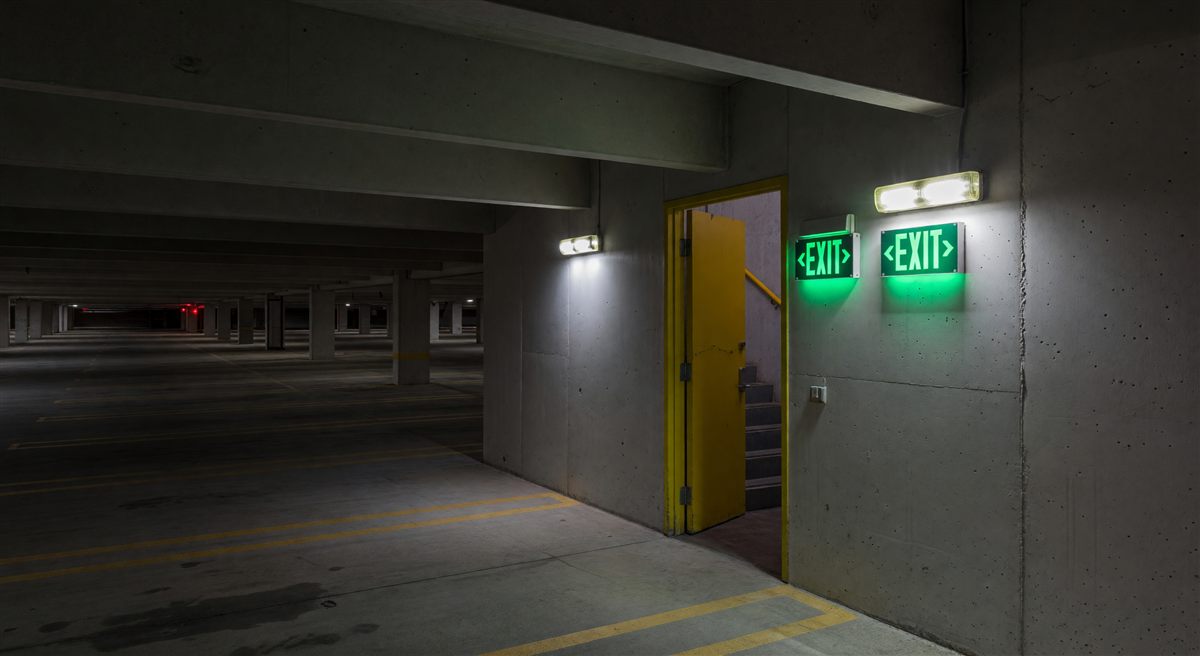
Emergency lighting in parking facilities is one of those compliance areas that sits in an uncomfortable gap — it touches life safety codes, electrical codes, accessibility standards, and local fire marshal requirements simultaneously. For facility managers, that overlap means one failed inspection or one power outage that leaves a garage dark can trigger enforcement action from multiple agencies at once.
This guide covers what the codes actually require, where facilities most commonly fall short, how to build a compliant inspection and testing program, and how to budget for upgrades without surprising the finance team.
Why Parking Facilities Are High-Risk for Emergency Lighting Failures
Parking structures present conditions that accelerate emergency lighting failures faster than most occupied buildings:
- Temperature swings. Enclosed garages in northern climates routinely cycle between -20°F in winter and 100°F+ in summer. Battery backup systems degrade significantly under thermal stress.
- Vibration. Vehicle traffic causes constant low-level vibration that loosens fixtures, corrodes connections, and shortens lamp life in ways that don’t show up until a monthly test.
- Exhaust and humidity. Vehicle exhaust deposits on optical components reduce lumen output. In coastal or humid climates, corrosion inside fixture housings is a chronic problem.
- Infrequent occupancy review. Unlike an office building where facilities staff pass through daily, parking structures are often only visited during complaints or scheduled inspections.
These factors combine to make parking facilities disproportionately prone to emergency lighting failures compared to their square footage.
Governing Codes and Standards
Emergency lighting requirements for parking facilities come from several overlapping sources. You need to know which ones apply in your jurisdiction.
International Building Code (IBC)
IBC Section 1008 requires emergency lighting in:
- Exit access corridors
- Exit stairways and ramps
- Exit passageways
- Rooms or spaces that require two or more exits
For enclosed parking garages, this typically means all pedestrian travel paths, stairwells, elevator lobbies, and egress routes to public streets must have emergency lighting. The IBC requires a minimum illumination level of 1 foot-candle average along the path of egress at floor level, with a minimum of 0.1 foot-candle at any point.
NFPA 101 (Life Safety Code)
NFPA 101, Chapter 7 governs means of egress illumination and emergency lighting. Key requirements:
- Emergency lighting must provide a minimum of 1 foot-candle at floor level along egress paths for at least 90 minutes following loss of normal power
- Systems must be arranged to provide initial illumination of no less than an average of 1 foot-candle and a minimum at any point of 0.1 foot-candle, measured along the path of egress at floor level
- Battery backup units must be tested monthly (30-second test) and annually (90-minute test)
- Test results must be recorded
NFPA 101 also applies to surface parking lots where pedestrian egress routes exist — not just enclosed structures.
NFPA 70 (National Electrical Code)
NEC Article 700 governs emergency electrical systems broadly. For parking facilities, the most relevant provisions cover:
- Transfer time: emergency systems must transfer to backup power within 10 seconds of normal power loss
- Battery unit ratings and installation requirements
- Wiring separation — emergency circuit conductors must be kept separate from normal wiring
Local Amendments and Fire Marshal Requirements
Most jurisdictions adopt IBC and NFPA with local amendments. In California, for example, Title 24 imposes stricter energy efficiency requirements on emergency lighting systems. Some municipalities require additional illumination at pay station locations or entry/exit points. Always verify with your local Authority Having Jurisdiction (AHJ) — the fire marshal or building department — before assuming national code is your only obligation.
Common Deficiencies Found During Inspections
Based on patterns reported across FM industry resources and fire marshal enforcement records, the most frequent emergency lighting violations in parking facilities fall into these categories:
| Deficiency | Why It Happens | Enforcement Risk |
|---|---|---|
| Failed battery backup units | Age, thermal stress, lack of testing | High — immediate notice of violation |
| Insufficient foot-candle levels | Original design outdated, lamps replaced with wrong spec | Medium — requires re-measurement |
| Missing test records | Testing done but not documented | High — treated same as no testing |
| Blocked or obscured fixtures | Pipes, signage, or paint partially blocking output | Medium |
| Exit signs with dead illumination | Lamps burned out, missed in rounds | High |
| No emergency lighting in stairwells | Added in renovation without updating life safety plan | High |
The most consequential deficiency is almost always missing documentation. A facility can have a fully functional system and still receive a violation if the 90-minute annual test wasn’t recorded. Inspectors treat missing records as non-compliance.
Building a Compliant Testing and Documentation Program
Monthly Testing (30-Second Test)
NFPA 101 requires monthly functional tests of all emergency lighting units. The test must:
- Simulate a power failure by activating the test switch on each unit (or cutting power to the circuit)
- Verify that all lamps or LEDs illuminate within the required transfer time
- Hold for a minimum of 30 seconds
- Restore power and verify the unit returns to normal charging mode
- Record the date, tester name, and pass/fail result for each unit
In a large parking structure, this is a significant labor investment. Facilities with more than 50 units often assign monthly testing to a contracted electrical maintenance vendor rather than in-house staff.
Annual Testing (90-Minute Test)
Once per year, each battery backup unit must sustain full emergency illumination for 90 minutes. This test:
- Must be conducted under actual or simulated loss of normal power
- Must verify the unit maintains minimum code illumination levels throughout the 90-minute period (not just at the start)
- Must be documented with the unit ID, location, test date, duration, and pass/fail outcome
Practical tip: Schedule annual tests for late spring or early fall. Testing in peak summer or winter heat stresses batteries that are already at the edge of their useful life and can cause failures in units that might otherwise pass in moderate temperatures.
Documentation Systems
At minimum, maintain a physical or digital log with:
- Complete fixture inventory (location, unit ID, manufacturer, installation date, battery replacement date)
- Monthly test log with individual unit entries
- Annual test log with 90-minute results
- Repair records for any failed units, including dates parts were ordered and work completed
Many facilities use a CMMS (computerized maintenance management system) for this. If yours doesn’t support emergency lighting specifically, a simple spreadsheet with the above fields is defensible as long as it’s kept current.
Foot-Candle Verification and Photometric Surveys
Code compliance isn’t just about having fixtures — it’s about delivering required illumination levels. The only way to know whether your facility actually meets the 1 foot-candle average / 0.1 foot-candle minimum requirement is to measure it.
When to Conduct a Photometric Survey
- When original construction documents are unavailable or outdated
- After any significant renovation that changes ceiling heights, reflective surfaces, or fixture locations
- When fixtures are replaced with different lamp types (e.g., upgrading from fluorescent to LED)
- When an inspection flags illumination as deficient
- As a proactive measure every 5–7 years in aging facilities
What the Survey Involves
A lighting professional (typically an electrical engineer or a certified lighting designer) will:
- Create a measurement grid across all egress paths
- Measure illumination at floor level under emergency power (or simulated emergency conditions)
- Calculate average and minimum foot-candle values
- Identify any points below the 0.1 foot-candle minimum
- Deliver a report with measurements and recommended corrective actions
Costs for photometric surveys in parking structures typically range from $2,000 to $8,000 depending on facility size and complexity. That’s a modest investment compared to the cost of a fire marshal enforcement action or a liability claim following an injury during a power outage.
Budgeting for Emergency Lighting Upgrades
Useful Life and Replacement Cycles
Emergency lighting components don’t last indefinitely. Planning for replacements before they fail keeps you out of reactive mode.
| Component | Typical Useful Life | Notes |
|---|---|---|
| LED exit signs | 10–15 years | Longer lamp life, but drivers degrade |
| Battery backup units (NiCad) | 5–8 years | Thermal cycling accelerates degradation |
| Battery backup units (LED + lithium) | 8–12 years | Higher upfront cost, longer service life |
| Central battery systems | 15–20 years | Requires professional maintenance contract |
| Fixture housings (parking-rated) | 15–20 years | Inspect for corrosion annually |
Cost Ranges for Capital Planning
These figures reflect typical replacement costs at the unit level for facility budget modeling. Labor and project management costs will vary by market and project scope.
| Item | Unit Cost Range |
|---|---|
| Self-contained emergency unit (LED) | $150 – $350 per unit |
| LED exit sign with battery backup | $100 – $250 per unit |
| Central battery system (per circuit) | $800 – $2,500 per circuit |
| Photometric survey (mid-size garage) | $2,500 – $6,000 |
| Annual testing labor (contracted) | $500 – $2,000 per facility |
For a 500-space enclosed parking structure with 80–100 emergency lighting units, a full system replacement typically runs $25,000–$60,000 installed, depending on whether you’re upgrading to a central battery system or maintaining distributed self-contained units.
Reserve Fund Implications
If your facility uses a reserve fund for capital replacements, emergency lighting should be included as a line item. Given a 7-year average useful life for battery components, a structure with $40,000 in total emergency lighting value should carry a reserve contribution of approximately $5,700 per year. Many facilities discover this line item is missing entirely from their reserve studies — if that’s your situation, raise it at the next budget cycle.
Special Considerations for Surface Lots
Emergency lighting requirements for surface parking lots are narrower than for enclosed structures, but they’re not zero. Key situations where surface lots need emergency lighting:
- Covered walkways and pedestrian tunnels connecting the lot to an occupied building
- Stairwells and ramps in multi-level surface structures (parking decks that aren’t fully enclosed)
- Pay station areas where local code or ADA requires accessible path illumination
- Gated entry/exit lanes where pedestrian crossings exist
If your surface lot connects to an occupied building via a covered walkway or tunnel, treat that entire path as a required egress route and apply IBC/NFPA 101 standards accordingly.
Coordinating with Your Fire Marshal
The most efficient way to stay ahead of emergency lighting compliance is to establish a working relationship with your local fire marshal’s office before an inspection happens. Practical steps:
- Request a pre-inspection walkthrough — many fire marshals will do an informal walkthrough on request, particularly for larger facilities, and will flag issues before they become violations
- Share your testing documentation proactively — bring your CMMS records or test logs to any inspection
- Ask about local amendments — codes vary by jurisdiction, and fire marshals generally appreciate when facility managers ask rather than assume
- Document all communications — keep emails and meeting notes from interactions with the AHJ in your compliance file
A fire marshal who knows your facility has a functioning testing program and documented maintenance history is far less likely to issue enforcement actions over minor deficiencies than one encountering your facility for the first time with no records in hand.
Key Takeaways
Emergency lighting compliance in parking facilities requires attention across three areas simultaneously: code requirements, operational testing programs, and capital planning for component replacement.
The facilities that consistently pass inspections share a few common practices: they maintain complete fixture inventories, they document every test regardless of whether it passed or failed, they budget proactively for battery replacement rather than waiting for failures, and they treat their AHJ as a partner rather than an adversary.
If your current program has gaps in any of these areas, the lowest-risk starting point is completing a full fixture inventory and establishing a documented monthly testing log. Both can be implemented without capital expenditure and immediately reduce your enforcement exposure.
Frequently Asked Questions
What illuminance does IBC require along egress paths in parking facilities? IBC Section 1008 requires emergency lighting to provide an average of 1 footcandle along the path of egress at the floor level, with a minimum of 0.1 footcandle at any point. The average-to-minimum ratio cannot exceed 40:1. These requirements apply when normal power fails — emergency lighting systems must switch to battery backup within 10 seconds of normal power loss and maintain the required levels for 90 minutes.
What codes govern emergency lighting requirements in parking facilities? Emergency lighting in parking facilities is governed by three primary codes: IBC Section 1008 (means of egress illumination), NFPA 101 Chapter 7 (life safety code egress lighting), and NFPA 70 Article 700 (emergency power system electrical requirements). These codes are typically adopted by reference in state and local building codes; facility managers must verify which editions and local amendments apply to their jurisdiction.
What testing is required for emergency lighting systems? Monthly 30-second functional tests are required to confirm that each emergency lighting unit activates upon simulated power failure. Annual 90-minute full-duration tests verify that battery backup capacity is sufficient to maintain illumination for the full required period. Test results must be documented; units that fail either test must be repaired or replaced immediately. Self-testing units that automatically log test results simplify compliance documentation.
What does a self-contained LED emergency lighting unit cost? Self-contained LED emergency lighting units with integral battery backup typically cost $150 to $350 per unit for commercial-grade products. LED emergency units have significantly longer lamp life than the fluorescent units they replace and often include self-testing capability that reduces the labor burden of monthly testing. For large facilities with many emergency lighting units, the transition to self-testing LED units provides both compliance assurance and labor cost savings.
What does a photometric survey for emergency lighting compliance cost? A professional photometric survey to verify emergency lighting illuminance compliance typically costs $2,000 to $8,000 depending on facility size, number of measurement points, and the complexity of the report required. Photometric surveys should be conducted after any significant changes to emergency lighting systems and periodically as part of a comprehensive compliance program. Survey results document the measured compliance status at a point in time.
Further Reading from Authoritative Sources
- NIST fire and egress safety research — nist.gov is on the whitelist and NIST’s fire and egress research provides the technical basis for the NFPA 101 and IBC emergency lighting standards discussed in this article.
- International Parking and Mobility Institute life safety and lighting compliance resources — parking-mobility.org (IPMI) is on the whitelist and provides parking industry application of code requirements that helps managers translate emergency lighting standards into facility compliance programs.