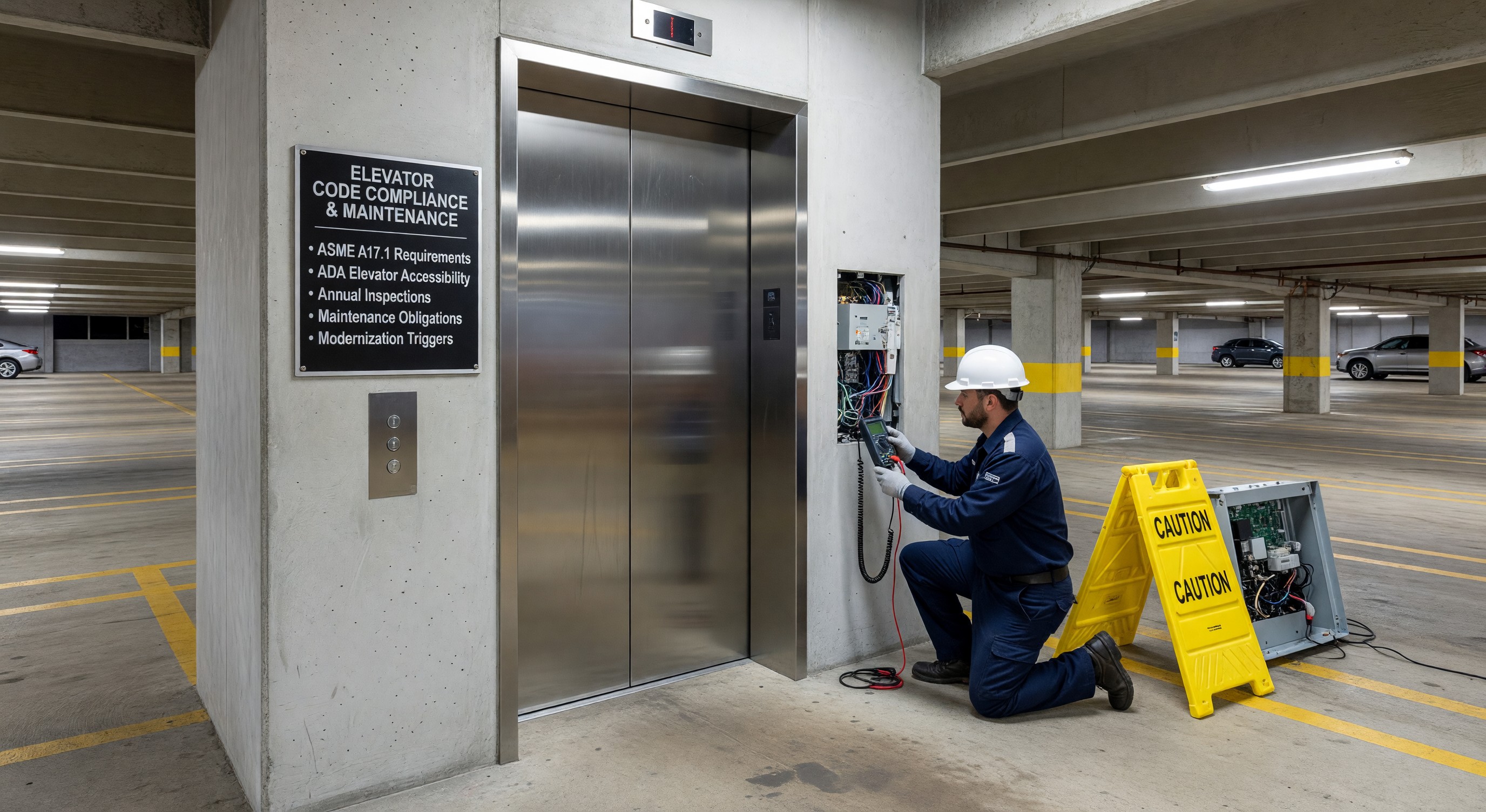
Elevators in parking structures are among the most heavily regulated building systems facility managers must manage. They are subject to the ASME A17.1 Safety Code for Elevators and Escalators, ADA accessibility requirements, state elevator licensing programs, mandatory annual inspections, and insurance requirements that all operate simultaneously.
The consequence of non-compliance is not merely regulatory — it is operational. A jurisdiction that finds a non-compliant elevator can order it taken out of service. For a parking garage where the elevator serves mobility-impaired users who cannot use stairs or ramps, an out-of-service elevator is both an accessibility failure and a significant operational problem.
ASME A17.1 and State Elevator Codes
The ASME A17.1 Safety Code for Elevators and Escalators is the primary technical standard for elevator design, installation, and operation in the United States. Most states adopt the ASME A17.1 as the basis for their elevator code, often with state-specific amendments.
State elevator programs typically require:
Installation permits: New elevator installations and major modifications require permits. Elevators installed without permits cannot receive operating certificates.
Operating certificates: Elevators must have a current operating certificate displayed in the cab. Certificates are issued after inspection by a state elevator inspector or a third-party inspector certified by the state.
Annual inspections: Most states require annual inspection of elevators by a licensed elevator inspector. Some states allow the owner to use a certified third-party inspector; others require state inspectors.
Safety tests: ASME A17.1 requires periodic safety tests including load tests, safety device tests, and governor and buffer tests. These tests are typically performed by the elevator maintenance contractor and witnessed by the inspector.
Confirm the specific requirements of your state elevator program. Operating an elevator without a current operating certificate is a violation that can trigger immediate shutdown orders.
ADA Accessibility for Parking Structure Elevators
For parking structures where the elevator is the primary accessible route between parking levels and building entrances, ADA compliance is essential.
Elevator minimum dimensions (2010 ADA Standards):
- Minimum cab inside dimension: 51 inches wide, 80 inches deep (for cars serving more than one floor)
- Minimum door clear width: 36 inches
Control requirements:
- Floor buttons at 42 inches maximum above floor for side-approach
- Braille and raised character floor designations
- Audible and visible floor indicators
Accessibility route continuity: The accessible route must extend from the accessible parking spaces through the elevator and to all accessible building entrances. Interruptions (locked elevator lobbies, route detours through inaccessible areas) break the accessible route.
Elevator availability: An elevator that serves as an accessible route from parking must be operational when the parking facility is open. Extended elevator outages that are not addressed promptly create ADA liability.
Maintenance Obligations and Contracts
Elevator maintenance is typically provided under service contracts with licensed elevator service companies. Key aspects of a quality elevator service contract:
Comprehensive versus oil and grease (O&G) contracts: Comprehensive contracts cover all parts and labor for routine wear and breakdown; O&G contracts cover only routine lubrication and adjustment. Comprehensive contracts cost more but eliminate surprises when components fail. For parking structure elevators with high usage, comprehensive contracts typically provide better value.
Response time commitments: Service contracts should specify response times for entrapment (someone trapped in a stalled elevator) and standard breakdown calls. Entrapment should trigger a response within 30 to 60 minutes maximum; standard breakdowns within 4 to 8 hours.
Modernization triggers: Elevator controllers, machines, and components have defined service lives. Service contracts should document components approaching end of useful life and include recommendations for modernization. Modernization planning should be incorporated into your capital reserve fund.
Annual Inspection Preparation
Before each annual inspection, prepare by:
- Completing any outstanding maintenance items from the prior inspection
- Ensuring the elevator machine room is clean, organized, and properly lit
- Verifying that required documents are current (operating certificate, maintenance log, last five-year test records)
- Confirming that smoke detectors, fire service operation, and elevator recall systems function correctly
Inspections that identify violations require correction within specified timeframes. Document all corrections with photographs and retain records.
FAQ
What happens if my elevator fails its annual inspection? Violations are categorized by severity. Immediately dangerous violations trigger immediate shutdown until corrected. Major violations require correction within a specified period (often 30 days) with a reinspection. Minor violations have longer correction periods. All violations must be corrected and reinspected before the operating certificate is renewed.
Are there specific ADA elevator requirements for parking garages versus other buildings? The ADA technical requirements (cab dimensions, controls, signage) apply uniformly. The operational requirement — that accessible routes be operational when the facility is open — has particular significance for parking structures where the elevator may be the only accessible route between parking levels and building entries. Ensure your service contract provides rapid response for ADA-route elevators.
When should I modernize versus maintain my parking elevator? Modernization is typically warranted when: annual maintenance costs approach 15 to 20 percent of modernization cost, the controller or motor generator (for older hydraulic units) reaches end of support, repeated breakdowns are affecting tenant satisfaction, or energy efficiency is significantly below current standards. Engage an elevator consultant for an independent modernization assessment.
Who is responsible for elevator compliance if a parking structure is managed by a third-party operator? Typically the property owner, unless the management contract specifically assigns regulatory compliance responsibilities to the operator. Elevator operating certificates are issued to the property owner. Regulatory violations are the property owner’s legal responsibility regardless of who manages day-to-day operations.
Further Reading from Authoritative Sources
- U.S. Access Board ADA elevator accessibility standards — access-board.gov is on the whitelist and is the authoritative source for ADA elevator accessibility requirements that are a central compliance dimension for parking facility elevators.
- ADA.gov elevator accessibility compliance guidance — ada.gov is on the whitelist as the DOJ’s ADA information portal and provides enforcement context that complements the technical standards from the Access Board.