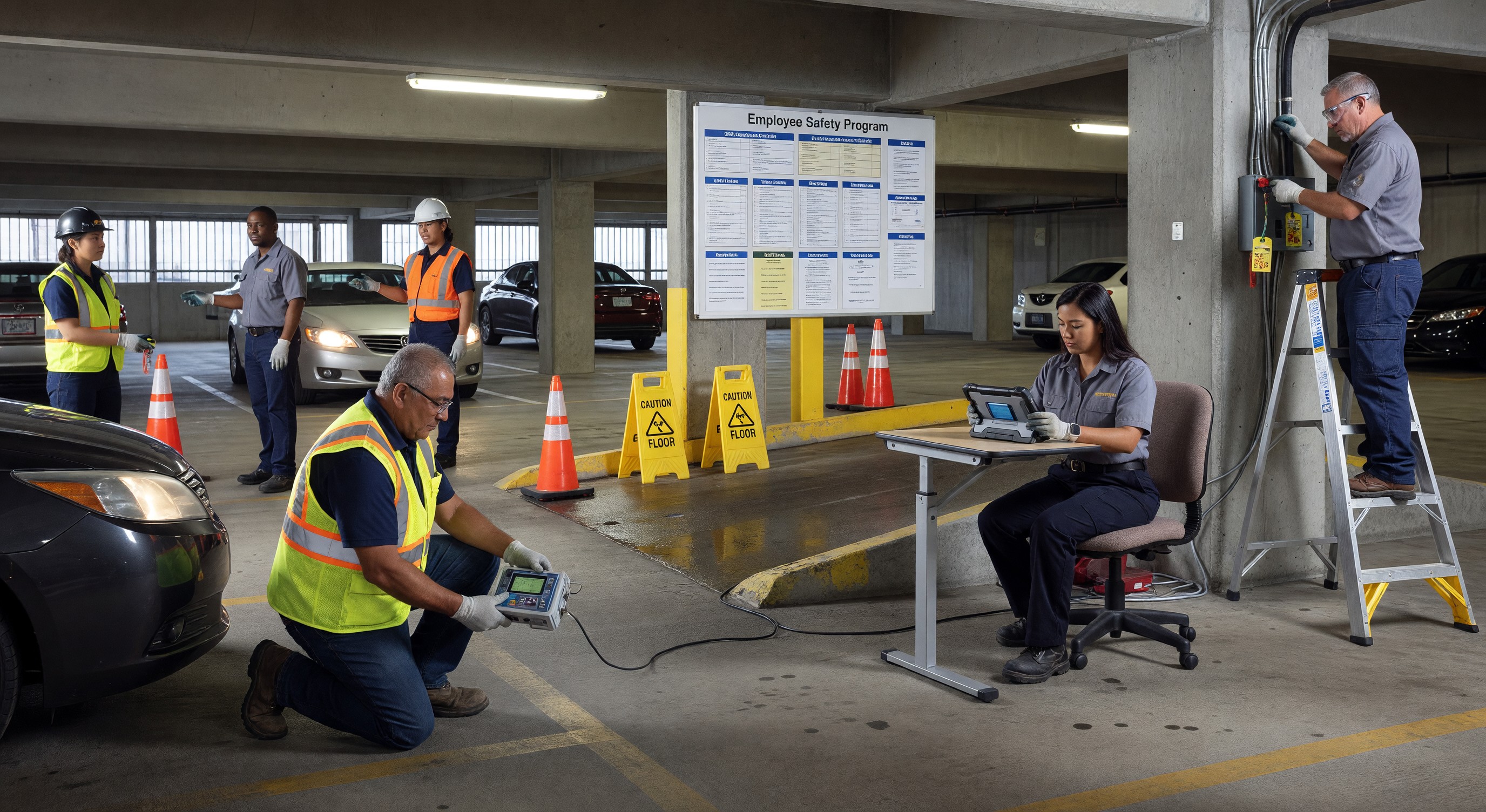
Parking facilities are not typically thought of as high-hazard workplaces, but employees who work in parking operations face real and specific occupational hazards. Carbon monoxide from vehicle exhaust, vehicle-pedestrian conflicts, slip and fall risks, and exposure to extreme weather create injury risks that OSHA regulations address directly.
Facility managers who employ parking personnel — whether in-house or through contractor relationships — must understand and manage these hazards under OSHA General Industry standards (29 CFR 1910) or Construction standards (29 CFR 1926) as applicable.
Carbon Monoxide: The Primary Occupational Health Hazard
For employees who work in enclosed or partially enclosed parking areas, carbon monoxide (CO) exposure is the most significant occupational health hazard. CO is produced by all internal combustion engines and accumulates rapidly in enclosed spaces with poor ventilation.
OSHA CO standards: OSHA’s permissible exposure limit (PEL) for CO is 50 parts per million (ppm) as an 8-hour time-weighted average, with a ceiling of 200 ppm and a peak of 300 ppm for 5 minutes in any 8-hour period. The NIOSH recommended exposure limit (REL) is more stringent at 35 ppm.
CO monitoring: For employees with regular exposure in enclosed parking areas, implement CO monitoring to verify that ventilation systems maintain exposure below OSHA limits. Area monitors with alarms provide continuous monitoring. Personal CO monitors are appropriate for high-exposure tasks.
Exposure controls: The hierarchy of controls applies: engineering controls (mechanical ventilation designed to maintain CO levels below limits) are preferred over administrative controls (limiting time in high-CO areas) or personal protective equipment (CO monitors, air-supplied respirators). ASHRAE 62.1 ventilation requirements, when properly maintained and operated, should maintain CO below OSHA limits in most facilities.
Medical surveillance: For employees with potential significant CO exposure, OSHA may require medical surveillance including baseline and periodic pulmonary function testing and blood testing for carboxyhemoglobin.
Vehicle-Pedestrian Conflict Zones
Parking facility employees who work in drive lanes — cashiers in booths, attendants directing traffic, maintenance personnel — face vehicle-pedestrian conflict risks. OSHA’s General Duty Clause requires employers to address recognized hazards.
Traffic control measures for employee safety include:
- High-visibility vests (ANSI Class 2 or 3 as appropriate) for all employees working in or near drive lanes
- Physical barriers between cashier booths and traffic lanes
- Clear traffic flow patterns that minimize employee exposure to vehicle paths
- Adequate lighting in areas where employees work near vehicles
Struck-by training: Employees who work in vehicle traffic areas must be trained on hazard recognition and safe work practices. Training should address awareness of vehicle blind spots, the requirement to make eye contact with drivers before entering a drive lane, and procedures for controlling traffic during unusual situations.
Slip, Trip, and Fall Prevention
Parking facilities present significant slip and fall hazards from wet surfaces (rain, car wash runoff, spilled fluids), icy conditions, surface irregularities, and changes in level between parking areas and building entrances.
OSHA general walking-working surfaces standard (29 CFR 1910.22) requires that walking surfaces be maintained in a clean and, to the extent feasible, dry condition. Where wet conditions cause slippage, walkways must be marked with hazard signs or have anti-slip surfaces.
Key slip and fall prevention measures:
Surface maintenance: Address pavement irregularities, cracks, and heaving that create tripping hazards. Conduct regular inspections and document corrective actions.
Winter safety: Establish ice and snow removal procedures that prioritize employee access areas. Salt and sand application before freezing rain is more effective than reactive removal.
Transition zones: Transitions between parking surfaces and building interiors, where wet footwear contacts smooth interior flooring, are high-risk slip zones. Floor mat programs and drainage management at entry points reduce risk.
Incident reporting: Establish a clear incident reporting process that captures near-miss events as well as injuries. Near-miss reporting is the foundation of proactive safety management.
Electrical Safety
Parking facilities have electrical hazards associated with revenue control equipment, lighting systems, EV charging infrastructure, and mechanical systems.
OSHA Lockout/Tagout (LOTO) standard (29 CFR 1910.147) applies to maintenance and service of equipment with hazardous energy. Employees who perform maintenance on revenue control gates, pay stations, lighting fixtures, or ventilation equipment must follow LOTO procedures to de-energize equipment before work.
LOTO program elements: Written procedures for each piece of equipment, training for authorized and affected employees, periodic audits of LOTO compliance, and documentation of training.
EV charging safety: As EV charging infrastructure is added to parking facilities, ensure maintenance personnel are trained on electrical hazards specific to EV charging equipment. High-voltage DC systems in DCFC equipment require specific safety protocols.
Ergonomic Hazards
Parking facility employees who perform physical work — maintenance technicians who handle equipment, cashiers with sustained static postures, staff who sweep and clean — face ergonomic hazards from repetitive motion, awkward postures, and forceful exertions.
OSHA’s ergonomics guidelines (not a formal standard, but industry guidance) recommend identifying ergonomic risk factors, implementing controls to reduce exposure, and training employees on proper body mechanics.
Practical ergonomic measures for parking operations:
- Adjustable-height workstations for cashier booths
- Ergonomic seating for personnel who sit for extended periods
- Proper lifting techniques training for maintenance personnel
- Mechanical assists (dollies, carts) for moving heavy equipment or supplies
Building a Safety Program
Formal OSHA compliance for parking operations requires a structured safety program, not just reactive hazard correction. Key program elements:
Hazard assessment: Document the specific hazards present in your facility and the controls in place for each.
Training: OSHA standards require specific training for recognized hazards. Document training completion, trainer qualifications, and training content.
Incident investigation: Investigate all workplace injuries and near-miss events to identify root causes and corrective actions. OSHA requires recording of qualifying injuries on the OSHA 300 log.
Emergency response procedures: Written procedures for emergency situations — medical emergencies, fire, chemical spill, active threat — must be communicated to all employees.
FAQ
Are independent contractor parking attendants covered by OSHA? Worker classification as independent contractors does not eliminate OSHA coverage if the nature of the work relationship makes the facility an employer for OSHA purposes. OSHA uses a multi-factor test that considers behavioral and financial control. Many “independent contractor” arrangements in parking are treated as employment for OSHA purposes. Consult your employment attorney on classification.
Do I need to conduct air quality testing for CO in my garage? If employees work regularly in enclosed or semi-enclosed areas where vehicles operate, initial air quality measurements to characterize exposure relative to OSHA PELs are appropriate. If ventilation systems are properly designed and maintained per ASHRAE requirements, CO levels typically remain below OSHA limits. Document initial measurements and repeat after any significant change to ventilation operation or use patterns.
What records are required under OSHA for parking operations? OSHA recordkeeping applies to employers with more than 10 employees. Required records include: OSHA 300 (Log of Work-Related Injuries and Illnesses), OSHA 300A (Annual Summary), OSHA 301 (Incident Report) for each qualifying injury. Training records, hazard assessments, and equipment-specific maintenance logs support compliance but are not universally required by specific OSHA standards.
Who is responsible for OSHA compliance when a third-party parking operator provides the staff? Both the property owner and the parking operator may have OSHA obligations depending on the nature of the relationship and control over the work environment. Multi-employer worksite principles apply — the host employer (property owner) has obligations for hazards they create or control, and the contractor employer has obligations for its employees’ safety. This area requires careful contractual clarity.
Further Reading from Authoritative Sources
- OSHA parking facility safety standards and guidance — osha.gov is on the whitelist as the authoritative source for the workplace safety regulations this article discusses, and linking directly to OSHA provides readers the primary regulatory text.
- International Parking and Mobility Institute employee safety resources — parking-mobility.org (IPMI) is on the whitelist and provides the parking industry application of OSHA standards that helps facility managers translate regulatory requirements into operational practice.