The 2024 International Building Code makes a genuinely large change to Section 915. Under the 2021 edition, carbon-monoxide detection was a Group R and Group E requirement — dwellings, sleeping units, and schools — triggered by a fuel-burning appliance, a fuel-burning fireplace, or an attached private garage. The 2024 edition drops the occupancy limitation. The trigger conditions now apply across occupancy classes: Group A assembly, Group B office, Group F factory, Group M mercantile, Group I institutional, and the rest.
That is the headline, and it has been summarised in enough trade coverage that facility managers with a parking deck bolted to an office tower are being told to budget for a detection retrofit. Before that line item goes into the FY2027 request, it is worth reading the trigger condition rather than the summary of it, because the code text says attached private garage — and in the IBC, “private garage” is not a synonym for the structure your tenants park in.
What actually changed in Section 915
Three changes matter for a commercial portfolio.
The occupancy scope opened up. The 2021 requirement was written around where people sleep and where children are. The 2024 requirement is written around where the hazard is. If a building has a fuel-burning appliance, a fuel-burning fireplace, or an attached private garage, CO detection is required regardless of what the building is used for.
Alarms and detectors are no longer interchangeable. This is the change most likely to blow a budget estimate built from residential experience. Listed single-station CO alarms — the kind that cost tens of dollars and mount on a ceiling — are now limited to dwelling units and sleeping units. Everywhere else, the code calls for CO detectors connected to a fire alarm control unit or a dedicated CO detection system, with the supervision, monitoring, and annual inspection-and-test obligations that come with system-connected devices. The device cost is a small part of that number. Circuit pathways, panel capacity, programming, and acceptance testing are the rest.
The maintenance tail is permanent. A system-connected detector is a tested device with a service life. CO sensing elements are typically rated in the range of six to ten years depending on the listing, so the retrofit is not a one-time capital event — it seeds a recurring replacement obligation that belongs in the operating budget from year one.
The term that decides whether this is your problem
The IBC classifies a private garage as a Group U accessory structure — the garage attached to a house, or a small accessory garage serving a building. A structure where the public or a tenant population parks is classified differently: open parking garages and enclosed parking garages are Group S-2, with their own chapter-by-chapter treatment for construction type, ventilation, and fire protection.
Section 915’s trigger is written against the private garage, not the Group S-2 parking garage. Read plainly, a commercial office building with an attached structured parking deck is not swept into the new CO-detection requirement by the attached-garage clause alone. It may still be swept in by the other two triggers — a fuel-burning appliance or a fuel-burning fireplace anywhere in the occupancy — and most buildings with a boiler, a gas-fired rooftop unit, or a gas water heater will be.
This distinction is not academic hair-splitting, and it is also not a licence to ignore the section. Two practical consequences follow:
- The scoping question changes. Instead of “do we have an attached deck,” the question is “do we have fuel-burning equipment, and where does the code require the detectors relative to it.” That is a different survey, usually a smaller one, and it produces a different device count.
- The answer is jurisdictional. State and local amendments routinely modify Section 915, and an authority having jurisdiction is entitled to read an attached enclosed parking structure as falling within the intent. Get the determination in writing during design review rather than discovering it at final inspection.
Where the parking deck obligation actually lives
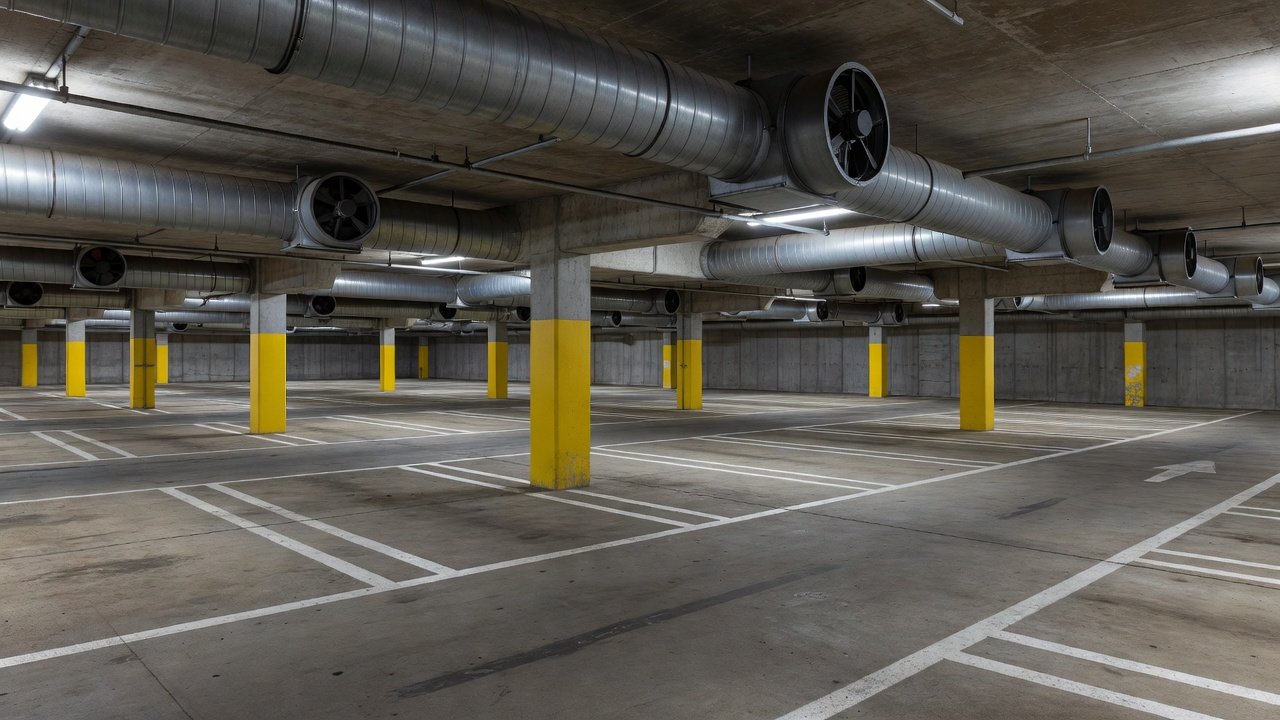
Structured parking already carries a CO obligation, and it is not in the building code — it is in the mechanical code. IMC Section 404 requires enclosed parking garages to be mechanically ventilated either continuously or automatically, under the control of CO detection. Where demand-controlled ventilation is used, the system must be capable of 0.75 cfm per square foot of floor area and may not throttle below 0.05 cfm per square foot. The 2024 IMC continues the move toward pairing CO sensing with nitrogen-dioxide sensing on the same control scheme, which matters in decks with meaningful diesel traffic, because NO2 concentration can be the binding constraint while CO still reads low.
If your enclosed deck is compliant with IMC 404, sensing hardware is already installed in it. The two systems serve different purposes — ventilation control versus occupant notification — and the sensors are generally not interchangeable, but the existence of the ventilation-control system is the right starting point for the conversation with your mechanical engineer. In some retrofits the practical answer is one integrated gas-detection system serving both the fan control logic and the alarm interface, which is cheaper than two parallel installations and easier to maintain.
Adoption is the variable that decides the timing
None of this is enforceable until your jurisdiction adopts the 2024 edition. ICC’s adoption tracking shows the 2024 I-codes moving through a growing list of states and large cities — including Colorado, Georgia, Illinois, Iowa, Nevada, New Hampshire, New Jersey, New York State, North Dakota, Oklahoma, Oregon, South Dakota, Texas, Utah, and Wyoming, alongside major municipal adopters and the federal GSA and Department of Defense. Much of the country remains on the 2021 or 2018 editions, and several large states run customised codes derived from the IBC with their own amendment cycles and effective dates.
For a multi-state portfolio, that means the compliance date is a property-by-property fact, not a corporate one. The useful artefact is a simple matrix: property, jurisdiction, current adopted edition, announced adoption date for 2024, and whether the local amendment touches Section 915.
What to do this budget cycle
Existing buildings are generally not forced to retrofit on adoption alone. The requirement attaches at new construction, and at alteration, addition, or change of occupancy — which is exactly why this lands on facility managers as a project cost rather than a portfolio cost. The deck rehabilitation you have scheduled, the tenant fit-out on the ground floor, the boiler replacement: each of those can pull Section 915 into scope for the affected work area.
Three things are worth doing before the FY2027 request closes.
Survey the fuel-burning equipment, not the parking. Your device count follows the appliances and their locations, and that survey is cheap.
Ask the AHJ the private-garage question in writing for any property where an enclosed deck is physically attached to the occupied building. A one-paragraph determination now is worth more than a contingency line later.
Where an enclosed deck already runs demand-controlled ventilation, price the integrated option alongside the standalone one. The incremental cost of extending an existing gas-detection system is frequently a fraction of a separate detection system, and it consolidates the annual test into one visit instead of two.