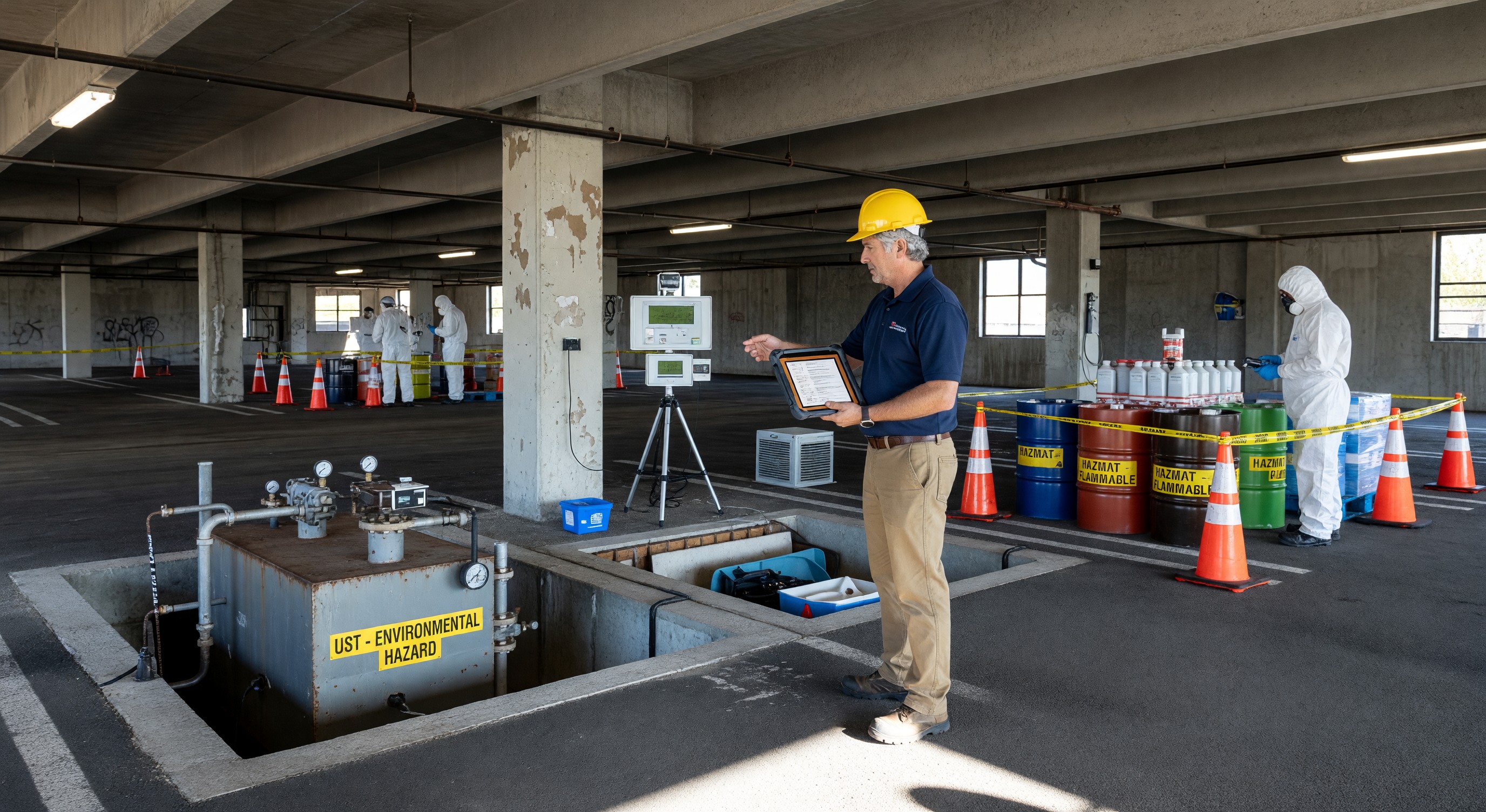
Parking facilities carry a range of environmental compliance obligations that facility managers in other property types may not encounter. Underground fuel storage, vehicle fluid contamination, lead-based paint in older structures, and mercury-containing lamp disposal all require specific management practices and documentation.
This guide covers the major environmental compliance areas for parking facilities, the applicable regulatory frameworks, and the documentation practices that support compliance.
Underground Storage Tanks (USTs)
Parking facilities associated with fleet operations, bus depots, or facilities that offer fueling services may have underground storage tanks for gasoline, diesel, or heating fuel. USTs are subject to federal EPA regulations under 40 CFR Part 280 and state-level UST programs.
Federal UST requirements apply to tanks with 10 percent or more of the tank volume underground. Key requirements include:
Leak detection: All regulated USTs must have leak detection systems appropriate for the tank and piping type. Options include automatic tank gauging (ATG) systems, continuous monitoring with sensors, statistical inventory reconciliation, or secondary containment with interstitial monitoring.
Release prevention: Tanks must have spill, overfill, and corrosion protection. Spill basins at fill ports, overfill protection devices, and appropriate corrosion protection (cathodic protection or coated steel) are required.
Release reporting: Confirmed releases must be reported to the state UST program within specified timeframes (typically 24 to 72 hours). Release investigation and cleanup obligations follow.
Recordkeeping: Maintain records of all required testing, inspections, and maintenance for at least one year (longer for equipment testing records — typically three years).
Closure: When a UST is taken out of service, closure procedures under 40 CFR 280.70 et seq. apply. Improper closure that leaves contaminated soil or groundwater creates long-term liability.
If you manage a facility with USTs, ensure you know the state UST program registration requirements and whether your tanks are current on all required testing and inspection.
Spill Prevention, Control, and Countermeasure (SPCC) Plans
Facilities that store oil (including petroleum products) above threshold quantities may require a Spill Prevention, Control, and Countermeasure (SPCC) plan under EPA regulations at 40 CFR Part 112.
SPCC thresholds: facilities with aboveground oil storage capacity greater than 1,320 gallons (or underground storage capacity greater than 42,000 gallons) that could reasonably discharge to navigable waters or adjoining shorelines must prepare and implement a SPCC plan.
A SPCC plan documents oil storage locations and quantities, containment measures, inspection procedures, and response procedures for spills. The plan must be certified by a licensed professional engineer and reviewed every five years.
For parking facilities with aboveground hydraulic fluid storage, waste oil storage, or diesel fuel storage that meets the threshold, confirm SPCC requirements with your environmental compliance consultant.
Lead-Based Paint in Older Parking Structures
Parking structures built before 1978 may contain lead-based paint on structural steel, concrete surfaces, and other components. Lead paint in deteriorated condition or disturbed during renovation or maintenance activities creates health and regulatory risks.
EPA Renovation, Repair, and Painting Rule (RRP) applies to facilities where lead paint may be disturbed during work. While RRP was primarily designed for residential properties, the underlying requirement to manage lead paint hazards applies in commercial settings under OSHA Lead Standard (29 CFR 1926.62 for construction work).
OSHA Lead Standard requirements for construction activities that may disturb lead paint include:
- Initial exposure determination before work begins
- Compliance planning for work that may expose workers to lead above the action level
- Biological monitoring and medical surveillance for workers with significant exposure
- Specific work practices to minimize lead dust generation
Before any work involving paint on older parking structures — sandblasting, welding, torch cutting, abrasive grinding — assess for lead paint and comply with applicable OSHA and EPA requirements.
Hazardous waste implications: Lead paint debris from construction activities may be a hazardous waste subject to EPA requirements under RCRA. Conduct proper characterization before disposal.
Mercury-Containing Lamps
Fluorescent and high-intensity discharge (HID) lamps commonly used in older parking facilities contain mercury, making them “universal waste” subject to EPA and state recycling requirements.
Universal waste requirements prohibit disposal of mercury lamps in municipal solid waste. Lamps must be:
- Recycled through an authorized lamp recycler
- Stored in closed, labeled containers while awaiting recycling
- Accumulated for no more than one year before recycling
Maintenance programs that collect spent lamps for recycling, rather than disposing of them in the trash, fulfill this requirement. Document lamp recycling with manifests from the recycler.
As LED retrofits proceed, the mercury lamp obligation diminishes. LED lamps do not contain mercury and are not universal waste.
Chlorinated Solvents and Degreasers
Parking facilities that perform vehicle maintenance or equipment cleaning may use chlorinated solvents (trichloroethylene, perchloroethylene, methylene chloride) or other regulated chemicals. These compounds are subject to EPA air emission standards under the National Emission Standards for Hazardous Air Pollutants (NESHAP) and may require hazardous waste management if discarded.
Evaluate whether maintenance operations at your facility use regulated solvents. Consider substituting less-regulated alternatives where technically feasible. Document proper disposal of any hazardous waste generated.
Air Quality: Vehicle Emissions in Enclosed Garages
Enclosed parking garages generate air quality concerns from vehicle exhaust. Nitrogen oxides (NOx) and volatile organic compounds (VOCs) from vehicle exhaust contribute to ambient air quality issues that are regulated at the state and local level.
Most air quality requirements for parking garages are addressed through mechanical ventilation requirements (ASHRAE 62.1) rather than direct emission limits on the facility. However, large facilities in non-attainment areas for air quality standards may face specific requirements under state implementation plans.
For very large parking structures, particularly in major urban markets, consult with an environmental attorney to assess whether any facility-specific air quality permit requirements apply.
FAQ
I inherited a facility with an old UST that may have been abandoned in place. What do I do? Contact your state UST program immediately. Many states have provisions for handling abandoned USTs, including cost-sharing programs for investigation and cleanup. Failing to disclose a known or suspected UST during a property transaction creates significant liability. Environmental site assessments before property acquisition are the standard practice for identifying unknown USTs.
Does my parking lot need a stormwater permit, or does the building’s stormwater permit cover it? The relationship between parking lot stormwater and building-wide permits varies by jurisdiction and permit structure. Verify with your local MS4 program administrator or state environmental agency whether your parking operations are covered under existing permits or require separate coverage.
What records should I retain for environmental compliance? Retain UST testing and inspection records for three years minimum (longer in many states); SPCC plan and inspection records for three years; hazardous waste manifests for three years; lamp recycling records for three years. Environmental permits and correspondence should be retained permanently.
Can my state program have requirements that differ from EPA requirements? Yes. State environmental programs typically must be at least as stringent as federal requirements, but may be more stringent. State UST programs, stormwater programs, and hazardous waste programs all commonly have requirements that exceed the federal baseline. Always confirm applicable state requirements for each jurisdiction.
Further Reading from Authoritative Sources
- U.S. Environmental Protection Agency parking facility environmental compliance resources — epa.gov is on the whitelist as the primary federal environmental authority and is the direct regulatory source for the compliance requirements discussed throughout this article.
- International Parking and Mobility Institute environmental compliance resources — parking-mobility.org (IPMI) is on the whitelist and translates federal environmental requirements into parking facility operational guidance for the audience this article serves.