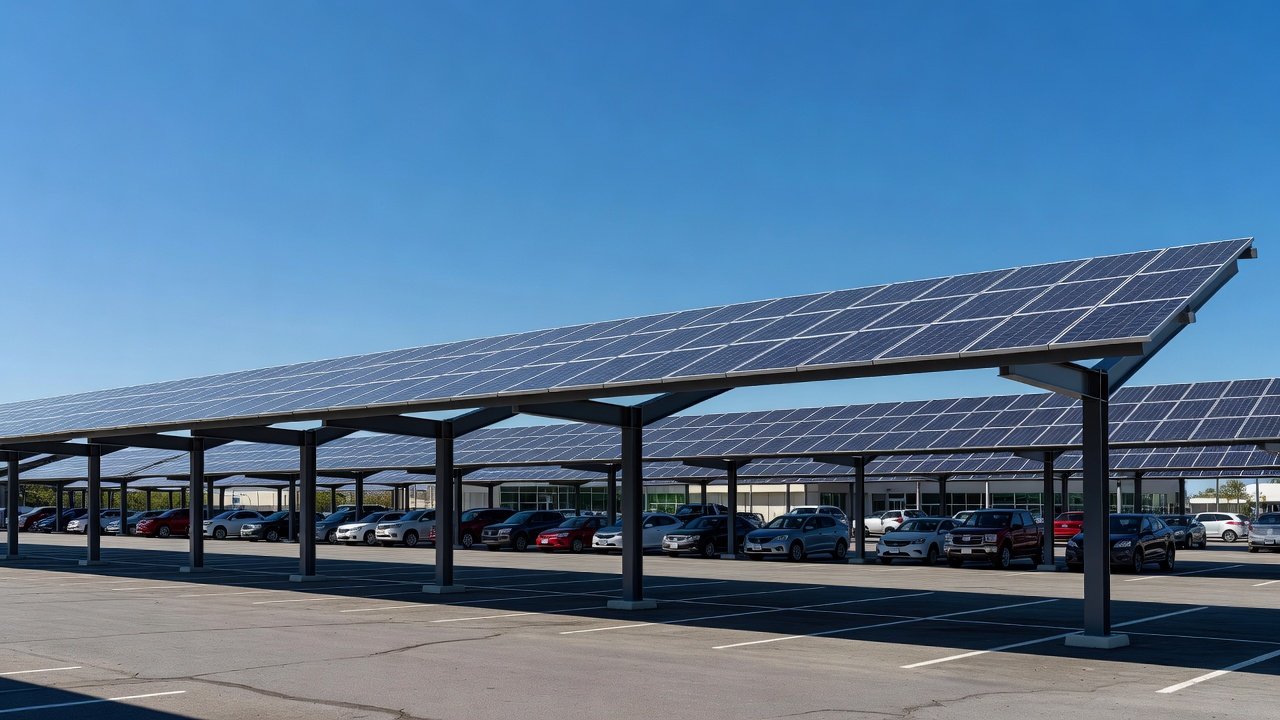
If you are evaluating a solar carport for a surface lot this budget cycle, the tax analysis is no longer the one in most vendor decks. The One Big Beautiful Bill Act terminated the Section 48E investment tax credit for solar facilities that begin construction after July 4, 2026 and are placed in service after December 31, 2027. That begin-construction date passed eleven weeks ago.
What that leaves is a single narrow path, and it changes the shape of the decision.
The two doors, and which one is still open
Door one — safe harbor, now closed. A project that began construction on or before July 4, 2026 preserved eligibility under the pre-existing begin-construction rules, generally through physical work of a significant nature or the 5% cost safe harbor, with the usual continuity requirement. Projects that walked through that door before it shut have a multi-year runway. If your organisation safe-harbored equipment in the first half of this year — many did, and some did it speculatively across a portfolio — find out. Unused safe-harbored equipment is an asset, and it is the only thing that makes a 2028 or later in-service date viable at 30%.
Door two — placed in service by December 31, 2027. This is the path available to a project starting today. The credit remains claimable for an eligible commercial solar facility placed in service on or before that date. It is a hard date, not a target.
For a carport specifically, working backwards from December 31, 2027 is tighter than it sounds. Structural engineering and foundation design on a canopy over an active lot, utility interconnection study and approval, local permitting, steel fabrication lead time, and construction phased around keeping stalls in service — a realistic schedule for a mid-size commercial carport runs twelve to eighteen months from decision to energisation, and the interconnection queue is the variable you control least. A project that has not secured an interconnection position by early 2027 is unlikely to make the date.
What the structure actually costs
Solar carports run roughly $3.15–$4.50 per watt installed in 2026. That is two to three times the comparable rooftop number: small commercial rooftop systems of 25–100 kW run about $1.80–$2.55 per watt, mid-size 100–500 kW systems about $1.40–$1.90, and large rooftop installations $1.10–$1.50.
The delta is structure. A carport is a purpose-built steel canopy with foundations engineered for wind uplift and, in northern markets, snow load — and it is erected over an operating parking lot, which adds phasing cost that a rooftop array does not carry.
That premium is why the honest framing of a carport is not “solar with a parking lot underneath.” It is a covered-parking capital project that happens to generate electricity and qualify for an energy credit. Evaluate it against what a shade canopy alone would cost you, and the arithmetic looks very different than it does against a rooftop array.
Where the value actually sits
Four value streams, in rough order of reliability:
Energy offset. Straightforward and modellable from your interval data. Note that a carport’s production profile is a good match for a commercial load shape — peak generation lands inside the peak demand window for most office, retail, and healthcare properties.
Demand-charge reduction. Frequently larger than the energy saving and frequently omitted from vendor models. Whether it materialises depends on your tariff and on whether your peak coincides with midday generation. Have your utility’s rate analyst or an outside consultant with no stake in the sale model this; do not take the developer’s number.
Covered parking as an amenity. Real and hard to price. In hot-climate retail and healthcare, shaded parking has measurable tenant and patient satisfaction value. In northern markets, reduced snow clearing on covered stalls is an operating line you can quantify from last season’s contractor invoices.
EV charging integration. The reason many facility managers look at carports at all. Co-locating chargers under the canopy shares the trenching and electrical infrastructure, which is the expensive part of a charger deployment. If EV charging is already in your capital plan, the incremental cost of doing it alongside a carport is meaningfully lower than doing it standalone — and that shared-infrastructure saving belongs in the carport’s business case, not the charger’s.
The comparison the hook usually gets wrong
Solar carports are commonly pitched against a resurfacing project, as though they compete for the same dollars. They do not compete for the same outcome, and putting them head to head produces a bad decision in either direction.
Resurfacing is deferred maintenance on an asset that is degrading. Skipping it means paying more later, plus liability exposure in the interim. A carport is a discretionary capital addition. The correct sequence is almost always: resurface first, then build over it. Erecting canopy foundations over pavement you intend to tear up within five years means paying twice for the same excavation and phasing.
Where they genuinely interact is timing. If resurfacing is due in the next two years and a carport is under consideration, do them as one mobilisation. The foundation work happens while the lot is already torn up and already closed. That is a real saving, and it is the one scheduling argument that justifies pulling a carport decision forward.
What to do if the December 2027 date is your target
Confirm first whether your organisation holds safe-harbored equipment from the first half of 2026 — that single question changes the entire timeline.
If not, the gating item is interconnection. Submit the application before you finish the financial model, because the queue position is what determines whether the credit is available to you, and everything else can be adjusted afterward. Get a written schedule commitment from the developer that names the placed-in-service date and states what happens to the contract price if it slips, because a project that misses December 31, 2027 loses 30% of its capital cost in credit and the economics do not survive that without renegotiation.
And model the project once without the credit. If it only works at 30%, it is a tax play on a deadline you do not fully control. If it works at 20%, it is a facility project, and those are the ones that get built.