Utility costs in parking facilities are often treated as a fixed operating expense — unavoidable costs to be managed but not materially reduced. This is a missed opportunity. Facility managers who apply systematic energy management to parking operations routinely achieve utility cost reductions of 30 to 60 percent, with payback periods of two to five years on the required investments.
This guide covers the major utility cost reduction opportunities in parking facilities, with realistic cost and savings estimates for each.
LED Lighting Retrofit
Lighting is the largest utility cost component in most parking facilities, typically accounting for 60 to 80 percent of parking-related electricity consumption. Traditional metal halide and high-pressure sodium (HPS) fixtures have two major efficiency disadvantages: high wattage consumption and significant warm-up and restrike time that discourages dimming or switching controls.
LED retrofits address both disadvantages. Modern parking LED fixtures operate at 40 to 70 percent lower wattage than the fixtures they replace while delivering equal or better light levels. LEDs also respond instantly to dimming and switching controls, enabling occupancy-based control strategies that were impractical with traditional sources.
Financial case for LED retrofit. A 500-space above-grade garage with 400 traditional 250-watt fixtures operating at an average of 4,000 hours per year consumes roughly 400,000 kWh annually. At $0.12 per kWh, that is $48,000 per year in lighting electricity. A full LED retrofit reducing wattage by 55 percent saves $26,400 per year in electricity alone.
Add occupancy controls, which can reduce lighting energy by an additional 30 to 50 percent in low-traffic areas during off-peak periods. Total savings could reach $40,000 per year on a $180,000 to $250,000 retrofit investment — a payback period of four to six years, with utility rebates potentially shortening it to three to four years.
Utility incentive programs. Most electric utilities offer rebates for LED lighting projects. Programs vary significantly by utility, but commercial rebates of $50 to $150 per fixture are common. For a 400-fixture retrofit, this could yield $20,000 to $60,000 in utility rebates that directly reduce net project cost.
Ventilation System Controls for Enclosed Garages
Enclosed parking garages require mechanical ventilation to manage carbon monoxide (CO) and nitrogen dioxide (NO₂) levels from vehicle exhaust. ASHRAE Standard 62.1 establishes minimum ventilation requirements, but many facilities operate ventilation fans continuously at full capacity regardless of actual occupant load and vehicle activity.
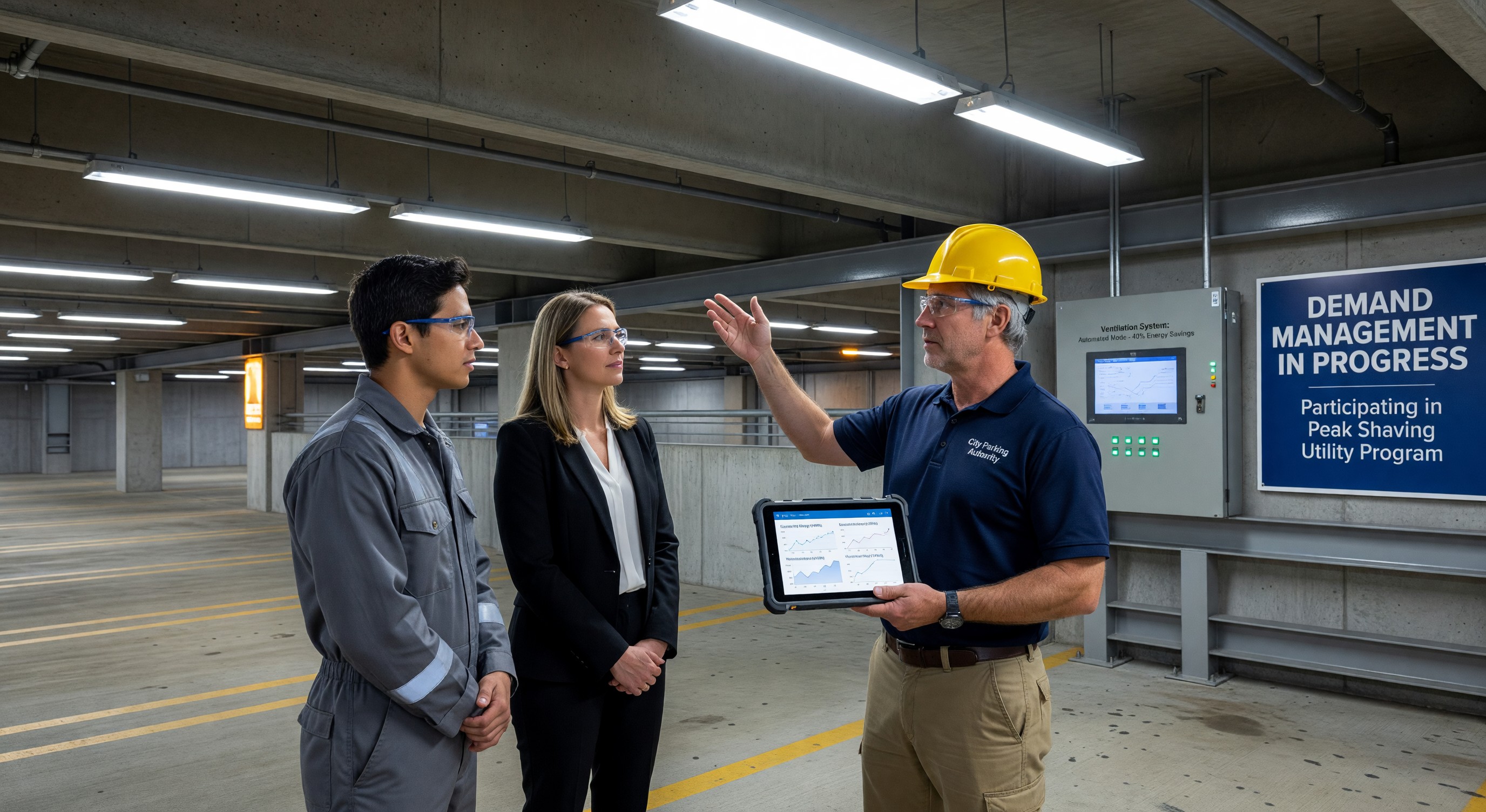
Demand-controlled ventilation (DCV) uses CO sensors to modulate fan speed based on measured contaminant levels. When occupancy is low and CO levels are below the action threshold, fans operate at reduced speed, consuming substantially less energy. When CO levels rise — during peak arrival and departure periods — fans ramp up to maintain compliance.
Energy savings. Fan energy consumption varies with the cube of fan speed (the fan affinity laws). Reducing fan speed to 50 percent of rated speed reduces energy consumption to 12.5 percent of full-speed consumption. In practical implementations, DCV typically reduces ventilation energy by 50 to 70 percent compared to constant-speed operation.
For a facility with $30,000 per year in ventilation electricity costs, DCV reduces this to $9,000 to $15,000 — saving $15,000 to $21,000 annually. DCV system installation typically costs $20,000 to $60,000 depending on facility size and the number of CO sensors and fan controls required. Payback periods of one to three years are common.
Compliance note. Any ventilation control modifications must be reviewed to ensure continued compliance with ASHRAE 62.1 and applicable local mechanical codes. DCV systems should be designed and commissioned by a licensed mechanical engineer, and CO setpoints should be established to maintain compliance margins.
Demand Management and Rate Optimization
Electricity bills for parking facilities often have two components: consumption charges (kWh) and demand charges (maximum kW in a billing period). For facilities with variable loads, demand charges can represent 20 to 40 percent of total electricity cost.
Demand charges are based on peak demand — typically the highest 15-minute or 30-minute average demand in the billing period. A single event (a system restart that turns on all equipment simultaneously, or a period when PARCS, ventilation, and EV charging all operate at peak simultaneously) can set a demand charge for the entire month.
Load scheduling. Review what equipment operates simultaneously and whether sequential starts or off-peak scheduling can reduce peak demand. HVAC in offices above garages, EV charger charging windows, and lighting control schedules all contribute to peak load profiles.
EV charger load management. Networked EV charging systems can implement load management algorithms that prevent simultaneous charging sessions from creating demand spikes. This is particularly important as EV charging penetration grows.
Utility rate analysis. Request a billing analysis from your utility to evaluate whether your current rate schedule is the most favorable available for your load profile. Some facilities qualify for time-of-use rates that reduce costs if flexible loads can be shifted away from peak pricing periods.
Energy Monitoring and Targeting
You cannot manage what you do not measure. Facilities without sub-metering for parking operations typically allocate utility costs using square footage formulas, which makes it impossible to evaluate parking-specific efficiency improvements.
Install sub-metering for major parking energy loads: lighting, ventilation, EV charging, and any significant mechanical systems. Monthly sub-meter readings establish baselines, allow variance tracking, and support utility incentive program applications.
For facilities that participate in utility demand response programs, real-time energy monitoring is typically required. Demand response programs pay facilities to reduce load during grid stress events; parking facilities with controllable loads (EV charging, lighting) can earn meaningful payments for program participation.
Water and Storm Water Costs
Below-grade garages and surface lots in jurisdictions with stormwater fee programs can face meaningful water-related utility costs. Review your utility bills for stormwater charges and confirm that impervious surface calculations used to determine your fees are accurate.
Permeable paving systems for surface lots can reduce stormwater fees in fee-based jurisdictions. The economics depend on local fee structures and paving costs, but facilities paying $10,000 or more per year in stormwater fees should evaluate the cost-benefit case.
FAQ
What is the first step in a parking utility cost reduction program? Establish your baseline. Collect 12 months of utility bills for parking-related electricity accounts, calculate cost per space per month and cost per square foot per year, and identify the largest cost components. Lighting and ventilation are almost always the largest opportunities in structured parking.
Can LED retrofits qualify for utility rebates? Yes, in most utility territories. Contact your utility’s commercial energy efficiency program before finalizing project specifications. Some utilities require pre-approval to qualify for rebates; others allow post-installation applications. Utility rebates can reduce net project cost by 15 to 40 percent.
Do DCV systems require continuous sensor calibration? CO sensors require periodic calibration and replacement. Most DCV systems include sensor monitoring that alerts when sensors drift outside calibration tolerances. Budget for annual sensor calibration service as part of ongoing maintenance.
How do I calculate the payback period for an LED retrofit? Calculate annual electricity savings (current consumption minus projected post-retrofit consumption, multiplied by your electricity rate). Divide the net project cost (after utility rebates) by annual savings. Add maintenance savings from LED’s longer lamp life compared to traditional fixtures, which can add $1,000 to $3,000 per year in reduced relamping labor.
Further Reading from Authoritative Sources
- U.S. Department of Energy commercial building energy efficiency resources — energy.gov is on the whitelist and is the primary federal authority on commercial building energy efficiency — directly relevant to LED conversion and DCV system guidance in this article.
- International Parking and Mobility Institute energy management resources — parking-mobility.org (IPMI) is on the whitelist and provides parking-specific implementation experience that complements the DOE’s technical guidance.