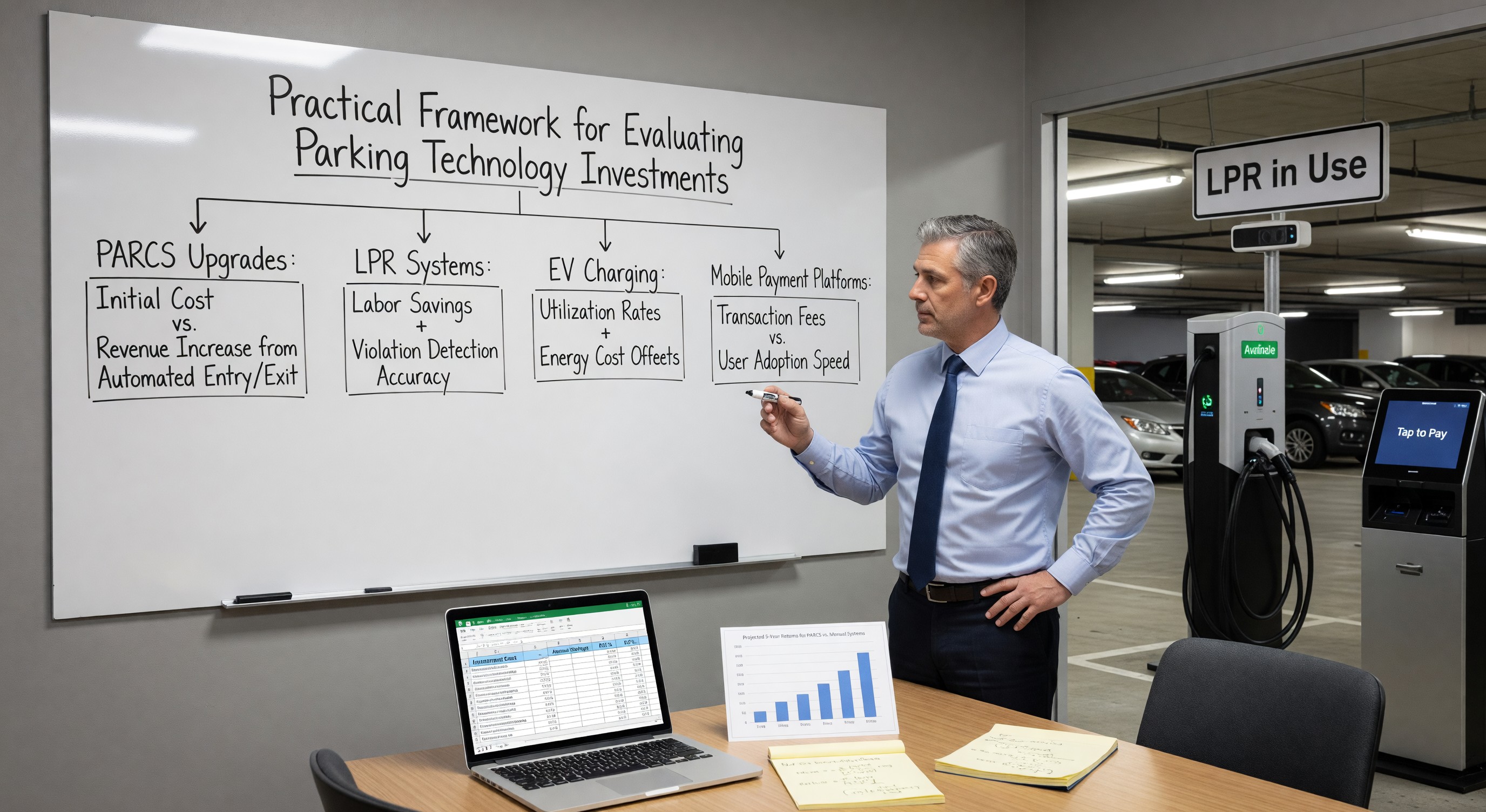
Parking technology decisions carry significant financial stakes. A full PARCS replacement can cost $200,000 to $600,000. An LPR enforcement system runs $80,000 to $250,000. Even a mobile payment integration can involve $30,000 to $80,000 in implementation and first-year costs. Making these investments well requires a structured approach to calculating return on investment — not just a vendor’s projected payback period.
This guide provides a framework for evaluating parking technology ROI that accounts for the full cost of ownership, realistic benefit projections, and the risk factors that commonly cause actual returns to fall short of projections.
The Full Cost of Ownership Framework
Vendor ROI projections typically focus on implementation cost and headline benefits. A more complete analysis accounts for all costs over the expected useful life of the technology.
Initial costs include hardware, software licenses, installation labor, network and infrastructure preparation, integration work with existing systems, training, and project management. Vendors frequently underquote installation labor and integration work. Require detailed line-item cost breakdowns and get independent estimates for installation.
Annual ongoing costs include software maintenance and support contracts (typically 8 to 15 percent of software license cost annually), hardware maintenance contracts, cellular connectivity fees, transaction processing fees (for credit card and mobile payment systems), and internal IT support allocation.
End-of-life costs include data migration, decommissioning, and the cost of replacement when the system reaches end of useful life. Systems that lock data in proprietary formats impose higher end-of-life migration costs.
For a 10-year investment horizon, ongoing costs often exceed initial costs. A PARCS system with a $250,000 implementation cost and $40,000 per year in annual costs has a 10-year total cost of $650,000 — more than 2.5 times the sticker price.
Quantifying Benefits
The benefit side of a parking technology ROI analysis should include both hard (quantifiable) and soft (directional) benefits.
Hard Benefits: Revenue Uplift
Payment system upgrades that add mobile and contactless payment options typically increase revenue capture from transient parkers. Facilities report revenue increases of 5 to 20 percent after removing cash-only barriers to payment. To project this benefit for your facility, look at the percentage of lost transactions — parkers who enter but leave without paying because they lack cash or because wait times are too long. Any reduction in lost transactions is direct revenue uplift.
Dynamic pricing capability, when paired with demand management, has been shown to increase revenue per space by 10 to 25 percent in facilities that implement it actively. However, this benefit requires ongoing pricing management — facilities that implement dynamic pricing capability but never actively manage rates see minimal benefit.
Hard Benefits: Cost Reduction
Labor cost reduction is the most commonly cited hard benefit of parking automation. Converting from a fully attended model to automated exit with remote monitoring can reduce staffing costs by 40 to 60 percent. Calculate this benefit based on actual loaded labor cost (wages, benefits, payroll taxes, uniforms, training) for the positions being eliminated or reduced.
License plate recognition enforcement systems improve violation collection rates. If your current enforcement program collects on 40 percent of violations and an LPR-based system with mail-in invoicing improves that to 70 percent, calculate the revenue improvement based on your current violation volume and average violation fee.
Hard Benefits: Operational Efficiency
Automated reporting reduces the time facility managers and operators spend on manual data compilation. Estimate the hours per month currently spent on transaction reconciliation, occupancy reporting, and financial reporting, and assign a dollar value based on staff hourly cost.
Soft Benefits
Soft benefits — customer satisfaction improvements, competitive differentiation, reduced tenant complaints — are real but harder to quantify. Include them in a qualitative section of your ROI analysis rather than assigning specific dollar values. Decision-makers can weigh qualitative benefits alongside quantified financial return.
Building the Financial Model
A proper ROI analysis for a parking technology investment should include:
Net Present Value (NPV): The present value of all projected net cash flows (benefits minus costs) over the analysis period, discounted at your organization’s required rate of return. A positive NPV indicates the investment clears the return threshold. Most organizations use a discount rate of 8 to 12 percent for facility infrastructure investments.
Payback Period: The number of years required for cumulative benefits to equal cumulative costs. For parking technology, payback periods of two to five years are typical for investments that clear most organizations’ thresholds.
Internal Rate of Return (IRR): The discount rate at which NPV equals zero. Comparing IRR to your organization’s required rate of return provides a simple go/no-go signal.
Build your model with conservative, base case, and optimistic scenarios. Conservative projections use the low end of benefit ranges and the high end of cost ranges. This is the scenario you should present to ownership as the basis for the investment decision.
Risk Factors That Reduce Actual Returns
Several factors commonly cause actual parking technology returns to fall short of projections.
Implementation overruns. Parking technology installations frequently exceed projected timelines and budgets. Integration challenges, permitting delays, and scope creep are common causes. Add a 20 percent contingency to implementation cost projections.
Adoption gaps. Mobile payment and app-based parking products require customer adoption to deliver projected revenue benefits. If parkers do not adopt the new payment method, the revenue uplift does not materialize. Evaluate the adoption rates the vendor can demonstrate from peer facilities before projecting adoption-dependent benefits.
Benefit attribution uncertainty. Revenue increases that occur after a technology implementation are not always caused by the implementation. If your market was growing during the same period, some of the revenue uplift would have happened anyway. Be conservative in attributing revenue changes entirely to technology.
Vendor support quality. Long-term ROI depends on the vendor’s ability to maintain and support the system over its useful life. A vendor who is acquired, exits the market, or reduces support quality can dramatically increase your ongoing costs. Evaluate vendor financial stability and support track record as part of the investment decision.
FAQ
What is a reasonable payback period for a PARCS replacement? Most organizations consider a two-to-five-year payback acceptable for parking infrastructure investments. Systems with payback periods beyond seven years should be evaluated carefully — they require a very long investment horizon to deliver meaningful return, and technology cycles may make them obsolete before the payback is complete.
How do I compare a capital purchase to a SaaS or subscription model? Use total cost of ownership over a consistent time horizon, typically 10 years. Capital purchases have higher upfront costs but potentially lower annual costs if the system performs well. SaaS models have lower upfront costs but ongoing commitments. NPV analysis at your discount rate will show which model is more favorable under your organization’s financial assumptions.
Should I include intangible benefits in my ROI analysis? Yes, but separately from quantified financial benefits. Present a section on qualitative benefits after your financial analysis. Decision-makers can weigh them alongside the numbers, but including them in the NPV calculation introduces subjectivity that undermines the credibility of the quantitative analysis.
What discount rate should I use? Use your organization’s standard hurdle rate for facility infrastructure investments. If you do not have a standard rate, 8 to 10 percent is a reasonable default for most commercial real estate contexts.
Further Reading from Authoritative Sources
- International Parking and Mobility Institute technology investment resources — parking-mobility.org (IPMI) is on the whitelist as the primary parking industry authority with directly relevant technology ROI content for the parking facility audience.
- Transportation Research Board parking technology research — trb.org is on the whitelist and TRB’s applied research provides empirical support for the technology performance claims and ROI ranges discussed in this article.