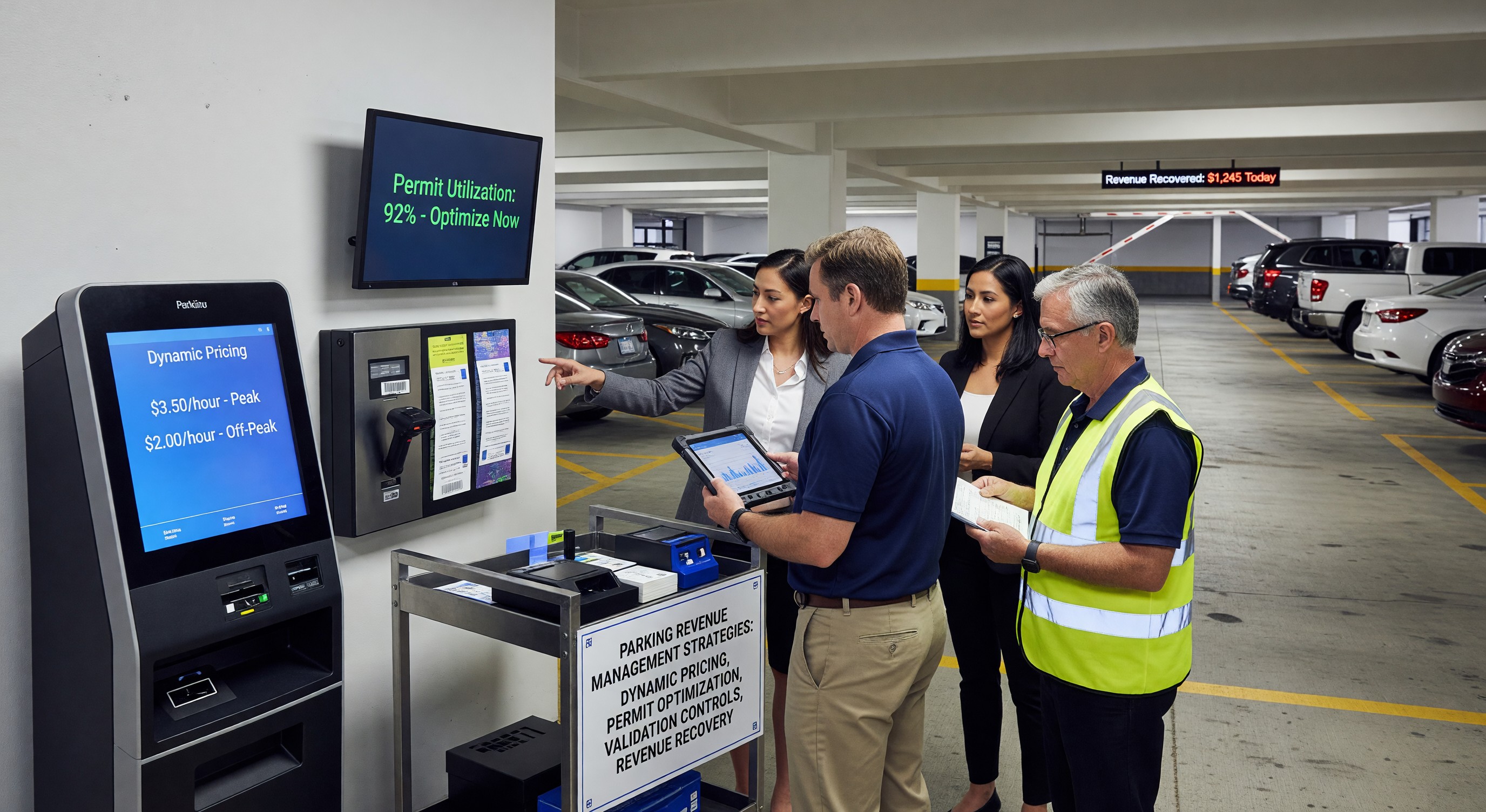
Parking revenue management has evolved significantly over the past decade. What once meant setting an annual rate and collecting what came in now encompasses dynamic pricing, demand forecasting, permit optimization, and revenue recovery programs. Facility managers who apply disciplined revenue management practices typically outperform peers on revenue per space by 15 to 30 percent without adding capacity.
This guide covers the revenue management principles and practical tactics that facility managers can implement regardless of whether they operate a small surface lot or a multi-structure portfolio.
Understand Your Demand Profile Before Changing Rates
The most common revenue management mistake is adjusting rates without first understanding the demand patterns that rates need to optimize.
Pull your transaction data and build a demand heat map. How does utilization vary by hour of day, day of week, and month of year? Where are your consistent peaks, and where is capacity going underused? A facility that runs at 95 percent occupancy on Tuesday through Thursday but 45 percent on Monday and Friday has very different pricing opportunity than one with flat 70 percent utilization all week.
If your system cannot generate transaction-level utilization reports, this is a capability gap worth addressing before any revenue management work. Modern PARCS systems should provide hourly occupancy reports at minimum. If yours does not, work with your vendor to extract the data you need or consider an upgrade.
Dynamic and Time-of-Day Pricing
Dynamic pricing — adjusting rates based on demand — is no longer limited to large urban operators. Smaller facilities have implemented simplified versions effectively.
The simplest form is time-of-day pricing: charge a premium rate during predictable peak hours and a reduced rate during off-peak hours. A medical center garage that fills by 9:00 AM might charge a premium rate from 7:00 AM to 2:00 PM and a reduced rate from 2:00 PM onward. This both maximizes revenue during peak periods and draws demand into underutilized off-peak windows.
Event-based pricing captures revenue during demand spikes. If your facility is near a sports venue, concert hall, or convention center, establishing a clear event rate ensures you capture the revenue opportunity rather than letting customers self-select a daily rate that was designed for normal-demand periods.
Before implementing dynamic pricing, communicate clearly with your regular users. Monthly permit holders who suddenly find their facility full at a premium-rate event feel underserved. Consider protecting reserved spaces for permit holders during events.
Monthly Permit Portfolio Optimization
Monthly permits provide revenue predictability but can also lock facilities into below-market rates for extended periods. A systematic approach to permit portfolio management avoids both extremes.
Review your permit rate annually relative to market. What are comparable facilities charging for monthly permits in your market? IPMI’s parking rate survey and data from regional parking associations can provide benchmarks. If you are 20 percent below market, a gradual catch-up strategy — 5 to 8 percent increases over two to three years — captures revenue while minimizing attrition.
Segment your permit portfolio by space type. Reserved spaces command a premium over unreserved; covered spaces command a premium over surface. If you are charging the same rate for reserved garage spaces and unreserved surface spaces, you are leaving money on the table.
Consider tiered permit programs. A “guaranteed space” permit at a premium over a standard permit appeals to users who cannot risk arriving to find no available space. Even if your facility rarely fills, users who prize certainty will pay for the guarantee.
Validation Program Financial Controls
Validation programs are one of the most common sources of parking revenue leakage. A program designed to provide tenant visitors with complimentary parking can quietly become an informal employee benefit if not monitored.
Audit your validation transactions quarterly. Review total validation volume, cost per validation, and whether validation usage is concentrated among a small number of tenant accounts. Spikes in validation volume without corresponding increases in visitor traffic are a signal that the program is being misused.
Set monthly validation caps for each tenant account and enforce them. When caps are approached, send automated notifications to the tenant’s contact. If a tenant regularly exceeds their cap, the right response is a conversation about their actual needs and a formal agreement about cost-sharing, not silent absorption of the overage.
Establish a cost-allocation policy that ensures validation expenses are charged to the benefiting party. Property-absorbed validation costs should be a deliberate policy choice, not an accounting default.
Transient Rate Optimization
For facilities with significant transient revenue, rate testing is an underused tool. Many parking operations set transient rates infrequently — often at annual budget time — rather than treating rates as a variable that should respond to demand data.
A structured approach to transient rate optimization begins with understanding your price elasticity. When you raised rates last, did transient volume decline? By how much? At what price point did volume hold steady? This analysis establishes the range within which you can adjust rates without significant volume loss.
Flat daily maximums can limit revenue when demand justifies it. A customer who arrives at 7:00 AM and stays for eight hours should pay more than one who arrives at 2:00 PM for two hours, but a flat daily maximum treats them identically. Removing or raising daily caps during peak-demand periods often increases revenue without reducing volume.
EV Charging Revenue
Electric vehicle charging infrastructure in parking facilities represents a growing secondary revenue stream. Networks like ChargePoint, Blink, and EVgo offer revenue-sharing models that allow facility operators to deploy charging infrastructure with limited capital investment while earning a share of charging fees.
Assess your current EV charging demand by monitoring how often existing charging spaces are occupied. If you have Level 2 charging spaces that are frequently occupied, there is likely demand for additional capacity. If spaces are rarely used, pricing or marketing may be limiting uptake.
From a revenue perspective, EV charging is currently more of a tenant and customer amenity than a primary revenue driver for most facility types. However, as EV adoption grows, facilities with robust charging infrastructure will command higher monthly permit premiums and better tenant retention.
Revenue Recovery: Handling Unpaid Obligations
Unpaid parking fees represent real revenue loss. Whether from monthly permit accounts in arrears, post-event billing discrepancies, or validation overages that were never charged back to tenants, recovery programs yield meaningful results.
Establish a clear accounts receivable process for parking. Monthly permit accounts should trigger an automated payment reminder when payment has not been received within five business days of the due date, a formal notice at 15 days, and suspension of access at 30 days. Consistent enforcement is more effective than periodic campaigns to collect accumulated arrears.
For facilities using LPR-based enforcement, license plate-based invoicing for violations reduces the friction of traditional ticketing and improves collection rates. Violation notices sent by mail have collection rates of 40 to 60 percent; online payment portals with automated reminders improve those rates meaningfully.
FAQ
What is a reasonable revenue per space target for an office building parking facility? Revenue per space varies widely by market and facility type. Urban office buildings in major markets typically target $100 to $250 per space per month in gross revenue. Suburban facilities are typically lower, at $40 to $100 per space per month. Benchmarking against IPMI survey data for your region and facility type gives you the most relevant comparison.
How do I make the case to ownership for implementing dynamic pricing? Present a revenue projection showing the difference between current flat-rate revenue and projected revenue under a time-of-day or demand-based model. Use your own transaction data to model the impact. Most ownership groups respond well to demonstrated revenue upside, especially when the implementation cost is low.
Should validation costs be tracked separately from operating expenses? Yes. Validation costs are effectively a marketing or tenant relations expense, not a parking operations expense. Tracking them separately helps you accurately assess parking operational efficiency and provides visibility into a cost that often runs materially above budget.
What is a healthy permit occupancy rate? For unreserved permit programs, 90 to 110 percent of physical capacity is a common target. Selling more permits than physical spaces works because permit holders are absent at predictable times. Above 110 percent, you risk customer dissatisfaction when demand peaks simultaneously. Monitor peak-period occupancy monthly to calibrate your permit inventory.
Further Reading from Authoritative Sources
- International Parking and Mobility Institute revenue management resources — parking-mobility.org (IPMI) is on the whitelist as the primary parking industry authority and its revenue management content directly supports the article’s dynamic pricing and program management discussion.
- Institute of Transportation Engineers parking demand management publications — ite.org is on the whitelist and ITE’s demand management research underpins the quantitative claims about dynamic pricing performance improvements in this article.