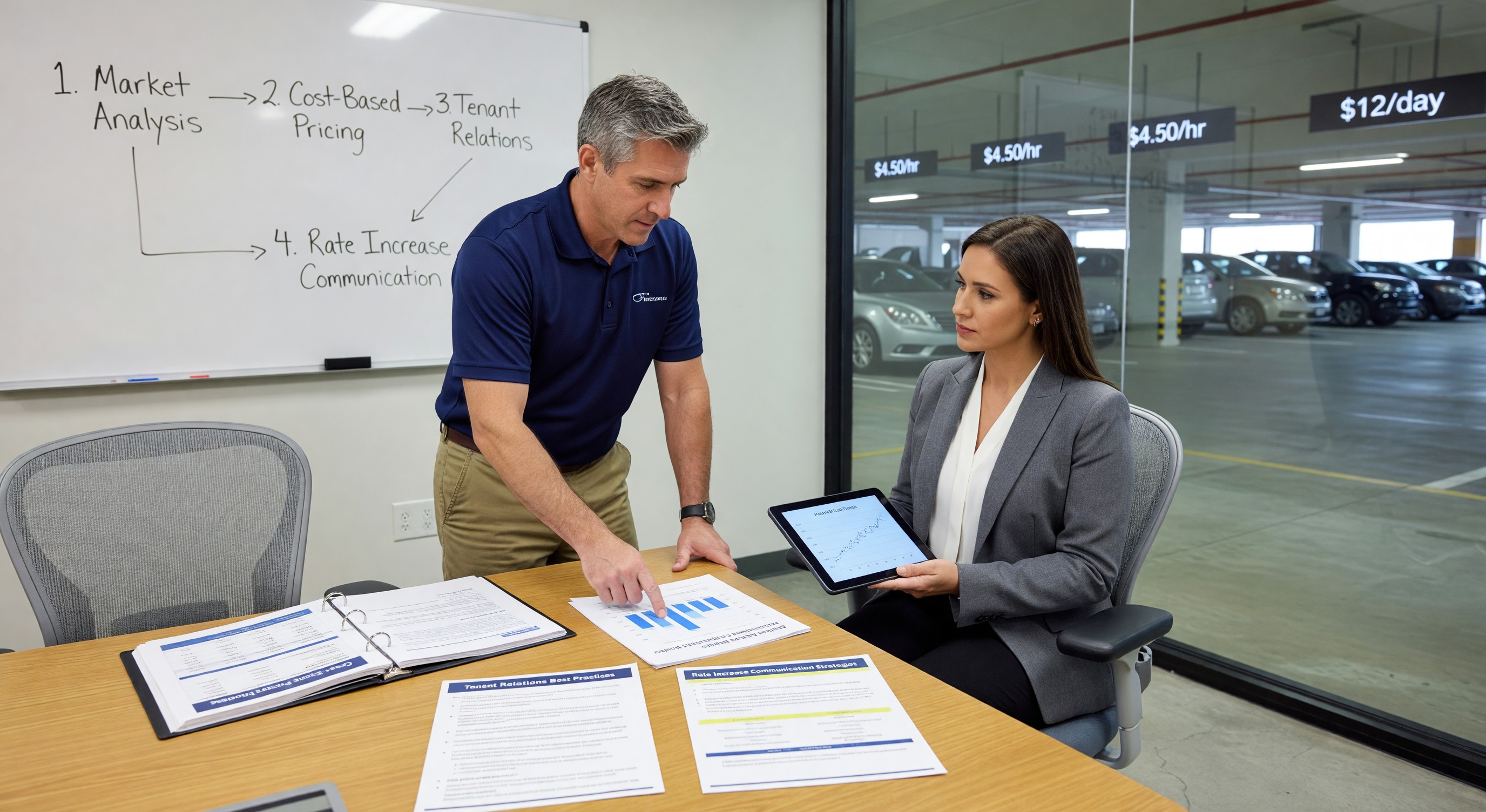
Setting parking rates is part financial analysis, part market research, and part stakeholder management. Get the number right but communicate it poorly, and you face tenant pushback that erodes relationships. Get the communication right but set the number wrong, and you leave revenue on the table or price yourself out of the market.
This guide walks through the components of a sound parking rate-setting process — from data gathering through communication — with practical guidance for the facility managers and property teams who own these decisions.
Start With Market Context
No rate decision should happen in isolation from the market. Facility managers who set rates without knowing what comparable facilities charge risk two failure modes: overpricing that drives parkers to competitors, or underpricing that leaves money on the table.
Market research for parking rates is straightforward. Survey comparable facilities within a reasonable driving or walking radius. Comparable means similar in terms of facility type (surface, structured, underground), access and security, and proximity to the same demand generators as your facility.
For each comparable facility, note the daily maximum, hourly rates for the first two to four hours, and monthly permit rates for unreserved and reserved spaces. This data is usually publicly available via parking facility websites, apps like SpotHero or ParkWhiz, or by calling the facility.
Organize this data in a simple spreadsheet. Calculate average market rates for each rate category. This becomes your market reference point.
Understand Your Cost Floor
While parking rates should be market-informed, they must also cover your costs. A cost-based analysis establishes the floor — the rate below which the operation loses money.
Calculate your total annual operating cost, including staffing, maintenance, utilities, management fees (if applicable), insurance, and a reserve contribution. Divide by the number of spaces and by twelve to arrive at a monthly cost per space. This is your break-even monthly rate.
For transient pricing, convert the monthly break-even to a daily equivalent. If your monthly break-even per space is $90, your daily equivalent (assuming 70 percent occupancy over 22 revenue days per month) is approximately $5.84. Any transient rate above that covers operating costs for that space; any rate below it subsidizes transient parking from other revenue sources.
Most facilities should price transient rates above operating cost break-even to generate margin for capital reserves and return to ownership.
Facility-Type Rate Considerations
Different facility types operate within different rate norms, driven by the expectations of their primary users.
Office and commercial properties typically offer monthly permit parking as the primary product, with transient pricing as a secondary use for visitors and event parkers. Monthly rates should reflect market comparables while supporting operational cost recovery. Tenants typically expect a discount to transient equivalent rates as part of the monthly product value.
Healthcare facilities serve a mix of employees, patients, and visitors with very different price sensitivities. Patient and visitor parking rates should be moderate — parking costs add to the financial stress of medical visits. Employee parking can typically be priced higher. Many healthcare facilities use validation programs to subsidize patient parking while charging market rates for employee monthly permits.
Retail and hospitality properties use parking as a customer amenity and often provide complimentary or discounted parking to customers. Rate structures should support the business objective (driving foot traffic, encouraging longer stays) rather than purely optimizing parking revenue.
Mixed-use properties have the most complex rate structures, serving multiple user types with different needs and price sensitivities across different times of day. Tiered rate structures with time-of-day components are most effective for maximizing utilization and revenue in mixed-use contexts.
Structuring Rate Changes
When rates need to increase, the structure of the increase matters as much as the amount.
Graduated increases of 4 to 8 percent per year maintain consistent revenue growth while staying within the range that most users accept as routine inflation adjustment. Infrequent large increases — for example, holding rates flat for four years and then raising them 20 percent — generate more resistance than the equivalent amount spread across annual increases.
Lead time and notice for rate increases should be at least 30 days for monthly permit holders, and 60 to 90 days is better practice. Tenants and employees who rely on monthly permits for commuting budgeting need time to adjust.
Rate increase rationale matters to tenants and employees even when the rationale is straightforward. A brief explanation — cost inflation, market alignment, equipment investment — that acknowledges the impact and provides context reduces resistance compared to a bare notification of the new rate.
Permit Rate vs. Transient Rate Relationship
A common rate structure mistake is allowing the monthly permit rate to drift too far below transient equivalent rates. When a monthly permit offers a very large discount to transient pricing, it creates an incentive to avoid transient purchases and increases permit demand. When permit demand exceeds supply, customer satisfaction declines and waiting lists develop.
A healthy relationship between monthly and transient rates: monthly rate should be equivalent to 12 to 18 transient daily visits. If your daily maximum is $15, a monthly rate of $180 to $270 is within the expected range. If your monthly rate is $90 against a $15 daily maximum, the gap is wide enough to encourage over-permitting.
Communicating Rate Increases
How you communicate a rate increase affects how it is received more than the amount of the increase in most cases.
Lead with value before price: “We have invested in improved lighting and security monitoring throughout the garage this year, and we are adjusting our rates to align with current market conditions.”
Be specific about the new rate and effective date. Avoid vague language. “Rates will increase beginning March 1, 2024 as follows: monthly unreserved from $150 to $162 per month.”
Provide a simple point of contact for questions. Rate changes generate questions; having a clear answer channel reduces frustration.
For significant increases, a brief one-on-one communication with key tenants before the general announcement maintains relationships and allows you to address concerns before they become formal complaints.
FAQ
How often should I review parking rates? Annually is best practice. Even if you decide not to change rates in a given year, conducting the market analysis keeps you informed about your competitive position and documents your rationale for the current rate level.
Should employee parking rates be different from public rates? Often yes. Employees who rely on parking for commuting have different price sensitivity than occasional transient users. Many organizations discount employee monthly rates as part of the benefits package. Quantify the cost of this discount — it is a real compensation expense that should be reflected in total compensation analysis.
What is the right response if a tenant threatens to leave over a rate increase? Take the threat seriously but evaluate it objectively. What is the probability they will actually leave? What is the cost of losing them? In most cases, a modest concession (phased implementation, a temporary rate hold) costs less than the disruption of tenant turnover. Avoid permanent exceptions that undermine rate integrity for a short-term retention result.
Can I charge different rates in the same facility for different spaces? Yes. Premium-location spaces (close to entrances, covered, reserved) can and should command higher rates than standard spaces. Differentiated rate structures improve revenue optimization and give users meaningful choices.
Further Reading from Authoritative Sources
- International Parking and Mobility Institute rate setting resources — parking-mobility.org (IPMI) is on the whitelist as the primary parking industry authority and is the most relevant source for parking-specific rate-setting methodology.
- Institute of Transportation Engineers parking demand and pricing resources — ite.org is on the whitelist and ITE’s demand research provides the empirical framework for understanding how parking rates affect utilization — directly relevant to rate-setting decisions.