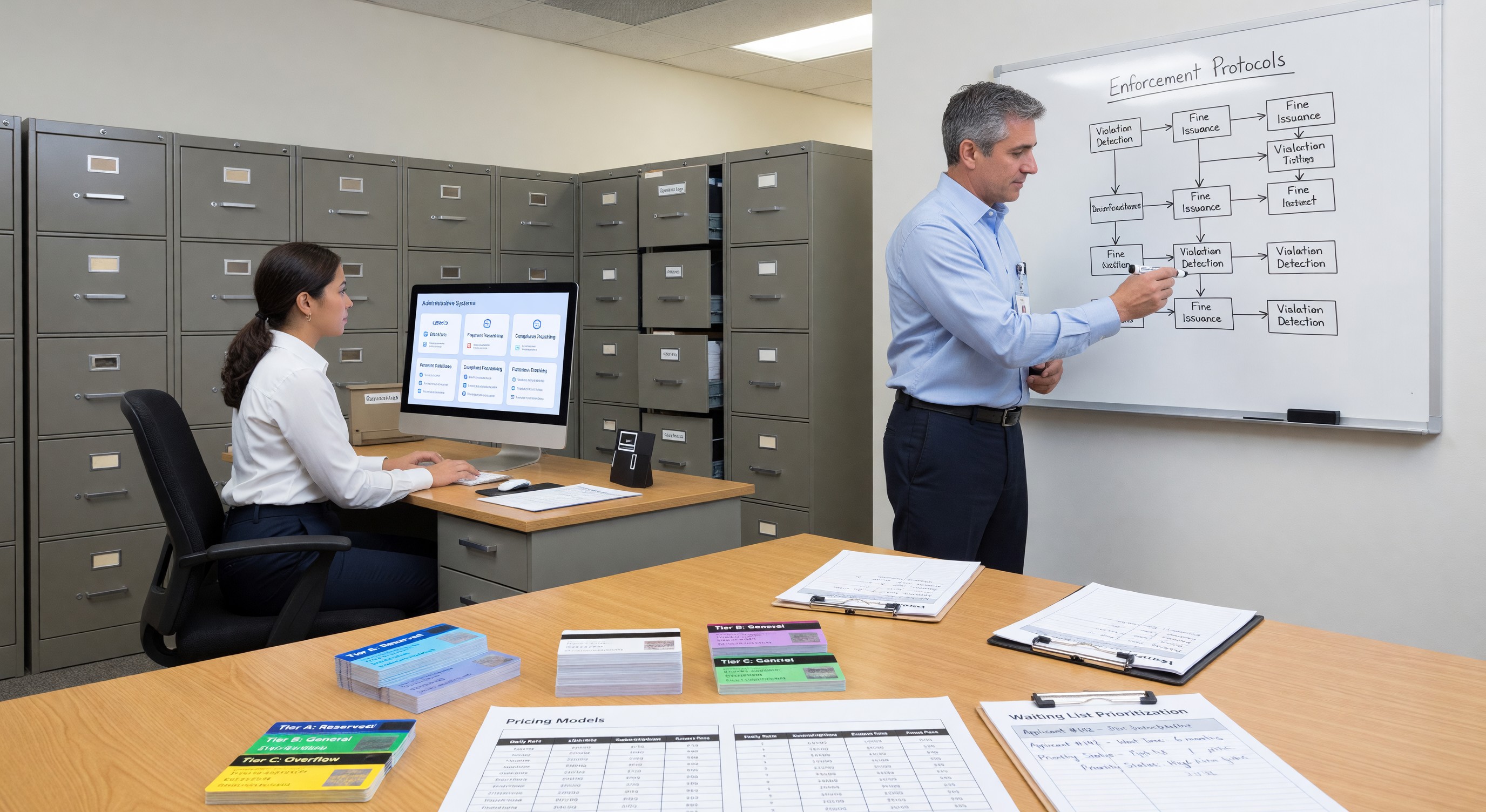
A well-managed parking permit program is the foundation of a stable parking revenue base. Permit revenue is predictable, contractual, and relationship-based — the closest thing to a recurring subscription that parking operations produce. A poorly managed permit program, on the other hand, generates constant administrative friction, customer complaints, and revenue leakage.
This guide covers the design, pricing, operations, and administrative systems for a professional parking permit program.
Permit Program Design Principles
Before setting rates or policies, define what you want your permit program to achieve. Common objectives:
Revenue stability. Monthly permit revenue provides the budget foundation that allows accurate financial planning. Target a permit revenue base that covers fixed operating costs regardless of transient volume.
Space utilization optimization. Permit programs should be sized to maximize space utilization without creating chronic overcrowding. Selling more permits than physical spaces works through statistical absence — permit holders who are not present on any given day create utilizable capacity. Managing this ratio is central to permit program design.
User satisfaction and retention. Monthly permit holders are your most valuable customers. High permit retention rates reduce administrative cost and stabilize revenue. Policies that create friction — arbitrary enforcement, unclear rules, poor communication — drive churn.
Permit Tier Structure
Tiered permit programs serve users with different needs and price sensitivities while optimizing revenue.
Reserved permits guarantee a specific named space and are the highest-value product. Reserved permit holders expect that their space is available when they arrive, every day, without exception. Pricing should reflect a significant premium over unreserved permits — typically 25 to 50 percent above unreserved rates.
Unreserved permits guarantee access to a space in the facility but not a specific location. The implicit agreement is that a space will be available at normal arrival times. When unreserved permits are oversold or when permit holders arrive during peak periods and find no spaces, you have a service failure.
24/7 unreserved permits are standard for facilities that serve regular weekday commuters. For facilities serving mixed-use properties, consider day-only or evening-only permit tiers that monetize capacity that goes unused during certain time periods.
Casual use or punch-card permits serve users with irregular schedules who do not need a full monthly permit. A pre-paid parking pass (20 or 30 day entries) captures commitment revenue without requiring daily transient payment. This tier often serves freelancers, part-time workers, and others with variable schedules.
Pricing Permit Tiers
Set reserved permit prices at the high end of market comparables for your facility type and location. Reserved permits command premium pricing because they eliminate the parking anxiety that unreserved parkers experience.
For unreserved permit pricing, target 12 to 18 transient-visit equivalents. If your daily transient rate is $15 and you assume an average user parks 20 days per month, the transient equivalent is $300. An unreserved monthly permit at $200 to $250 represents a meaningful discount to the transient equivalent while still capturing reliable monthly revenue.
Review permit pricing annually. Rate increases of 4 to 8 percent per year, applied consistently, are more sustainable than holding rates flat for years and then implementing large increases.
Managing the Permit Waitlist
Most well-run parking facilities have waitlists for their most desirable permit categories. A managed waitlist is both a demand signal and a customer relations opportunity.
Establish formal waitlist procedures: how users register, how they are notified when a space becomes available, and how long they have to respond to an offer before it passes to the next applicant. Communicate waitlist position and expected wait time to registrants periodically.
For reserved permit spaces, a turnover rate of 10 to 20 percent annually is typical. Forecast how many spaces will become available in the coming year and communicate expected wait times accordingly. Users with realistic expectations are more patient than users who feel ignored.
Consider waitlist-specific pricing: charging a modest non-refundable waitlist registration fee demonstrates commitment from registrants and generates modest revenue from users who ultimately choose not to accept a space when it becomes available.
Permit Administration Systems
Manual permit administration — spreadsheets, paper applications, physical hang tags — is error-prone and labor-intensive. Modern permit management software handles application intake, approval workflows, payment processing, access control integration, and waitlist management.
When evaluating permit management software, key capabilities to assess:
Online application portal. Users should be able to apply for, renew, and modify permits online without staff assistance for routine transactions.
Access control integration. Permit validation should integrate with your access control system so that permit status is automatically reflected in gate access without manual updates.
Automated payment processing. Monthly autopay reduces payment failures and administrative follow-up for past-due accounts. Most permit management platforms support ACH and credit card autopay.
Reporting. The system should provide at-a-glance views of permit inventory, waitlist depth, revenue by permit category, and upcoming renewals.
Enforcement Integration
Permits only have value if they are enforced. Users who discover that non-permitted vehicles regularly occupy permit spaces will question whether their permit is worth paying for.
Integrate your permit validation process with your enforcement program. Whether enforcement is through physical permit tags, license plate recognition, or a combination, the enforcement data should feed back into permit records. Chronic violators should trigger administrative review rather than just a violation citation.
For facilities using LPR, monthly permit vehicles should be registered in the system so they are automatically recognized as compliant. Vehicles not on the permit registry trigger an enforcement action. This model reduces enforcement labor while maintaining effectiveness.
Handling Cancellations and Transfers
Permit cancellation policies should be clear and consistently applied. Standard terms include 30-day notice for permit cancellation, with the permit holder responsible for the final month’s payment during the notice period.
Permit transfers — allowing a permit holder to transfer their permit to a colleague or family member — should be explicitly addressed in your policy. Some facilities allow name transfers with administrative approval; others restrict permits to named individuals. Permitting transfers reduces churn when the original holder no longer needs the space but another person does, maintaining revenue continuity.
For facilities with waitlists, prohibit unauthorized transfers, which allow permit holders to extract value from their permit position by selling access to non-waitlist users.
FAQ
How many permits can I sell per space? For unreserved permits, industry practice ranges from 100 to 130 percent of physical spaces, depending on your expected absence rate. If your permit holders are predominantly 9-to-5 weekday commuters with predictable schedules, you can sell closer to 120 to 130 percent. If permit holders have variable schedules with more frequent daily use, stay closer to 100 to 110 percent. Monitor peak-period occupancy monthly to verify your ratio is working.
What is an appropriate permit cancellation notice period? Thirty days is standard. Some facilities use 60-day notice for reserved permits, which have higher administrative and financial impact when vacated. The notice period should be clearly stated in the permit agreement and consistently enforced.
How do I handle permit holders who park in unauthorized spaces? Address promptly and consistently. A permit holder who parks in a reserved space they do not hold is violating the rights of another customer. Issue a formal notice, and if the behavior continues, suspend permit access pending resolution. Permitting unauthorized parking behavior erodes trust in the entire program.
Should I offer permit discounts for annual prepayment? Yes, if cash flow permits. Annual prepayment eliminates monthly administrative overhead and provides certainty for budget planning. A 5 to 10 percent discount for annual prepayment is standard. Evaluate whether the cash flow benefit and administrative saving justify the discount.
Further Reading from Authoritative Sources
- International Parking and Mobility Institute permit program resources — parking-mobility.org (IPMI) is on the whitelist as the primary parking industry authority with directly relevant permit program management content.
- Institute of Transportation Engineers shared parking and demand management resources — ite.org is on the whitelist and ITE’s demand management research provides the technical foundation for permit oversell ratios and occupancy management strategies discussed in this article.